 Bellingham Siding
 Cordata's Climate Is Harder on Siding Than It Looks
Cordata sits in north Bellingham, close enough to Bellingham Bay and the greater Puget Sound to catch salt-laden air on windy days, and squarely inside Whatcom County's marine west coast weather pattern: mild temperatures year-round, but a long, wet season where driving rain comes sideways off the water instead of straight down. Add in the mature tree cover common to this part of Bellingham, and you get shaded, damp wall sections that barely dry out from October through May. That combination — salt exposure, wind-driven rain, and an extended moss and algae season — is exactly the kind of environment that separates siding products that hold up from ones that don't.
None of this means Cordata is an unusually harsh place to own a home. It means the siding has to be matched to the job it's actually doing here, not to a national-average climate. A product that performs fine in a dry inland state can struggle on a north-facing wall in Whatcom County that never gets direct sun for months at a time.
What "Salt Air" Actually Does to a House
Salt in the air isn't just a coastal curiosity — it's a slow chemical process. Airborne salt settles on exterior surfaces and accelerates corrosion of exposed metal fasteners, flashing, and trim hardware, and it can also stress paint films and caulk joints faster than inland exposure would. Over years, that shows up as rust streaking at nail heads, premature caulk failure at joints, and finish that chalks or fades ahead of schedule.
What "Driving Rain" Actually Does to a House
Wind-driven rain doesn't just fall on a wall — it gets pushed sideways and upward into laps, seams, and trim joints that vertical rain would never reach. If the siding, flashing, and drainage plane underneath aren't detailed correctly, that water finds its way behind the cladding instead of running down the face of it. Once moisture is trapped behind siding, it doesn't matter how good the surface material looks — sheathing and framing underneath start absorbing damage long before anything is visible from the curb.
What a Long Moss Season Actually Does to a House
Moss and algae need three things to establish on a wall: shade, moisture, and a surface they can grip. Whatcom County's overcast, drizzly stretch from fall through spring supplies the first two for months at a time, and porous or wood-based siding supplies the third. Once moss takes hold on a wall, it holds moisture directly against the siding surface around the clock, which is a very different — and much worse — exposure than the intermittent wetting the same wall gets from rain alone.
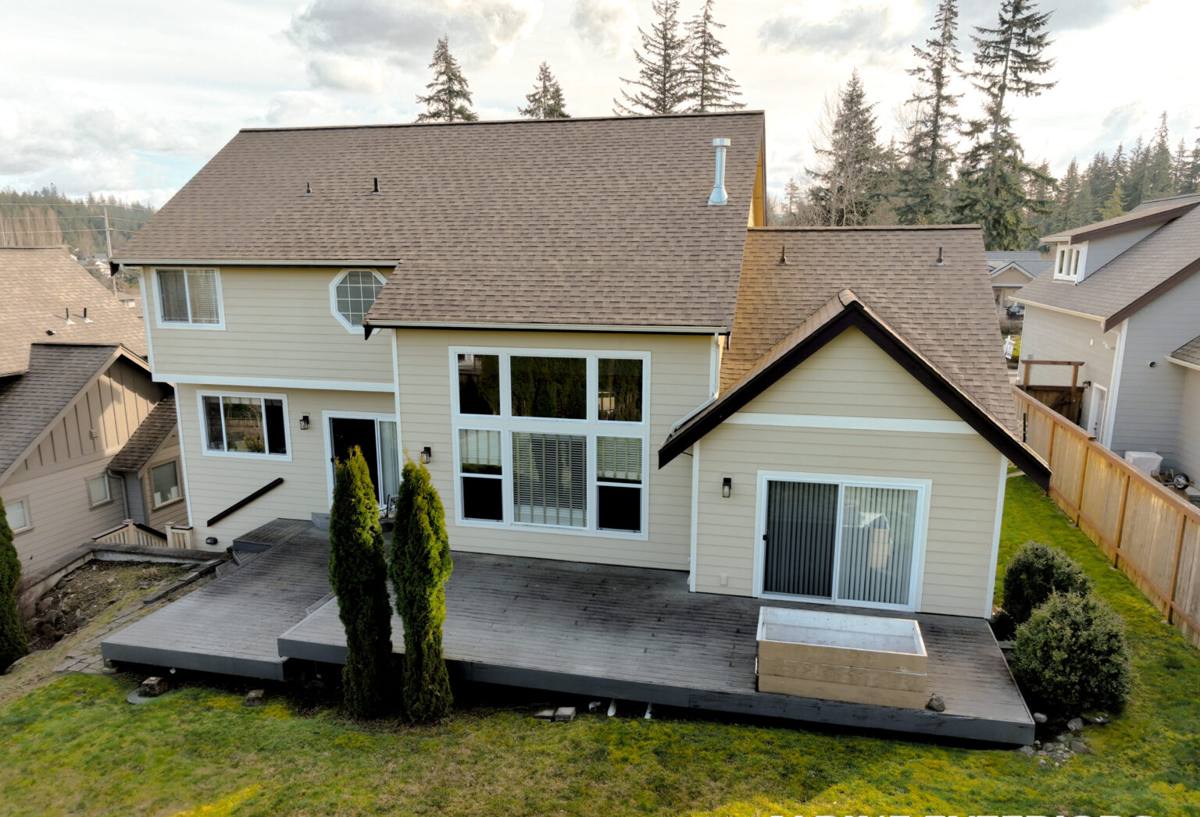
Signs a Cordata Home Needs Siding Replacement, Not Just Repair
Not every siding problem calls for a full replacement — but ignoring the early signs in this climate tends to turn a patch job into a full re-side a few years later, once moisture has reached the sheathing. Here's what we look for during an evaluation:
- Soft, spongy, or springy spots when you press on the siding, especially near the bottom courses close to grade
- Paint that won't hold anymore, even after prep and a fresh coat — a sign the substrate underneath is breaking down
- Moss or algae staining that comes back within a season or two of cleaning, especially on shaded or north-facing walls
- Boards that are visibly cupping, bowing, or separating at the seams
- Gaps opening up at corners, window and door trim, or panel joints
- A musty smell near exterior walls, or interior drywall/trim that's staying damp or discolored
- Noticeably higher heating bills, or drafts near exterior walls in winter
Any one of these on its own might be a repair. Several of them together, especially combined with visible rot at a bottom course, usually means the wall assembly has been taking on water for a while and a full replacement is the more honest recommendation.
What a Correct Siding Replacement Actually Involves
Siding replacement done right is mostly about what happens before the new boards ever go up. The finish material gets the attention, but the layers behind it are what determine whether the job lasts fifteen years or fifty.
Tear-Off and Sheathing Inspection
We remove the existing siding down to the sheathing rather than installing over it. That's the only way to actually see what's happening underneath — and in a climate like this one, it's common to find soft or delaminated sheathing behind old siding that looked fine from the outside. Any damaged sheathing gets replaced before anything else happens; installing new siding over compromised sheathing just locks the problem in behind a fresh surface.
Weather-Resistive Barrier and Drainage
A properly lapped weather-resistive barrier (housewrap) goes over the sheathing, integrated correctly with window and door flashing so water is directed out and down rather than trapped. Depending on the wall assembly, a rainscreen gap between the barrier and the siding gives any moisture that does get past the cladding a path to drain and dry instead of sitting against the wall — which matters more here than in a drier climate, given how much of the year Cordata walls stay damp.
Flashing at Every Penetration
Every window, door, hose bib, vent, and light fixture is a place water can get behind the siding if it's not flashed correctly. This is the detail work that separates a driving-rain climate installation from a fair-weather one — it's also the part that's invisible once the job is finished, which is exactly why it has to be right the first time.
Installation to Manufacturer Spec
Fastener type, spacing, nailing height, and joint treatment all follow the manufacturer's published specifications for the product and exposure. Cutting corners here doesn't show up immediately — it shows up as premature failure five or ten years down the road, which is far more expensive to fix than it would have cost to do correctly at install.
Why We Install Only James Hardie Fiber Cement Siding
We don't install vinyl, LP SmartSide, Cemplank, Allura, primed spruce, or cedar. That's a deliberate standard, not a limitation of what we're capable of installing. In a climate that combines salt air, driving rain, and a long moss season, the material matters as much as the workmanship, and James Hardie's fiber cement system is what we've found holds up best to all three at once.
Fiber cement is non-combustible and dimensionally stable, so it doesn't swell, cup, or rot the way wood-based products can when they take on repeated moisture — a real advantage on shaded Cordata walls that stay damp for months. Hardie's engineered HZ product lines are formulated for specific climate zones, including the wetter Pacific Northwest, rather than being a one-size-fits-all product. The factory-applied ColorPlus finish is baked on under controlled conditions and backed by its own finish warranty, which avoids the field-painting seams and touch-up cycle that comes with primed wood or spruce siding. And because it's a cement-based product rather than an organic one, it doesn't give moss and algae the same foothold that wood-based siding does.
None of the alternatives we don't install are bad products in every situation — vinyl is inexpensive, LP SmartSide has real fans, cedar has a look some homeowners want. Our position is narrower than "those products are wrong everywhere." It's that for what this climate does to a wall over twenty or thirty years, we'd rather stand behind one system we trust completely than offer several we'd have reservations about.
How Common Siding Materials Compare in Cordata's Climate
| Material | Moisture/Rot Resistance | Salt Air Durability | Moss/Algae Resistance | Typical Maintenance |
|---|---|---|---|---|
| James Hardie Fiber Cement | Strong — cement-based, dimensionally stable | Strong with factory finish | Strong — non-organic surface | Occasional wash, no repainting needed |
| Vinyl | Doesn't rot, but can warp/crack with age and impact | Fair — can chalk and fade faster near salt exposure | Fair — smooth surface but seams collect grime | Low, but limited repair options once damaged |
| LP SmartSide (Engineered Wood) | Moderate — wood-based, sensitive to sustained moisture | Moderate | Moderate — organic substrate | Regular inspection of seams and cut edges |
| Cedar / Primed Spruce | Weaker under sustained damp exposure without upkeep | Weaker without diligent maintenance | Weaker — natural wood favors moss growth | Repainting/staining cycle every few years |
This table reflects general material behavior, not a claim that every installation of every product will perform this way — installation quality matters enormously for all of them. It's simply why, when we get to choose, we choose fiber cement for homes in this climate.
Our Siding Replacement Process
- Free on-site evaluation. We walk the exterior with you, check problem areas, and give you an honest read on whether you're looking at repair or full replacement.
- Tear-off and sheathing inspection. Old siding comes off, sheathing gets inspected, and any damaged sections are identified and replaced.
- Weather barrier and flashing. Housewrap and flashing go in around every window, door, and penetration before a single piece of new siding is hung.
- James Hardie installation. Siding goes up to manufacturer fastening and clearance specifications, with attention to the details that matter most in a wet, wind-driven climate.
- Trim, caulking, and finish detail. Joints are sealed and trim is finished so the whole system sheds water the way it's designed to.
- Final walkthrough. We go over the finished job with you before we consider it done.
What Affects the Cost of a Siding Replacement
Every home is different, so we don't publish flat prices — but these are the main factors that move a siding replacement estimate up or down:
| Cost Factor | Why It Matters |
|---|---|
| Home size and wall area | More square footage means more material and labor |
| Sheathing condition | Rotted or delaminated sheathing found during tear-off needs replacement before new siding goes up |
| Existing siding type | Some materials are more labor-intensive to remove than others |
| Number of windows, doors, and trim details | Each one needs flashing and precise cutting, which adds labor time |
| Siding profile chosen | Lap, shingle, and panel styles each install differently and use material at different rates |
| Home height and accessibility | Multi-story homes or tight lot lines require more setup, staging, and safety equipment |
The only way to get a real number for your home is a walk-through — but knowing these factors ahead of time helps you understand why two similar-looking homes can land at different estimates.
Why Hiring a Crew That Already Works in Cordata Matters
Siding contractors who work regularly in this part of Bellingham build up something that's hard to fake: a working knowledge of how the local microclimate actually treats different wall assemblies over time, not just in a brochure. That shows up in a few concrete ways.
- Familiarity with Whatcom County permitting and inspection requirements, so the job moves without avoidable delays
- An eye for the specific failure patterns that show up on shaded, moisture-prone walls in this neighborhood — versus generic siding wear
- Established relationships with material suppliers, which keeps lead times predictable instead of open-ended
- A realistic sense of local weather windows, so tear-off doesn't leave a wall exposed longer than it should be
A crew that's new to the area isn't necessarily worse at installing siding — but a crew that already knows how Cordata's mix of salt air, driving rain, and moss season behaves on real walls has a head start on catching problems before they become expensive ones.
Get an Honest Look at Your Siding
If your Cordata home is showing any of the warning signs above, or you're just planning ahead for a re-side, we're glad to come take a look. The estimate is free, there's no pressure, and if what you actually need is a repair instead of a full replacement, we'll tell you that too. Fill out the form below to get started.