 Bellingham Siding
 Why We Narrowed Down to One Product
Most siding contractors in Whatcom County will install whatever a homeowner picks off a sample board — vinyl, LP SmartSide, cedar, fiber cement, whatever's cheapest that week. We used to do the same. Over years of tear-offs and warranty calls in Bellingham, Fairhaven, and out toward Ferndale and Lynden, a pattern kept showing up: the homes holding up best after fifteen or twenty years were almost always sided in James Hardie fiber cement, installed correctly. So we stopped offering the rest and standardized on one manufacturer, one product family, installed to spec every time. This page explains the reasoning, not the marketing.
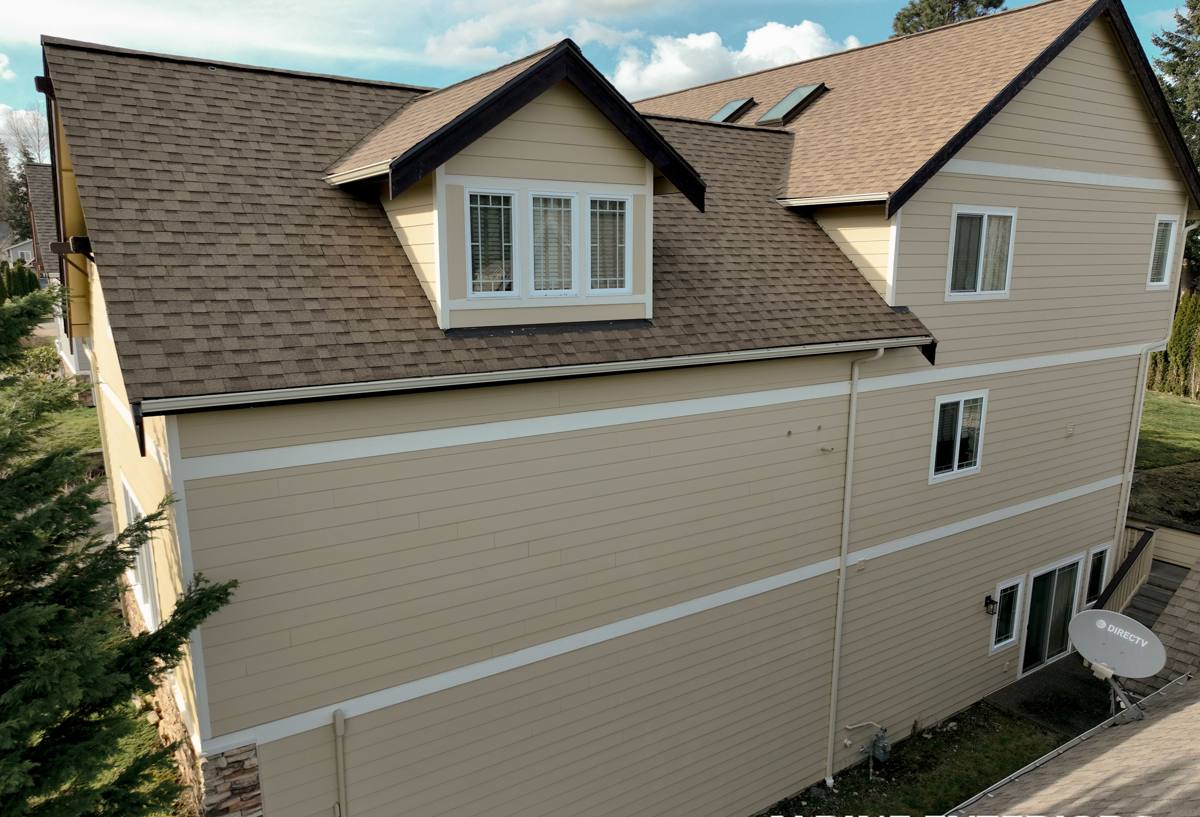
What Bellingham's Climate Actually Does to Siding
Whatcom County sits in a spot that's tougher on exterior building materials than it looks from the outside. We're close enough to Bellingham Bay and the Salish Sea to get real salt-laden air, especially in neighborhoods closer to the waterfront. Layer on driving rain that comes in sideways off Pacific storms, months of damp shade under conifers, and a moss and algae season that can run nearly nine months out of twelve, and you've got an environment that punishes any siding material with a weak point in its moisture handling.
Salt air accelerates corrosion of fasteners and metal trim and speeds up the breakdown of lower-grade coatings. Driving rain finds every gap in flashing and caulk. Moss and algae don't just look bad — sustained organic growth holds moisture against a wall system, which is exactly the condition that causes rot, delamination, and paint failure over time. A siding product that's marketed for a dry climate, or that relies on a coating rather than a material that resists moisture at its core, tends to show its age fast here.
Why We Stopped Installing the Alternatives
Vinyl
Vinyl is inexpensive and low-maintenance in mild climates, but it expands and contracts significantly with temperature swings, which opens seams over time. In driving rain, those seams become entry points. Vinyl also can't be painted a different color without voiding warranties on many products, and impact damage means replacing whole panels rather than spot repair. It's a reasonable product — just not one built for this coastline.
LP SmartSide and other engineered wood
Engineered wood siding is wood strand product bonded with resin and coated with a treatment to resist moisture and insects. It performs well when the coating stays intact and water is kept off the cut edges. The problem in a climate like ours is that any breach in that coating — a hairline crack, an unsealed cut edge at a corner, a fastener that backs out — gives moisture a path into a wood-based substrate, and wood-based substrates swell and can deteriorate once wet. We saw enough of this on tear-offs to stop recommending it.
Cedar and primed spruce
Real cedar is beautiful and has genuine rot resistance in the heartwood, but it requires ongoing refinishing — stain or paint every few years — to keep that resistance intact, and moss loves the texture of cedar clapboard. Primed spruce is a step below that: it's a paint substrate, not a finished product, and the burden of maintaining that paint film falls entirely on the homeowner from day one.
Other fiber cement brands (Cemplank, Allura)
These are legitimate fiber cement competitors and the base material — Portland cement, sand, and cellulose fiber — is chemically similar to Hardie's. Where we saw the difference was in factory finish consistency, climate-specific engineering, and warranty structure, all covered below. We're not saying these products fail; we're saying that after comparing installed performance over time, we chose to standardize on one system rather than stock and warranty multiple lines.
What "Climate-Engineered" Actually Means
James Hardie makes region-specific formulations under its HZ5 and HZ10 designations, engineered for wetter, more variable climates like the Pacific Northwest, as opposed to the HZ formulations sold in the hot, dry Southwest. The fiber cement mix, moisture resistance, and freeze-thaw performance are tuned to the climate zone the siding ships to. For a Whatcom County home, that means the product arrives already formulated for the rain and humidity it's going to sit in for the next several decades, rather than a generic national product.
Fiber cement itself — Portland cement, sand, and cellulose fibers, cured under pressure — is non-combustible and doesn't expand and contract with moisture and temperature the way wood-based or vinyl products do. That dimensional stability is what keeps seams tight and paint film intact over the long haul in a climate that never really dries out for long.
ColorPlus Finish vs. Field-Applied Paint
A meaningful part of why we standardized on Hardie is the ColorPlus factory finish, not just the substrate. Field-painted siding depends on weather conditions at the time of installation, the skill of the painter, and how many coats actually go on. ColorPlus is baked on in a controlled factory environment, cured to the fiber cement before it ever reaches Bellingham, and backed by its own finish warranty separate from the substrate warranty. In a climate with this much rain and moss pressure, a factory-cured finish holds color and resists the fading and chalking we see on lesser field-applied jobs after a decade.
Touch-up paint matched to ColorPlus colors is available for the rare ding or scratch, so this isn't an all-or-nothing repaint situation if something gets damaged — but the vast majority of the wall never needs to be touched.
The Product Lines We Install
| Product | Typical Use | Notes for This Climate |
|---|---|---|
| HardiePlank lap siding | Primary wall cladding | Most common choice; several exposure widths and textures |
| HardieShingle | Accent gables, Craftsman/Cape Cod details | Staggered or straight-edge panels for architectural detail |
| HardiePanel | Modern vertical siding, board-and-batten | Popular on newer Bellingham builds and additions |
| HardieTrim | Corners, fascia, window/door surrounds | Matches substrate stability of the field siding |
| HardieSoffit | Eaves and overhangs | Vented options help manage attic moisture |
We spec the combination of these based on the home's architecture and how exposed each elevation is to weather — a west-facing wall taking direct driving rain gets treated differently in flashing detail than a sheltered, tree-shaded north wall prone to moss.
The Warranty, and Why It Matters
James Hardie backs its fiber cement siding with a non-prorated, transferable limited warranty, and ColorPlus finishes carry their own separate finish warranty. Transferability matters in a market like Bellingham's where homes change hands — it's a real asset at resale, not just paperwork. That said, a manufacturer warranty on the product is only half the equation. Warranty terms typically require installation according to Hardie's published specifications, which is why the installation details below matter as much as the material itself.
What Correct Installation Actually Involves
Fiber cement siding fails prematurely far more often from installation shortcuts than from the material itself. Here's what we hold every job to:
- Proper starter strip and minimum clearance from grade, decks, and roof lines to keep the bottom edge out of standing water
- Correct fastener type, spacing, and placement — face-nailing or blind-nailing per the specified pattern, not "close enough"
- Rain screen or drainage plane behind the siding so incidental moisture can drain and the wall can dry
- Sealed and back-primed cut edges wherever a factory edge is cut on site
- Correct joint flashing and caulking at butt joints, corners, and penetrations — the details that keep driving rain from getting behind the panel
- Proper overlap and exposure per the specified reveal, especially around windows, doors, and roof transitions
- Ventilation behind and above the siding to let the wall assembly dry out during our long damp stretches
Every one of those items is inspectable, and every one of them is a place where a rushed crew can cut a corner that won't show up as a problem for a few years — right about the time it's someone else's warranty claim to deal with.
Cost Factors Worth Understanding
| Factor | Why It Moves the Price |
|---|---|
| House size and elevation complexity | More corners, dormers, and cuts mean more labor and waste |
| Existing siding removal | Tear-off and disposal of old material adds cost vs. new construction |
| Underlying sheathing condition | Rot repair found once old siding comes off is a common surprise |
| Product line and texture | Shingle and panel details cost more in labor than straight lap siding |
| Trim and accent work | HardieTrim detailing around windows and corners adds labor hours |
We won't quote a number without seeing the house, because the condition of what's underneath the existing siding is often the biggest variable — and it's not knowable from the street.
What This Means for Your Home
Standardizing on one manufacturer means we know this product system inside and out — every fastener spec, every flashing detail, every warranty requirement — rather than juggling install specs for five different brands. For a Bellingham home dealing with salt air, driving rain, and a long moss season, that depth matters more than having more options on a sample board.
If you're weighing a siding replacement or want a straight answer on whether your current siding is holding up the way it should, we're happy to take a look and walk the exterior with you. Reach out for a free, no-pressure estimate using the form below.