 Bellingham Siding
 Blaine's Exterior Climate: Salt, Rain, and Shade
Blaine sits at the far northern edge of Whatcom County, right up against the water and the Canadian border. That location gives it a distinct exterior climate compared to homes even a few miles inland: more direct exposure to marine air, more wind-driven rain off the water, and a moss season that runs longer than most homeowners expect. None of this is unusual or alarming — it's just what a house on the water has to deal with, year after year. The problem is that a lot of siding products were never engineered with this combination in mind, and it shows up as maintenance headaches within a decade or two.
Salt Air and Marine Exposure
Homes closer to the shoreline and open water take on a steady, low-grade dose of salt-laden air. It's not dramatic like a beach house in a hurricane zone, but it's constant. Salt air accelerates corrosion on fasteners and metal trim, and it can be harder on paint film and caulk joints than drier inland air. Materials that rely on a factory finish holding up without regular repainting have an advantage here, because homeowners in this part of Blaine often go longer between recoats than they'd like — life gets busy, and a north-facing wall facing the water isn't always top of mind.
Driving Rain Off the Strait
Whatcom County gets a lot of rain overall, but the character of that rain changes near the water. Wind off the Strait of Georgia and the bay can push rain sideways into siding, trim, and window flashing rather than letting it simply fall straight down and shed off a wall. Wind-driven rain finds gaps that vertical rain never would — behind loose trim, into unsealed butt joints, under poorly lapped courses. Over years, that's how water gets behind siding that looks fine from the curb.
Moss and the Long Wet Season
Between the rainfall totals and the tree cover common on North County lots, moss and algae growth on north- and west-facing walls is close to a given. Shaded siding that stays damp for days at a stretch is exactly the environment moss wants. On some materials that's mostly cosmetic. On others — particularly wood-based products — sustained moisture contact under moss growth is where rot actually starts.
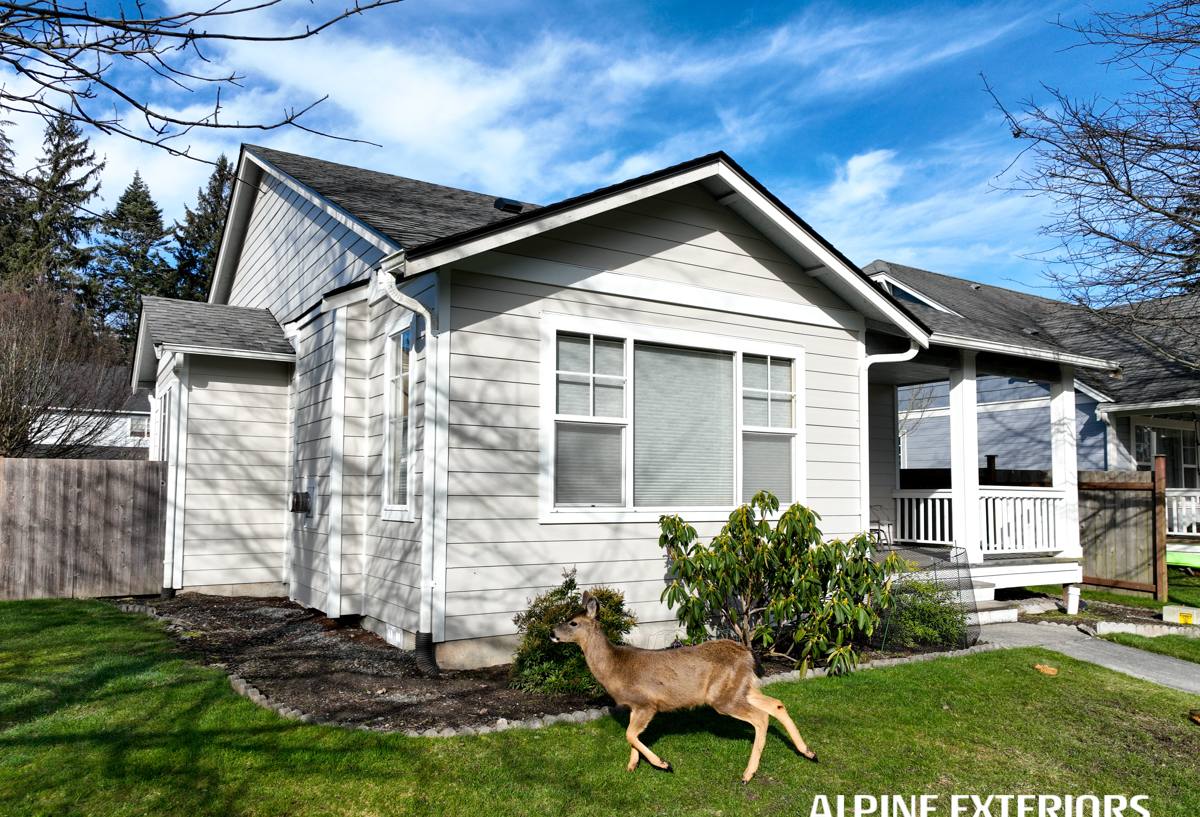
Why Siding Choice Matters More Here Than Inland
Every siding product on the market can look good on a sunny showroom day. The differences show up after five, ten, fifteen years of the specific conditions above. In a climate like Blaine's, the two things that separate a low-maintenance exterior from a recurring problem are how the material handles sustained moisture exposure, and how well the finish resists breaking down under salt air and UV without a repaint. That's the lens we use with every homeowner in this area, and it's why we've standardized on one product system rather than offering a menu of options with different long-term track records.
Why We Install Only James Hardie Fiber Cement
We don't install LP SmartSide, vinyl, Cemplank, Allura, primed spruce, or cedar. That's a deliberate call, not a lack of options. Each of those products has real strengths — vinyl is inexpensive and low-maintenance in dry climates, engineered wood products have improved a lot, and cedar has a look that some homeowners genuinely prefer. But in a marine, high-moisture, moss-prone climate, they each carry trade-offs we're not willing to build a business around:
- Wood-based siding (cedar, primed spruce, LP SmartSide) relies on intact paint or factory coating to keep moisture out of wood fiber. Once that coating is compromised — by a nick, a caulk failure, or sustained moss contact — moisture can wick into the substrate, and wood-based products are inherently more vulnerable to rot than a cement-based material.
- Vinyl siding is affordable and won't rot, but it expands and contracts with temperature swings, can crack in impact events, and its color is baked into thin plastic that fades over time with no practical way to refinish it — you replace panels, not repaint them.
- Other fiber cement brands (Cemplank, Allura) are legitimate products, but we've built our installation training, warranty relationships, and color program around one manufacturer so we can guarantee consistent results rather than juggling specs across several systems.
James Hardie fiber cement is non-combustible, dimensionally stable, and doesn't feed moss growth the way organic wood fiber does. Hardie's ColorPlus finish is baked on in a factory-controlled process, which holds up better against UV and salt air than field-applied paint and comes with its own finish warranty. For a climate that includes wind-driven rain and long stretches of shade and moisture, that combination is why it's what we put on homes in Blaine.
What Correct Installation Looks Like on the Coast
Fiber cement siding is only as good as the installation behind it. In a wind-driven-rain climate, the details that get skipped on a rushed job are exactly the details that matter most:
- Proper weather-resistive barrier and flashing at every window, door, and penetration, lapped correctly so water sheds outward rather than in
- Correct fastening pattern and clearance so panels aren't held tight against trim in a way that traps moisture
- Minimum ground clearance and clearance from roof lines, decks, and grade, so splash-back and standing water don't sit against the bottom course
- Factory-cut and factory-primed edges used wherever possible, with any field cuts properly sealed per manufacturer spec
- Caulk and sealant at joints that's rated for the exposure, not just whatever was on the truck
These aren't exotic requirements — they're standard Hardie installation practice — but they take more time and more attention on a home with real marine exposure than on a sheltered inland lot. A crew that installs Hardie regularly in this specific climate knows where the failure points tend to show up and builds the installation around avoiding them.
Cost Factors for Blaine Homeowners
Every home is different, but a few factors consistently move the price of a siding project in this area up or down. We give firm numbers only after walking a specific home, but this is the general shape of what affects cost:
| Factor | Why it matters here |
|---|---|
| Existing siding removal | Wood or vinyl tear-off, plus any hidden moisture or sheathing damage found underneath, adds labor and sometimes repair work before new siding goes on |
| Wall exposure and elevation | Sides facing prevailing wind and water exposure often get upgraded flashing detail and trim treatment |
| Trim and detail package | HardieTrim boards, corner treatments, and belly bands change both material and labor cost |
| Color and finish | Factory ColorPlus finishes cost more upfront than primed panels but remove the need for a full repaint down the road |
| Access and lot conditions | Tree cover, tight lot lines, and water-adjacent properties can affect staging and scaffolding needs |
Roofing, Windows, and Decks: The Rest of the Envelope
Siding doesn't work in isolation. On a coastal, high-moisture lot, the roof, windows, and any exterior decking are all managing the same weather, and a weak point in one usually shows up as damage in another. A roof that's shedding water improperly can send it straight down a wall. Windows with failed flashing or worn seals let wind-driven rain past the frame regardless of how good the siding is. Decks exposed to the same rain and moss conditions face similar maintenance decisions to siding — which is part of why we handle all four trades rather than just one. When we're on a property for a siding project, it's a natural point to flag anything we see on the roof, windows, or deck that's worth addressing at the same time, instead of a homeowner having to coordinate separate contractors for problems that are really one system.
Choosing a Local Contractor
Blaine is a small enough market that homeowners often ask why local experience matters versus hiring a larger regional or national outfit. In practice, a crew that works this specific stretch of coastline regularly has already seen how salt air, wind direction, and moss behave on homes like yours — that's not something you can fully substitute with general experience elsewhere. A few things worth checking before you hire anyone for exterior work in this area:
- Washington state contractor license, active and in good standing
- Liability insurance and, if they have employees, workers' comp coverage
- Manufacturer training or certification specific to the siding product being installed, not just general carpentry experience
- A written estimate that spells out product lines, trim details, and warranty terms — not just a lump-sum number
- References or completed work you can actually see, ideally on homes with similar exposure to wind and water
- A clear answer on who handles flashing and moisture barrier work, since that's where most long-term failures originate
Be cautious of any bid that's dramatically lower than others for the same product and scope — on a coastal home, the corners that get cut to hit a low price are usually the flashing and prep work you can't see once the siding is up.
Get a Straight Answer for Your Home
Every property in Blaine handles wind, rain, and shade a little differently depending on its orientation and lot. If you're dealing with moss buildup, failing paint, soft spots in existing siding, or you're just planning ahead for an exterior that can handle the next few decades on the water, we're glad to take a look. Fill out the form below for a free, no-pressure estimate — we'll walk the property, tell you honestly what we see, and explain what a James Hardie installation would look like for your specific home.