 Bellingham Siding
 What Primed Wood Siding Actually Is
Primed wood siding, sometimes sold as primed spruce or primed pine, is solid-sawn wood milled into lap boards or panels and coated at the factory with a single layer of primer. It is not a finished product. The primer is a base coat meant to seal the wood temporarily and give a topcoat of exterior paint something to grip. The finish paint, the caulking of every joint, and all future maintenance are left entirely to the installer and the homeowner.
There is a reason this material has been used on houses in the Pacific Northwest for generations. It is affordable, it is easy for a carpentry crew to cut and fit around trim and windows, and a freshly painted wood-sided home has a warmth to it that some homeowners genuinely prefer over engineered products. We are not going to pretend those points don't matter. They do, for the right project and the right owner willing to keep up with it.
What we install instead, on every siding job we take on in Bellingham and the rest of Whatcom County, is James Hardie fiber cement. This page explains the specific reasons primed wood didn't make the cut for our crews, not as a knock on the material itself, but as an honest look at what it demands from a house sitting a few miles off Bellingham Bay.
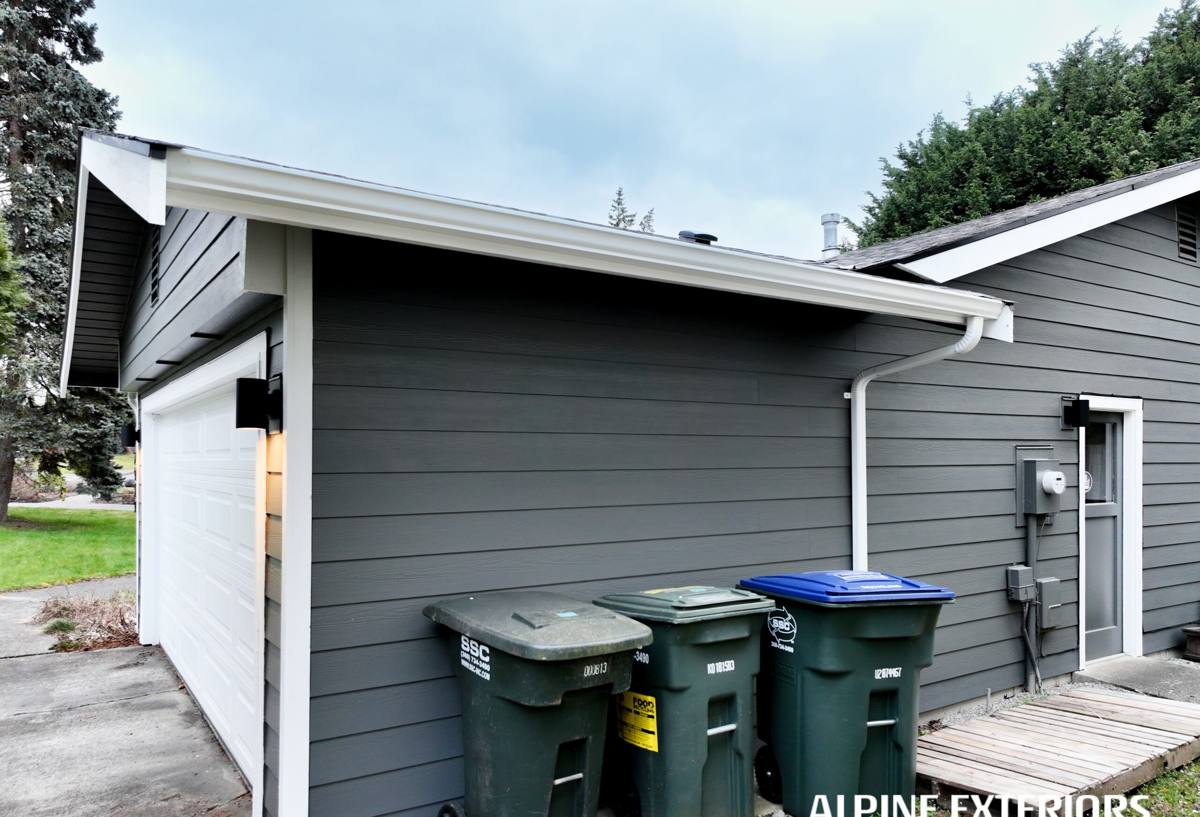
The Climate Problem: Salt Air, Driving Rain, and Moss Season
Bellingham sits on Bellingham Bay, with weather that rolls in off the Salish Sea and dumps close to 40 inches of rain a year, most of it between October and April. That rain rarely falls straight down. It comes sideways off the water, driven by wind, which means it hits vertical wall surfaces directly instead of just soaking into the ground. Add in the salt air that comes with living near tidal water, and you have two forces working against any painted wood surface at once: constant moisture and a mild corrosive element in the air.
Then there's moss. Whatcom County's mild, wet winters and heavy tree cover create a moss season that can run half the year on north-facing walls and shaded elevations. Moss holds water against a surface long after a storm has passed, and it doesn't care whether that surface is a roof, a deck, or a painted wood wall. On primed wood siding, trapped moisture under a mat of moss is exactly the condition that breaks down a paint film and starts wood rot underneath it.
None of this is unique to any one neighborhood. Whether a house sits in the Fairhaven Historic District two blocks from the water, up in the York or Puget neighborhoods, or out toward Ferndale and Lynden with more open exposure, every home in this county deals with some combination of driving rain and long wet seasons. Primed wood siding is asking a single factory-applied primer coat, followed by whatever field paint job gets done after install, to hold up against all of it, indefinitely, with no engineered moisture barrier built into the board itself.
Why This Matters More Here Than Inland
A primed wood siding installation in a drier inland climate, say eastern Washington, faces a different set of stresses. Less rain, lower humidity, less moss. The same product performs differently depending on where it sits. In a marine climate like Bellingham's, the maintenance window shrinks and the consequences of a missed repaint cycle show up faster, usually as soft spots at butt joints, corners, and anywhere caulk has started to crack.
The Maintenance Reality Homeowners Aren't Always Told
Primed wood siding is not a paint-once, forget-it product. It is the entry point of an ongoing maintenance cycle that the homeowner takes on the day the crew leaves.
- A full field topcoat is required within a limited window after installation, typically 30 to 90 days, or the primer itself begins to break down from UV and moisture exposure.
- Every seam, joint, and fastener head needs to be caulked and kept caulked. Caulk fails well before paint does, and a cracked bead is a direct path for water into the board.
- Repainting on a marine-climate schedule generally runs every 5 to 8 years for the full house, sooner on south and west-facing walls that take the most sun and weather.
- Any spot where paint fails, chips, or peels needs to be caught and touched up quickly. Bare wood left exposed even for one wet season can start absorbing moisture.
- Moss and mildew growth needs to be washed off walls periodically, not just roofs, particularly on shaded north elevations.
Add that up over a 20 or 30 year ownership horizon and primed wood siding is not a one-time purchase. It's a recurring line item in the household budget, and it only works if someone stays on top of it every few years without fail.
Moisture Behavior: Where Wood Struggles
Wood is a natural material, and it moves. It expands and contracts with humidity, which stresses paint films and caulk joints over time even when nothing has failed yet. Once water does get past the finish, wood absorbs it readily and holds onto it, which is the setup for rot, especially in a climate where boards rarely get a long stretch of dry weather to fully dry back out.
| Factor | Primed Wood Siding | James Hardie Fiber Cement |
|---|---|---|
| Moisture absorption | Absorbs water readily once finish is compromised | Engineered to resist moisture-related swelling and rot |
| Finish system | Factory primer only; field paint required | Factory ColorPlus finish baked on, or field-painted option |
| Repaint cycle in this climate | Roughly every 5-8 years, sooner on exposed walls | ColorPlus finish typically holds well past 15 years before repaint |
| Combustibility | Combustible, as with any solid wood product | Non-combustible fiber cement |
| Pest vulnerability | Susceptible to woodpeckers, carpenter ants, and rot-loving insects | Not a food or nesting source for wood-boring pests |
| Climate engineering | Generic product regardless of region | HZ product lines engineered for specific climate zones, including the Pacific Northwest's wet zone |
Upfront Cost Versus Cost Over Time
Primed wood siding usually has a lower material cost at install than fiber cement, and we want to be straight about that rather than pretend otherwise. But the upfront number is only part of the picture. Fiber cement siding installed with a factory finish shifts most of the long-term cost, the repainting, the caulk maintenance, the touch-ups, off the homeowner's calendar for well over a decade. Primed wood keeps that cost active from year one.
| Cost Factor | Primed Wood Siding | James Hardie (ColorPlus) |
|---|---|---|
| Material and install cost | Generally lower upfront | Higher upfront |
| First repaint | Required within 30-90 days of install | Not required; factory finish is complete on delivery |
| Ongoing repaint cycle | Recurring cost every 5-8 years | Deferred well past 15 years typically |
| Warranty structure | Varies by mill; often limited or none on the wood itself | Manufacturer-backed, transferable product warranty |
Why We Standardized on James Hardie Instead
We made a decision as a company to install one siding system, James Hardie fiber cement, rather than offer primed wood, vinyl, LP SmartSide, or the other cement-board alternatives on the market. That decision came down to wanting to stand behind what we put on a house without hedging.
Hardie's fiber cement is non-combustible, which matters in a region that has seen increasing wildfire smoke and risk awareness even west of the Cascades. The HZ5 product line is engineered specifically for climates like ours, with freeze-thaw cycling and sustained moisture built into the design criteria rather than treated as an afterthought. The ColorPlus factory finish process bakes color onto the board under controlled conditions, which is a more consistent, durable result than a field-applied topcoat exposed to whatever the weather is doing the week of installation, an especially real concern in a place where a dry three-day install window in October is never guaranteed. And Hardie backs the product with a strong, transferable warranty, which matters to homeowners in Bellingham's active resale market where a documented warranty transfer is worth something at closing.
None of that makes primed wood siding a bad product in the abstract. It makes it a product that asks a lot of ongoing attention in a climate that doesn't give much room for skipped maintenance years. We would rather install something we know performs here with predictable, honest long-term costs than something that looks the same on day one but diverges sharply by year ten depending on how well it gets maintained.
What to Ask Before Choosing a Siding Product
- What does the manufacturer's warranty actually cover, and is it transferable to a future buyer?
- Does the finish come factory-applied, or will a field topcoat be needed, and on what timeline?
- How is the product rated for moisture exposure and freeze-thaw performance specifically in a marine climate?
- What is the realistic maintenance schedule over 10, 20, and 30 years, not just the first year?
- Is the product non-combustible, and does that matter for insurance or peace of mind?
- What does the contractor themselves install on their own projects, and why?
Getting an Honest Look at Your Project
Every house on your street is dealing with the same rain, the same salt air off the bay, and the same moss season, whether the siding on it shows it yet or not. If you're weighing siding options for a home in Bellingham or elsewhere in Whatcom County, we're happy to walk your property, look at your current siding's condition, and talk through what James Hardie fiber cement would look like on your specific house. There's no pressure and no cost to get a straight answer. Request a free estimate below and we'll take it from there.