 Bellingham Siding
 Exterior Work in Puget: A Different Set of Rules
Puget sits close enough to the water and far enough into Whatcom County's weather patterns that its homes take on a specific kind of punishment. It's not one dramatic storm a year that does the damage — it's the steady grind of salt-tinged air, rain that comes in sideways off Bellingham Bay, and a moss season that can run from October well into spring. Any exterior material that goes on a Puget home has to hold up to all three at once, year after year, without babying.
We're a Bellingham-based crew, and Puget is part of our regular route, not a place we drive out to occasionally. That matters more than it sounds like it should. Knowing which streets sit in a wind tunnel off the water, which lots stay shaded and damp longer than their neighbors, and which older homes in the area were sided with materials that were never meant to handle this climate — that's the kind of knowledge that only comes from doing the work here repeatedly, not from a regional franchise passing through.
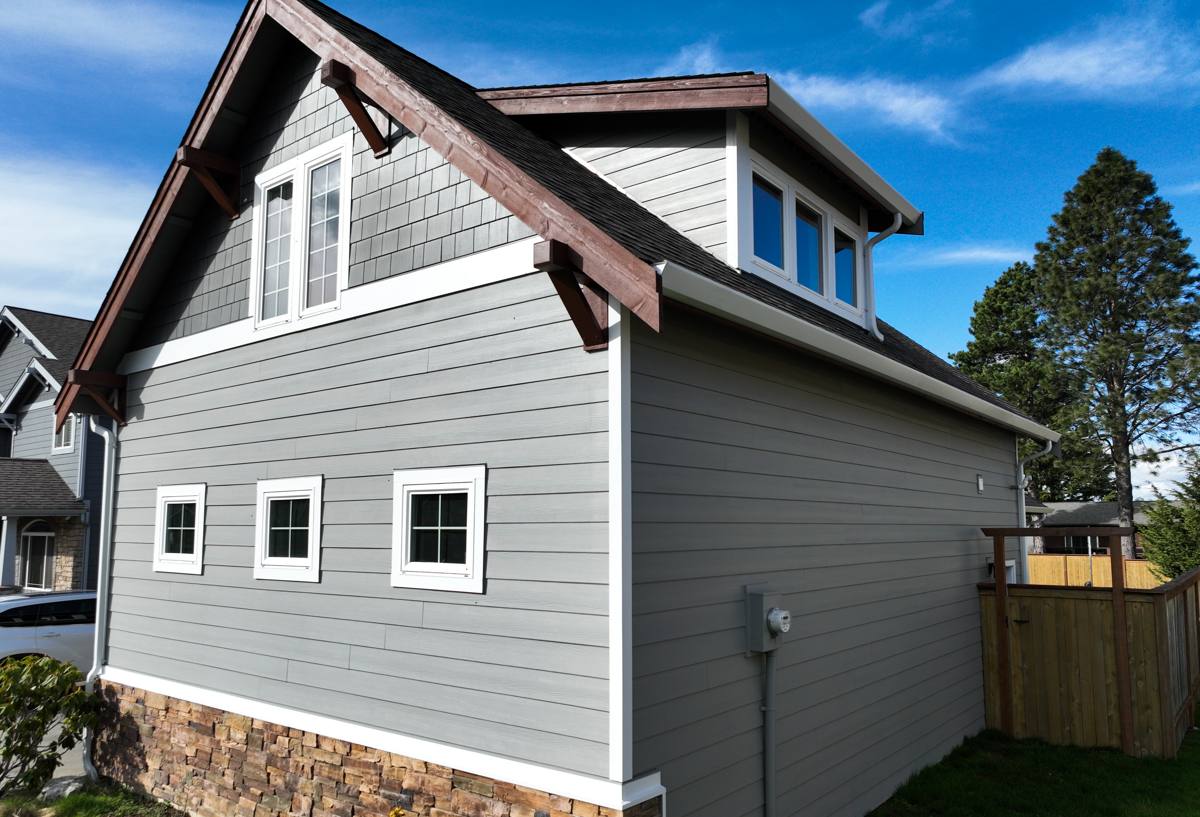
What Salt Air and Driving Rain Actually Do to Siding
Salt air doesn't need to be overwhelming to cause problems — a light, near-constant presence is enough over years. It accelerates corrosion on fasteners, hardware, and any exposed metal trim. On siding itself, salt-laden moisture works its way into seams and butt joints, and if the material underneath swells, checks, or softens when wet, that's where the trouble starts.
Driving rain is the second half of the problem. Wind-driven rain in this part of Whatcom County doesn't just fall on a wall — it gets pushed into it, forced under laps and around penetrations if the water-resistive barrier, flashing, and siding profile aren't detailed correctly. A siding product that's marginal in dry, still conditions can fail outright in a wall assembly that's regularly hit at an angle.
Why This Combination Is Harder Than Either Alone
Salt air plus driving rain is worse than the sum of its parts. Salt residue left on a wet surface holds moisture longer than clean rainwater would, slowing dry-out time between storms. In a climate where storms stack up back-to-back for weeks, a siding material with a slow dry-out cycle spends more of the year damp than dry — and that's the condition under which rot, delamination, and coating failure take hold.
Moss Season and What It Means for Your Exterior
Moss doesn't just grow on roofs in this part of the county — it colonizes siding, trim, and anything else that stays shaded and damp long enough. A long moss season means more months where organic growth is actively holding moisture against exterior surfaces rather than letting them dry between rain events. On wood-based products, that sustained dampness is exactly what invites rot. On any painted surface, trapped moisture under a film coating leads to peeling and cracking well before the coating's rated lifespan.
Moss also tends to concentrate on north- and west-facing walls and under eaves with limited sun exposure — which in Puget can be most of a house, depending on the lot and surrounding tree cover. A siding system that resists moisture absorption and holds a factory finish well is far easier to keep moss-free with routine washing than a porous or paint-dependent surface.
Why We Install Only James Hardie Fiber Cement
We made a deliberate call as a company to install James Hardie fiber cement siding exclusively, and we don't treat that as marketing — it's a standard we hold to because of what this climate does to lesser-suited materials. Fiber cement is non-combustible, dimensionally stable when wet, and doesn't absorb moisture the way wood-based or wood-composite products can. Hardie's ColorPlus factory finish is baked on under controlled conditions, which gives it better adhesion and UV resistance than field-applied paint, and it comes with a meaningful transferable warranty backing it.
We don't install vinyl, LP SmartSide, Cemplank, Allura, or primed wood siding, and we're upfront about why: in a climate defined by salt air, driving rain, and long damp stretches, those products ask more of routine maintenance and installation precision than we're comfortable relying on for a Puget home. That's our standard, not a claim that every other product fails everywhere — but it's the reason our trucks only carry one brand of siding.
Hardie's HZ5 Engineering
Hardie manufactures its siding in climate-specific formulations, and the HZ5 line is engineered for the wetter, more freeze-cycle-prone regions of the Pacific Northwest, including Whatcom County. That's a meaningful distinction from a one-size-fits-all product — the HZ5 formulation is built with this region's moisture exposure in mind, not just a national average.
How a Siding Replacement Project Works Here
Every Puget project starts with an honest look at the existing wall assembly, not just the siding surface. If the substrate, house wrap, or flashing details are compromised, replacing siding without addressing what's underneath just resets the clock on the same failure.
- Assessment: We inspect current siding, trim, flashing, and any visible moisture damage, including areas prone to wind-driven rain exposure.
- Tear-off: Old siding comes off down to the sheathing so we can evaluate what's actually there — this is often where hidden rot or past water intrusion shows up.
- Weather barrier and flashing correction: We repair or replace the water-resistive barrier and correct flashing at windows, doors, and penetrations before anything new goes on.
- Hardie installation: Fiber cement panels or lap siding are installed to manufacturer spec — correct fastener pattern, gapping, and clearances matter as much as the product itself.
- Trim and detail work: Trim, corners, and transitions are finished to shed water rather than trap it.
- Final walkthrough: We go over the finished exterior with the homeowner before calling the job done.
Installation Details That Matter in This Climate
Correct installation is what actually determines how a fiber cement wall performs against driving rain — the product can be right and the result can still fail if the details are wrong. A few specifics we hold to on every Puget job:
- Minimum clearance between siding and grade, decks, and roof lines to avoid wicking moisture from below
- Properly lapped and sealed house wrap with correct flashing integration at every penetration
- Manufacturer-specified fastener spacing and embedment, not shortcuts
- Caulking only where Hardie's install guide calls for it — over-caulking traps moisture rather than shedding it
- Field-cut edges primed or sealed per spec before installation
Beyond Siding: The Rest of the Exterior Envelope
Siding doesn't work in isolation — it's one part of an exterior envelope that also includes the roof, windows, and any attached structures like decks. We handle all four, and that matters for a Puget home specifically because these systems interact. A roof that's shedding moss debris onto siding below, windows with failing flashing that push water behind the wall, or a deck ledger board that's rotting into the house wall — these are the kind of connected problems a siding-only contractor might miss or simply not be equipped to address.
Roofing
Roofs in Puget deal with the same moss pressure as siding, plus the added stress of driving rain finding any weak point in flashing or underlayment. Keeping moss under control and flashing tight protects both the roof and the siding below it.
Windows
Window flashing is one of the most common sources of hidden water intrusion behind siding. When we replace siding around existing windows, we check flashing integration as a matter of course — it's cheap to fix while the wall is open and expensive to ignore.
Decks
Deck ledger boards attach directly to the house wall, and a poorly flashed ledger is a well-documented path for water to get behind siding at exactly the point where two structures meet.
Comparing Siding Approaches for a Puget Home
| Factor | James Hardie Fiber Cement | Wood-Based / Composite | Vinyl |
|---|---|---|---|
| Moisture absorption | Very low, dimensionally stable | Higher, prone to swelling | Non-absorptive but seams can trap moisture |
| Moss/algae resistance | Factory finish resists organic growth | Coating can trap moisture under growth | Grows algae readily in shaded, damp areas |
| Salt air performance | Stable, non-combustible | Coating and substrate can degrade faster | Can become brittle over long UV/salt exposure |
| Finish longevity | Factory-applied ColorPlus, strong warranty | Field paint, shorter repaint cycle | Color can fade; not repaintable easily |
| Fire rating | Non-combustible | Combustible | Combustible, can melt/deform |
Signs a Puget Home May Need New Siding
- Visible warping, buckling, or soft spots when pressed
- Paint that's peeling or bubbling repeatedly in the same spots
- Persistent moss or algae growth that returns quickly after cleaning
- Gaps opening at seams, corners, or trim joints
- Discoloration or staining that suggests water tracking behind the surface
- Rising energy bills that may point to a compromised wall assembly
- Siding that's original to a home built more than 20-25 years ago with no major update since
What Drives Cost on a Puget Siding Project
| Factor | Why It Matters |
|---|---|
| Home size and complexity | More wall area, corners, and trim detail means more material and labor |
| Existing wall condition | Hidden rot or moisture damage found during tear-off adds repair scope |
| Siding profile chosen | Lap, panel, and shingle profiles from Hardie's lineup vary in material and labor cost |
| Trim and accent work | Custom trim details and color-matched accessories add to the scope |
| Access and site conditions | Steep lots, limited access, or tight setbacks affect labor time |
We don't quote a number without seeing the house — anyone who does is guessing. What we can say is that a correctly installed fiber cement system is an investment in not redoing this work again in 10-15 years the way some lower-cost materials in this climate require.
Why a Local Bellingham Crew Matters Here
A contractor who works Whatcom County regularly knows what a Puget-area wall assembly is up against without needing it explained. That translates into faster, more accurate assessments, fewer surprises during tear-off, and installation choices — clearance heights, flashing details, fastener selection — that are already dialed in for this climate rather than generic to a national average. It also means we're around after the job is done, not a crew that finished up and moved to the next region.
If you're weighing a siding replacement — or want a second opinion on whether your current exterior is holding up the way it should — we're happy to come take a look. The estimate is free, there's no pressure, and you'll get a straight answer about what your home actually needs.