 Bellingham Siding
 Siding Built for Happy Valley's Weather, Not Just Its Curb Appeal
Happy Valley sits close enough to Bellingham Bay and the surrounding hillside tree cover that its homes take on a particular kind of weathering. It's not one dramatic storm that wears down a house here — it's the accumulation. Salt-tinged air drifting in off the water, driving rain that comes in sideways more often than straight down, and a moss season that can stretch from October well into spring. Add in the mature tree canopy that shades a lot of Happy Valley lots, and you get siding that stays damp longer after every rain than siding in a more open, sun-exposed part of Whatcom County.
None of that is unusual for this part of Bellingham. But it matters when you're choosing what goes on the outside of your house, because not every siding material handles sustained moisture and shade the same way. We install exclusively James Hardie fiber cement siding, and a neighborhood like Happy Valley is a good example of why: it's exactly the kind of environment where the difference between a wood-based product and a cement-based one shows up over time, not on day one.
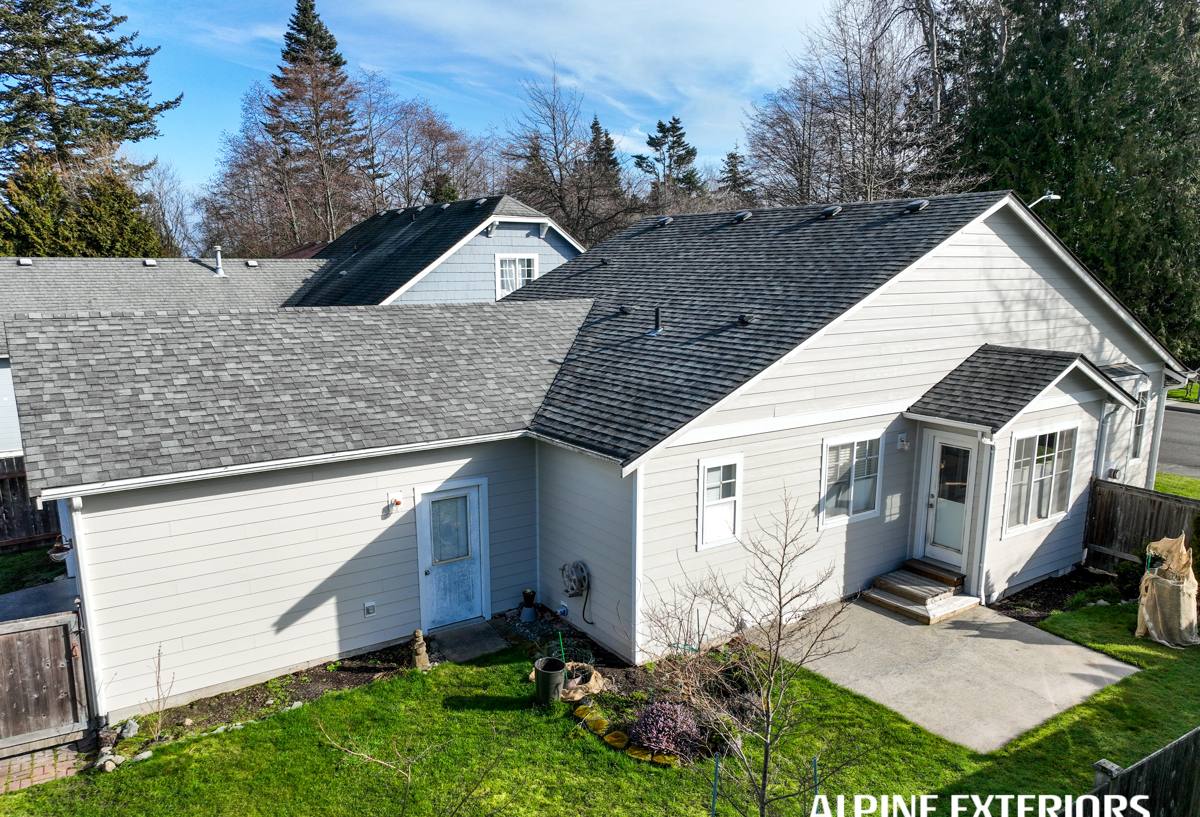
What Happy Valley Homes Are Up Against
Moisture That Doesn't Dry Out Quickly
Tree-shaded lots and proximity to the bay mean a lot of Happy Valley siding stays damp longer after rain than it would in full sun. That's normal for this part of Bellingham, but it's tough on any siding material that can swell, delaminate, or take on water at the edges. Fiber cement doesn't absorb and swell the way wood-based sidings can, which is a big part of why it holds up better in shaded, moisture-heavy microclimates like this one.
Moss and Organic Growth
Where there's shade and moisture, there's moss — on roofs, on decks, and yes, on siding, especially in corners and behind trim where airflow is limited. Moss holds moisture against the surface it's growing on, and over years that constant dampness is hard on paint film and substrate alike. Regular gutter and downspout maintenance, and siding installed with proper clearances and flashing, go a long way toward keeping moss from getting a foothold in the first place.
Salt Air and Coastal Exposure
Happy Valley isn't right on the water, but Bellingham Bay is close enough that homes here get some of the same salt-air exposure that coastal Whatcom County properties deal with. Salt air accelerates corrosion on fasteners and metal trim, and it can be hard on paint finishes that aren't formulated to handle it. This is one of the reasons factory-applied, baked-on finishes tend to outperform field-applied paint in this kind of environment.
Wind-Driven Rain
Storms coming off the Strait of Georgia and Bellingham Bay often bring rain in at an angle rather than straight down. That kind of wind-driven rain finds gaps in flashing, seams, and butt joints that a calmer rain would never reach. It's a detail-level problem, which means it's solved with careful installation — correct overlaps, properly flashed penetrations, and sealed joints — more than with any single product choice.
Why We Standardized on James Hardie Fiber Cement
We used to get asked, more than we do now, why we don't offer vinyl, LP SmartSide, or other engineered wood siding products alongside Hardie. The honest answer is that after years of installing and repairing siding around Bellingham and Whatcom County, we stopped seeing a good reason to put anything else on a house.
- Non-combustible material. Fiber cement is made from cement, sand, and cellulose fiber — it doesn't burn, which matters more every year as wildfire smoke seasons stretch further north.
- Doesn't feed moisture damage the way wood-based products can. In a shaded, damp neighborhood like Happy Valley, that's not a minor point — it's the whole ballgame for long-term performance.
- ColorPlus factory finish. The color is baked on at the factory under controlled conditions, not brushed or sprayed on-site. That finish holds up better against UV, salt air, and repeated wet-dry cycles than field-applied paint.
- Climate-engineered product lines. Hardie makes HZ5 and HZ10 formulations specifically for different climate zones, including the wetter, milder Pacific Northwest profile Bellingham falls into.
- A warranty structure that's actually transferable if you sell the house, which matters in a market where siding condition comes up in nearly every home inspection.
We're not going to tell you other siding products are junk — that's not honest, and it's not our call to make about a manufacturer's whole product line. What we will say is that after weighing moisture behavior, maintenance burden, installation forgiveness, and long-term appearance, Hardie is what we're willing to put our name behind and warranty our labor on. That's a professional standard we hold company-wide, not a Happy Valley-specific policy — but it's easy to see why it matters most in neighborhoods like this one.
What Full Exterior Service Looks Like for a Happy Valley Home
Siding rarely fails in isolation. A roof that's shedding granules, gutters that overflow at the wrong spot, or windows with failed seals will all eventually show up as a siding problem — staining, rot at trim boundaries, or moisture intrusion behind the cladding. Because we handle siding, roofing, windows, and decks, we look at the whole envelope of the house, not just the piece we're there to quote.
Roofing
A roof in poor condition sends water somewhere, and often that somewhere is down behind fascia and into the top course of siding. If your roof is due, it's worth addressing before or alongside a siding project rather than after.
Windows
Window flashing and siding meet at some of the most failure-prone joints on a house. When we replace siding around existing windows, we pay close attention to how that transition is flashed — and if the windows themselves are old enough to be leaking, we'll tell you honestly whether it makes sense to address them at the same time.
Decks
Decks in shaded, damp Happy Valley yards face a lot of the same moss and moisture pressure as siding does. If your deck ledger board meets the house near an area we're already re-siding, it's worth having us look at both at once.
Comparing Siding Options for This Climate
| Factor | James Hardie Fiber Cement | Vinyl Siding | Wood-Based / Engineered Wood |
|---|---|---|---|
| Moisture resistance in shaded, damp lots | Strong — doesn't swell or delaminate | Doesn't absorb water, but can trap moisture behind it if installed poorly | Vulnerable to swelling and rot if edges aren't sealed and maintained |
| Fire resistance | Non-combustible | Can melt or deform under heat | Combustible |
| Finish durability | Factory-baked ColorPlus finish | Color molded through, but can fade and chalk over time | Field-applied paint, needs recoating on a cycle |
| Maintenance | Periodic washing, minimal repainting | Low, but prone to cracking in impact/cold | Regular repainting and sealed-edge inspection |
| Typical lifespan with proper install | 30+ years | 20-30 years, appearance degrades sooner | Highly install- and maintenance-dependent |
What Correct Installation Actually Involves
James Hardie siding performs the way it's engineered to only when it's installed to spec. That's not a marketing line — it's the reason installer training and site conditions matter as much as the product itself.
- Proper starter strip and clearance from grade, decks, and roof lines so the bottom edge of the siding never sits in standing water
- Correct fastener type, spacing, and depth — over-driven or under-driven nails are a common source of early callbacks
- A weather-resistant barrier installed and lapped correctly behind the siding, with flashing integrated at every window, door, and penetration
- Properly caulked and painted cut edges, since factory finish doesn't extend to field cuts
- Adequate gaps at butt joints and trim to allow for expansion without forcing water behind the panel
On a Happy Valley lot with shade and limited airflow, these details are what separate siding that looks good for thirty years from siding that starts showing problems in five.
A Local Crew Matters More Than It Sounds
A crew that works Bellingham and Whatcom County regularly knows which side of a Happy Valley lot tends to hold moss, how far south-facing walls get from summer sun before shade takes over again, and what kind of flashing detail actually keeps wind-driven bay-area rain out. That's not knowledge you get from a spec sheet — it's from doing this work, in this weather, on homes like yours, year after year. It also means when you call about a warranty question five years from now, you're calling a company that's still local and still standing behind its own installation.
Signs It's Time to Look at Your Siding
- Visible cracking, warping, or soft spots, especially near the ground or under downspouts
- Persistent moss or algae staining that comes back shortly after cleaning
- Paint that's peeling or bubbling rather than just fading evenly
- Gaps or separation at trim, corners, or window and door edges
- A musty smell or visible staining on interior walls near exterior corners
- Siding that's original to a home built more than 20-25 years ago, particularly wood or older composite products
Getting Started
If you're noticing any of the signs above, or you'd just like an honest read on where your siding stands, we're happy to come take a look. We'll tell you straight whether it's a repair, a partial replacement, or worth doing the whole exterior at once — and why James Hardie is what we'd put on your home if it comes to that. Reach out for a free, no-pressure estimate using the form below.