 Bellingham Siding
 South Hill's Exterior Climate Challenges
South Hill sits above Bellingham Bay, and that elevation cuts both ways. Homes up there get some of the best views in Whatcom County, but they also catch weather that lower, more sheltered neighborhoods don't see as directly. Wind off the water carries salt-laden moisture inland, and on exposed lots that means siding, trim, and fasteners take on a slow, steady dose of corrosive air year-round. Add in Bellingham's driving rain — the kind that comes sideways off the Sound during a fall or winter system — and you've got a combination that punishes any exterior material that isn't built to shed water and resist the elements.
South Hill's tree cover and hillside shade also mean a long moss season. Northern-facing walls, areas under overhangs, and anything tucked behind mature landscaping can stay damp far longer after a storm than a wall in full sun. That extended damp period is exactly what moss, algae, and mildew need to get established, and once they take hold on a vulnerable siding surface, they hold moisture against it even longer. It becomes a cycle that accelerates wear rather than just sitting on the surface cosmetically.
Why Siding Wears Out Faster on Hillside Homes
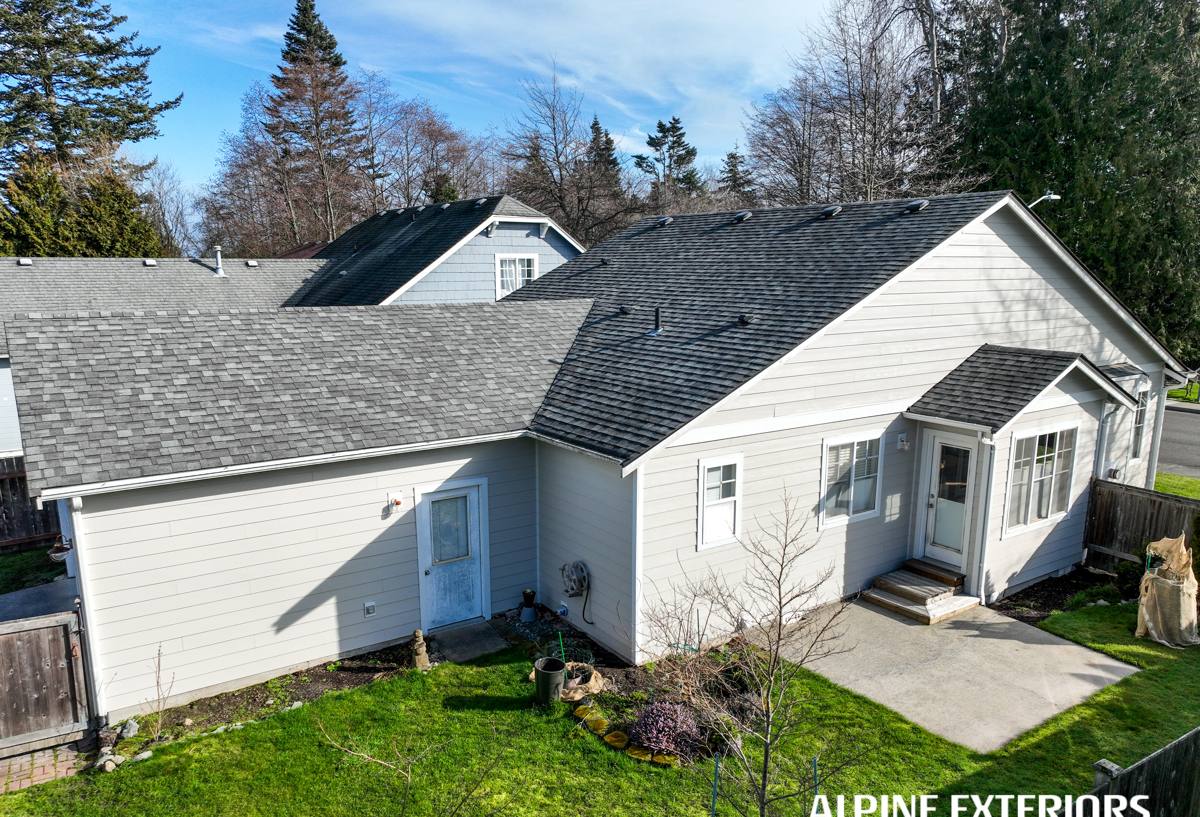
We see a consistent pattern on South Hill: homes with older wood, vinyl, or lower-grade composite siding show more paint failure, swelling, and moss staining than comparable homes in more sheltered parts of Bellingham. It's not that the siding was installed badly — it's that the material itself wasn't matched to the exposure. Constant damp-dry cycling stresses seams, caulk joints, and fastener points. Salt air accelerates corrosion on nails and trim flashing. And moss holds water against the wall surface long after a storm has passed, which is worse for most siding than a single hard rain.
This is also a neighborhood with a good mix of home ages, from older bungalows and craftsman-era houses to newer builds. Older homes often have layers of siding history — sometimes wood over the original sheathing, sometimes a vinyl or composite retrofit from decades back. Before we talk about new siding, we look at what's happening underneath: sheathing condition, moisture intrusion history, and whether the wall assembly is set up to dry out if it does get wet.
What We Look for During a South Hill Inspection
- Signs of moss or algae staining, especially on shaded or north-facing walls
- Soft or delaminating sheathing behind existing siding, particularly near grade and window openings
- Corrosion on nail heads, flashing, or trim hardware from salt air exposure
- Caulk and seam failure at butt joints, corners, and penetrations
- Paint or finish failure that suggests the substrate is absorbing and releasing moisture repeatedly
How We Approach Siding Replacement in South Hill
We don't treat every job the same regardless of address. A South Hill home with heavy tree shade and hillside wind exposure gets a different plan than a flat, sunny lot elsewhere in Bellingham. That starts with the inspection above and carries through into material choice, water-resistive barrier detailing, and how we flash windows, doors, and butt joints.
Tear-Off and Substrate Repair
Once old siding comes off, we don't just re-cover a problem. If sheathing is soft or water-damaged, it gets replaced before anything new goes up. Skipping this step is one of the most common reasons a siding job fails early — new material over a compromised wall just hides the problem instead of solving it.
Weather-Resistive Barrier and Flashing
Given how much rain and damp South Hill sees, we're careful about the drainage plane behind the siding — the layer that lets any moisture that does get past the surface find its way back out instead of sitting against the sheathing. Proper window and door flashing, correctly lapped house wrap, and attention to butt joints and corners matter more here than in a drier, more sheltered spot.
Installation to Manufacturer Spec
James Hardie siding is engineered to perform, but only if it's installed the way the manufacturer specifies — correct clearances from grade and roof lines, proper fastener spacing and type, and caulking only where the manufacturer calls for it. We install to that spec every time, which is also what keeps the product's warranty intact.
Why We Install Only James Hardie Fiber Cement
We made a decision as a company to install one siding system: James Hardie fiber cement. We don't install LP SmartSide, vinyl, Cemplank, Allura, primed spruce, or cedar. That's not a marketing angle — it's a standard we hold because we've seen how each of those alternatives performs over time, particularly in a coastal, wet climate like Whatcom County's.
Vinyl is affordable and low-maintenance in the sense that it doesn't need painting, but it's a thin plastic product that can warp in heat, crack in cold, and fade — and it doesn't hold up well against wind-driven debris or impact. Engineered wood products like LP SmartSide use real wood fiber, which means they're more vulnerable to moisture intrusion at cut edges and seams than a cement-based product, and that's a real concern in a climate with as much annual rainfall as ours. Cedar and primed spruce are natural wood — attractive, but they require ongoing maintenance (painting, caulking, moisture monitoring) to hold up, and Bellingham's damp, moss-prone conditions shorten the maintenance interval considerably. Cemplank and Allura are also fiber cement products and share some of Hardie's core advantages, but we've standardized on Hardie specifically for its factory-applied ColorPlus finish, its HZ5 product engineering for cold, wet climates, and the strength of its transferable warranty when the installation is done correctly.
Fiber cement itself doesn't rot, it doesn't attract pests, and it's non-combustible — a genuine advantage for wildfire-adjacent exposure risk, even in a wet region like ours. It holds paint and factory finish far longer than wood, and it resists the swelling and cracking that plague vinyl and lower-grade composites in freeze-thaw and salt-air conditions.
| Material | Moisture Behavior in Wet Climate | Maintenance | Why We Don't Install It |
|---|---|---|---|
| Vinyl | Doesn't rot but warps/cracks with temperature swings | Low, but not repairable — panels are replaced | Impact and wind vulnerability, limited lifespan in coastal exposure |
| LP SmartSide | Wood-fiber core is moisture-sensitive at cut edges/seams | Moderate; edge sealing is critical | Higher long-term moisture risk in a high-rainfall climate |
| Cedar / Primed Spruce | Natural wood — absorbs and releases moisture readily | High — regular painting and caulking | Maintenance burden accelerates in moss-prone, shaded conditions |
| Cemplank / Allura | Similar fiber cement performance to Hardie | Low | We standardized on Hardie's finish system and warranty structure |
| James Hardie | Engineered fiber cement, HZ5 formulated for cold/wet regions | Low — factory finish, no painting needed for years | This is what we install |
Beyond Siding: Roofing, Windows, and Decks
Siding is only one piece of a home's exterior envelope, and on South Hill it rarely makes sense to look at it in isolation. Roofing, windows, and decks all deal with the same salt air and driving rain, and problems in one area often show up as damage in another — a failing roof edge or gutter can send water straight down a wall, and old windows with failed flashing can rot the framing around them regardless of how good the siding is. We handle all four so a homeowner can address the whole envelope with one crew instead of coordinating separate contractors who may not communicate about how the pieces fit together.
If you're replacing siding on a South Hill home, it's worth having us take a quick look at the roof edge, window flashing, and any deck ledger connections while we're there. Catching a small flashing issue during a siding job is far cheaper than discovering it later as interior water damage.
What to Expect: Process and Timeline
Every project starts with an in-person inspection and a written estimate — no pressure, no obligation. From there, a typical siding replacement on a South Hill home moves through a fairly consistent sequence, though hillside access and tree-lined lots sometimes call for extra planning around staging and material delivery.
- On-site inspection and measurement, including a look at trim, flashing, and any moss or moisture concerns
- Written estimate outlining scope, materials, and timeline
- Material order — Hardie panel and trim are ordered to the specific colors and profiles selected
- Tear-off of old siding and inspection/repair of sheathing underneath
- Installation of weather-resistive barrier, flashing, and new Hardie siding to manufacturer spec
- Final walkthrough and cleanup
Weather windows matter in Bellingham, and we plan around the wetter months when we can, though tear-off and reinstallation can be sequenced carefully even during a typically rainy stretch to keep the wall assembly protected.
Why a Local Crew Matters on South Hill
A crew that works across Whatcom County regularly understands things a national or regional franchise doesn't always account for: how differently a shaded, hillside lot ages compared to an open one, how much salt air exposure varies by elevation and orientation even within the same neighborhood, and how Bellingham's building and permitting process actually works. That local knowledge shows up in the details — where we pay extra attention to flashing, how we sequence a job around wet weather, and which parts of a South Hill home are most likely to need extra care.
We're not choosing James Hardie because it's the easiest sell. It's the product we've found holds up to this specific climate — salt air, sustained rain, and long damp seasons — when installed correctly. That's the standard we hold on every South Hill project.
If you're noticing moss buildup, paint failure, or soft spots on your siding, or you're just planning ahead for a home on South Hill, we're happy to take a look. Reach out for a free, no-pressure estimate — there's a form below to get started.