 Bellingham Siding
 Siding in Cordata: Built for What This Neighborhood Actually Deals With
Cordata sits in north Bellingham, one of the areas that's seen the most residential growth in Whatcom County over the past couple of decades. That means a wide mix of home ages and construction types — newer subdivisions with builder-grade siding installed under time pressure, older homes that have already been through one or two rounds of exterior repairs, and everything in between. What all of them share is exposure to the same regional weather pattern: marine air pulled in off the Salish Sea, long stretches of driving rain from fall through spring, and the low winter sun angles that keep north-facing walls damp for months at a time.
We're a local siding, roofing, window, and deck crew that works this exact climate every week, not a national outfit that rotates through the Pacific Northwest between other regions. That matters more than most homeowners realize until they've had a contractor disappear mid-warranty or misjudge how a product behaves once it's actually been rained on for three winters straight.
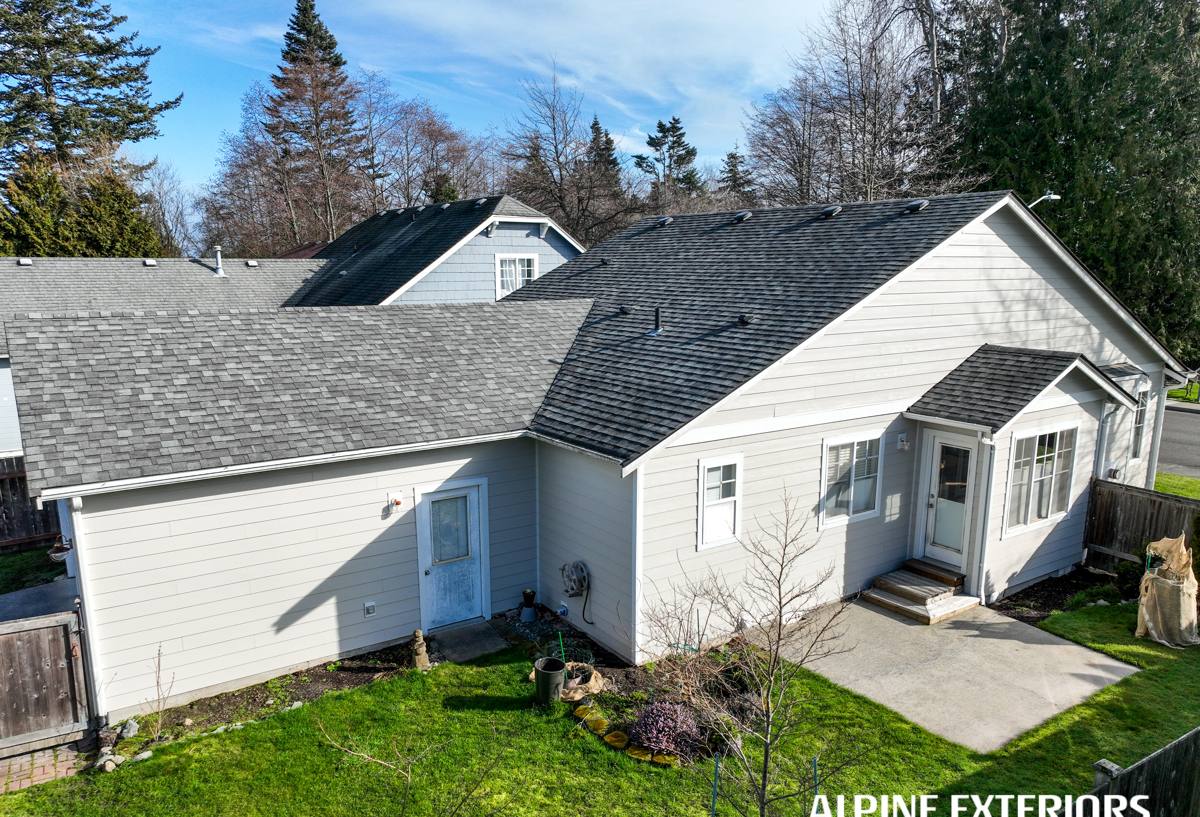
What Bellingham's Climate Does to Exterior Siding
Salt Air and Moisture
Bellingham Bay isn't far from any point in the city, and Cordata gets its share of salt-laden marine air moving inland. Salt air accelerates corrosion on fasteners, trim flashing, and any metal components in a siding system. It also tends to hold moisture against surfaces longer than dry inland air would, which matters for any siding material that isn't fully engineered to resist water absorption.
Driving Rain
Whatcom County doesn't get the heaviest annual rainfall in Washington, but it gets a lot of wind-driven rain — the kind that hits siding at an angle instead of falling straight down. That pattern stresses seams, laps, and butt joints far more than a light vertical drizzle would. Poorly installed or poorly engineered siding shows its weaknesses first at these joints, usually as swelling, staining, or paint failure.
The Long Moss Season
Shade, moisture, and mild temperatures are a perfect combination for moss and algae growth, and Cordata's tree cover and cloudy stretches give both plenty of time to establish themselves on north- and west-facing walls. Moss holds moisture against a surface constantly, which is a slow but real threat to any siding material that isn't dimensionally stable or properly sealed at the factory.
Why We Only Install James Hardie Fiber Cement
We made a deliberate decision years ago to stop installing anything other than James Hardie fiber cement siding. That's not a marketing angle — it's a standard we hold to on every job, including in Cordata. Fiber cement is manufactured from cement, sand, and cellulose fibers, which makes it non-combustible and dimensionally stable in a way that wood-based and vinyl products simply aren't. In a climate defined by constant moisture cycling, that stability is the difference between siding that holds its line for decades and siding that starts telegraphing problems within a few wet seasons.
James Hardie also engineers specific product lines for different climate zones — the HZ5 line, used in colder, wetter regions like ours, is formulated to resist moisture-related damage that would affect a product built for a drier climate. Add the factory-applied ColorPlus finish, which is baked on under controlled conditions rather than field-painted, and you get a finish that resists the fading and chalking that's common on repainted siding exposed to years of UV and salt air.
We won't install LP SmartSide, vinyl, Cemplank, Allura, or primed wood species like spruce or cedar. Each of those products has legitimate uses and a following, and we're not interested in badmouthing them. But we've made the call that our name goes on installations we're confident will hold up here, and that means standardizing on one system we know inside and out rather than juggling installation methods across five different products.
How James Hardie Compares to Common Alternatives on Regional Durability
| Factor | James Hardie Fiber Cement | Vinyl | Engineered Wood (LP-type) | Untreated/Primed Cedar or Spruce |
|---|---|---|---|---|
| Moisture resistance | Engineered for wet climates (HZ5 line) | Doesn't absorb water, but expands/contracts with heat, opening seams | Vulnerable at cut edges and seams if not fully sealed | Absorbs moisture; prone to swelling and rot without diligent upkeep |
| Combustibility | Non-combustible | Melts/deforms in heat | Wood-based, combustible | Combustible |
| Finish longevity | Factory ColorPlus finish, long fade warranty | Color molded through material but can fade and chalk | Factory or field-applied finish, variable durability | Requires repainting/staining on a recurring cycle |
| Moss/algae resistance | Stable substrate doesn't feed growth | Surface can host growth in shaded areas | Wood fiber content can be more hospitable to growth | Natural wood is highly susceptible |
| Typical warranty structure | Long-term, transferable | Varies widely by manufacturer | Varies, often shorter on finish | Minimal, if any, product warranty |
How We Approach a Cordata Siding Project
Assessment First
Every project starts with an honest look at what's actually happening behind the existing siding, not just what's visible from the curb. In this climate, we pay particular attention to moisture intrusion around windows, doors, and any point where two materials meet — those are the spots that fail first and often the reason a homeowner started looking into replacement in the first place.
Correct Installation Matters More Than the Product
Fiber cement performs the way it's supposed to only when it's installed to manufacturer specification — correct fastener placement, proper clearances, and flashing details that account for wind-driven rain rather than just straight-down precipitation. We follow James Hardie's installation guidelines closely because we've seen what happens on other jobs when crews treat fiber cement like any other lap siding and skip the details that actually matter in a marine climate.
Trim, Flashing, and the Details That Get Skipped
A siding job is only as good as its weakest transition point. Window and door flashing, kick-out flashing at roof-to-wall intersections, and properly lapped house wrap all matter more here than in drier parts of the country, because there's more moisture pushing against every gap for more months of the year.
Beyond Siding: A Full Exterior Crew
Because we also handle roofing, windows, and decks, we can look at a Cordata home's exterior as one connected system rather than a series of unrelated projects. Roof flashing, gutter placement, and window trim all interact directly with how well siding performs — a leaking gutter or a poorly flashed window can undermine even a correctly installed fiber cement wall. Homeowners planning a larger exterior update often find it more efficient to sequence siding, roofing, and window work together rather than hiring separate crews who don't coordinate on these overlap points.
What to Expect: A Practical Checklist
- An on-site assessment of your current siding condition, including any hidden moisture damage
- A clear explanation of which James Hardie product line and profile fits your home and budget
- A written scope covering trim, flashing, and house wrap details — not just panel installation
- A realistic timeline that accounts for Whatcom County's weather windows
- A transferable warranty on both the product and our installation work
- A crew that's local to Bellingham and available if a question comes up after the job is done
Cost Factors Homeowners in Cordata Should Understand
| Factor | Why It Affects Price |
|---|---|
| Home size and wall complexity | More corners, gables, and dormers mean more cutting, trim work, and labor time |
| Current siding removal | Tear-off and disposal of old material, especially if hazardous materials like old paint are involved |
| Extent of hidden damage | Rot or moisture damage found once old siding comes off may require sheathing repair before new siding goes on |
| Product line and profile chosen | Lap width, texture, and specific James Hardie line selected affect material cost |
| Trim and accessory work | Window and door trim, corner boards, and fascia detailing add labor and material |
| Access and site conditions | Multi-story sections, tight lot lines, or landscaping constraints can affect labor time |
Why a Local Crew Makes a Real Difference
Siding and roofing crews that travel between regions don't always internalize the difference between "rain" as a general concept and the specific way wind-driven rain and prolonged marine moisture behave against a wall assembly in Whatcom County. We live with this climate ourselves, and every project we take on in Cordata gets built with the same assumptions we'd apply to our own homes: that the moss will come back every year, that the rain will come in sideways more often than not, and that the materials and installation details need to hold up to both without a decade of maintenance headaches.
If you're weighing a siding replacement in Cordata, we're happy to come take a look, walk you through what we're seeing, and give you a straightforward estimate — no pressure, no hard sell on a product we don't believe in. Fill out the form below and we'll get in touch to schedule a time.