 Bellingham Siding
 Two Very Different Materials, One Big Decision
If you're replacing siding in Bellingham, you'll eventually land on the same fork in the road nearly every homeowner in Whatcom County faces: vinyl or fiber cement. Both are legitimate, widely used products. Both have manufacturers who will tell you theirs is the obvious choice. We're not going to do that. We install James Hardie fiber cement exclusively, and we think you deserve to know exactly why — not through marketing language, but through a plain comparison of how each material actually performs against our local weather, over the years, not just on installation day.
This isn't a takedown of vinyl. It's a widely used, budget-friendly product that does its job on a lot of homes. But "does its job" and "is the right call for a house on Bellingham Bay or up in a moss-heavy neighborhood off Alabama Hill" aren't always the same thing. Here's the honest breakdown.
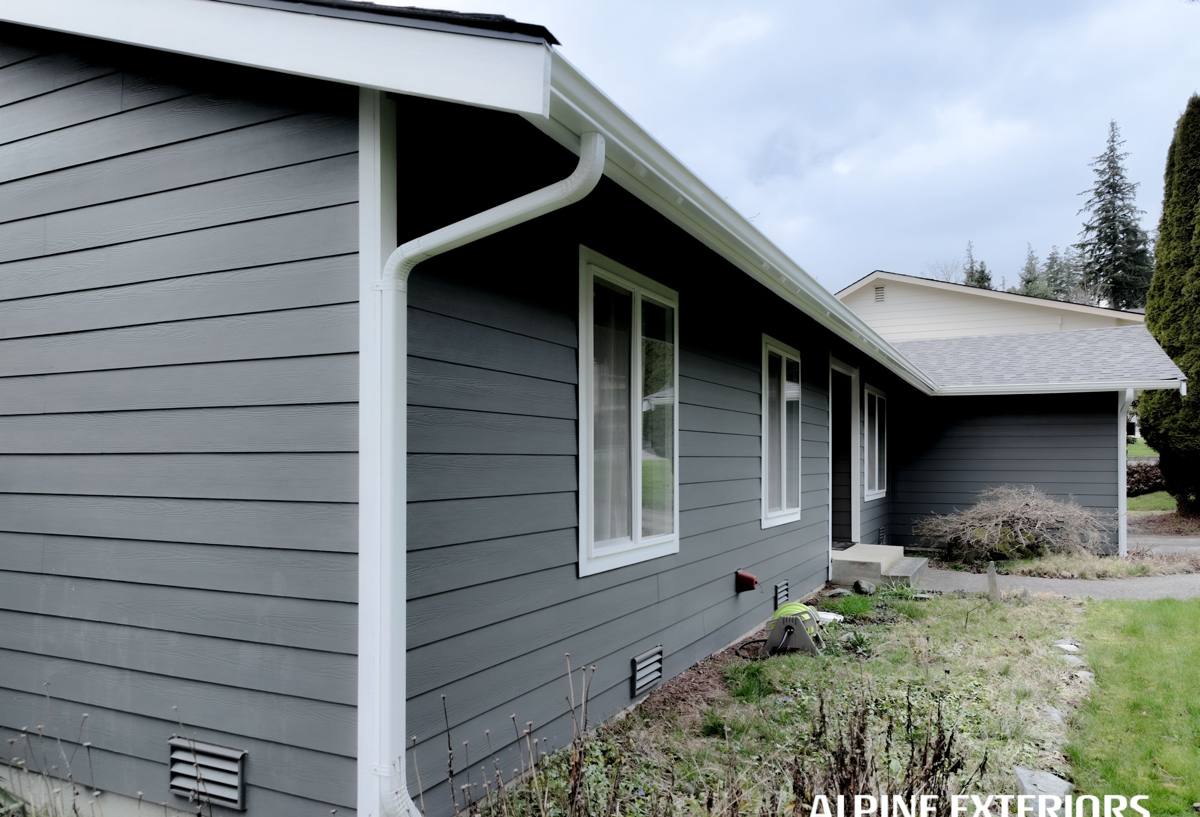
What Vinyl Siding Gets Right
Vinyl earned its market share for real reasons, and it's worth naming them before we get into where it falls short.
- Lower upfront material and labor cost compared to fiber cement, which matters on tight budgets or investment properties.
- Fast installation — panels snap into place quickly, which keeps labor hours (and cost) down.
- No painting required out of the box, since color is baked into the plastic itself.
- Lightweight, which simplifies handling and can reduce structural load considerations on some builds.
For a homeowner planning to sell in a couple of years, or working with a hard budget ceiling, those are real advantages. We're not going to pretend otherwise.
Where Vinyl Struggles Against Bellingham's Climate
Moss, Algae, and Constant Moisture
Whatcom County's long, wet stretch from fall through spring — plus the shade many lots get from mature evergreens — creates a near-perfect environment for moss and algae growth on exterior surfaces. Vinyl's textured, slightly porous surface and its horizontal laps give moisture and organic growth places to take hold, especially on north-facing walls that never fully dry out. It's not that vinyl "fails" because of this — it's that the maintenance burden (pressure washing, algae treatments, more frequent cleaning) tends to be higher than most homeowners expect when they buy it.
Driving Rain and Wind-Driven Water
Bellingham doesn't just get rain — it gets sideways rain, especially in exposed spots near the water or up on hillsides that catch weather off the Strait. Vinyl siding relies on lap-over installation and drainage gaps to manage water; it's not a sealed, monolithic surface. When installed correctly it sheds water fine, but any gap, warp, or improperly lapped section becomes an entry point, and vinyl's tendency to expand and contract with temperature swings can loosen fastener tolerances over time, especially on lower-quality or improperly installed jobs.
Salt Air Along the Coast
Homes closer to Bellingham Bay, Chuckanut, or the county's coastal edges deal with salt-laden air that accelerates wear on a lot of exterior materials. Vinyl doesn't corrode the way metal does, but salt air combined with UV exposure speeds up the chalking and fading that vinyl is already prone to — and unlike a painted surface, faded vinyl can't be refreshed with a repaint. Once the color shifts, replacement is the only fix.
UV Fading and Heat Distortion
Vinyl's color runs through the material, which sounds durable, but UV exposure over years causes noticeable fading and chalking, particularly on darker colors and south- or west-facing walls. Vinyl can also warp or buckle in direct, sustained heat — less of a daily concern in our marine climate than in hotter regions, but it does happen on sun-exposed walls, especially with darker panels that absorb more heat.
What Fiber Cement (James Hardie) Gets Right
Fiber cement is a blend of cement, sand, and cellulose fibers, engineered to be dimensionally stable and resistant to the specific things that wear down siding in a marine climate: moisture, UV, and temperature cycling.
- Dimensionally stable — it doesn't expand and contract with temperature swings the way vinyl or wood does, which means fewer gaps, less buckling, and fastener lines that hold over decades.
- Non-combustible — fiber cement doesn't contribute fuel to a fire, which matters increasingly for insurance considerations even in a wet climate like ours.
- Factory-applied ColorPlus finish — baked-on, UV-cured color that resists fading far better than field-applied paint or vinyl's molded-in pigment, and it's backed by its own finish warranty.
- Engineered for moisture-heavy climates — Hardie's HZ5 product line is specifically formulated for the Pacific Northwest's freeze-thaw and moisture exposure, not a one-size-fits-all national product.
- Holds paint and caulk properly at trim and joints, which matters for keeping water out at the details — usually where siding failures actually start, regardless of material.
None of this makes fiber cement maintenance-free. It still needs to be kept clean, caulking still needs periodic inspection, and moss can still grow on any exterior surface in our climate if it's shaded and never dries. But the material itself isn't the weak point the way it can be with vinyl — the surface holds up, and when it does need attention, it's a wash or a caulk touch-up, not a warped panel that needs replacing.
Cost and Lifespan, Side by Side
Cost is where this conversation usually starts, so let's be direct about it. Fiber cement costs more upfront than vinyl — both in material and in labor, since it requires more careful installation. The honest question isn't "which is cheaper to install," it's "which costs less over the time you'll own the house."
| Factor | Vinyl Siding | James Hardie Fiber Cement |
|---|---|---|
| Upfront cost | Lower | Higher |
| Typical lifespan | 20–30 years, variable with exposure | 30–50+ years when installed to spec |
| Fading resistance | Fades and chalks over time, cannot be repainted easily | ColorPlus finish resists fading; can be repainted if desired |
| Moisture/moss resistance | Prone to algae and moss buildup in shaded, damp areas | Resists moisture damage; still needs periodic cleaning |
| Fire rating | Combustible, can melt/deform under heat | Non-combustible |
| Impact resistance | Can crack or shatter in cold weather | Resists denting and cracking |
| Resale perception | Viewed as standard/budget | Viewed as an upgrade, often noted in listings |
On a straight per-year-owned basis, fiber cement's higher install cost is usually offset by not needing a full re-side in 20 years, plus lower fading-driven "it just looks old" depreciation. That math changes if you're planning to sell within a few years — in that case the upfront cost gap matters more than the long-term one.
Installation Sensitivity Is the Part Nobody Talks About
Here's something both products share: they only perform as well as the install. But they're not equally forgiving of mistakes.
Vinyl is designed to "float" — nailed loosely enough to expand and contract without buckling. Overdriven nails, wrong flashing details, or skipped house wrap are common enough shortcuts that most homeowners can't detect until water gets behind the panels years later. Fiber cement is less forgiving in a different way: it requires correct fastener spacing, proper joint treatment, factory-recommended caulking (or none, per Hardie's specifications, at certain joints), and painted or capped cut edges to prevent moisture wicking. Done right, it's an extremely durable system. Done wrong, either product can fail — but fiber cement mistakes tend to show up as isolated, fixable issues (a joint, a cut edge), while vinyl mistakes tend to show up as systemic water intrusion behind a whole wall section.
This is a big part of why installer experience with the specific product matters as much as the product itself.
Questions Worth Asking Before You Decide
- How is this contractor manufacturer-certified for the specific product they're proposing?
- What warranty applies to the material itself, and separately, to the labor and installation?
- Who is responsible if the siding fails due to an installation error versus a manufacturing defect?
- Does the quote include correct water-resistive barrier, flashing, and trim details, or just the panels?
- How does this product perform specifically in coastal, high-moss, high-rainfall conditions — not just "in general"?
- What does long-term maintenance actually look like — cleaning frequency, repainting needs, caulk inspection?
Why We Standardized on James Hardie
We don't install vinyl, LP SmartSide, or the other fiber cement alternatives on the market. That's a deliberate choice, not a lack of options. After years of servicing and replacing siding across Whatcom County — including plenty of homes where the original siding was a different product entirely — we settled on James Hardie because it holds up to the specific conditions we deal with here: near-constant moisture, a long moss season, salt air along the coast, and driving rain that finds every gap in a lesser installation. It carries a strong transferable warranty, a factory finish that doesn't rely on us getting field paint conditions perfect, and product lines engineered for exactly this climate zone. When we put our name on a job, we want the material working with us, not against the weather five years down the road.
If you're weighing vinyl against fiber cement for your own home, we're glad to walk through what we're seeing on that side of it — no pressure, no sales script. Reach out for a free estimate and we'll give you a straight read on what your specific house needs.