 Bellingham Siding
 Columbia's Siding Problem Isn't Like Other Neighborhoods'
Columbia sits close enough to Bellingham Bay that salt air is a real factor on top of everything else Whatcom County throws at exterior surfaces: long stretches of driving rain off the water, short dry summers, and a moss season that can run eight or nine months out of the year on shaded lots. Any one of those on its own is manageable. Together, they're a slow, steady test of whatever material is covering a home's walls — and it's a test a lot of siding products quietly fail over a decade or two rather than all at once.
We install James Hardie fiber cement siding exclusively, and we've worked enough homes in and around Columbia to know what actually shows up on siding here: moss lines under eaves and behind shrubs, paint that's chalked and faded on the west and south faces, and soft spots where trim boards took on water and never fully dried out. This page is about what that means for a siding job done right in this specific neighborhood, not a generic rundown of siding in general.
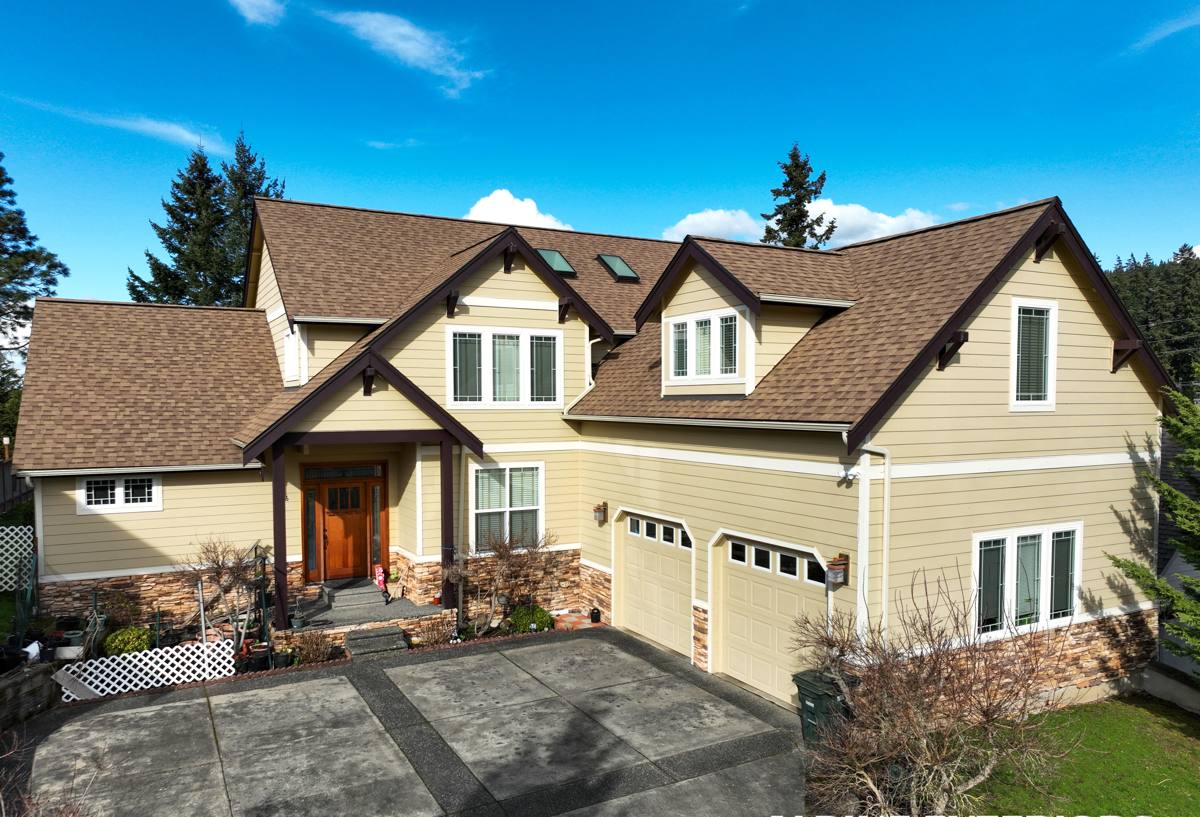
What Salt Air, Rain, and Moss Actually Do to a Wall
Salt Air
Bellingham Bay isn't the ocean, but proximity to saltwater still matters. Airborne salt accelerates corrosion on fasteners, flashing, and any exposed metal trim, and it can leave a fine residue on siding surfaces that holds moisture longer than a dry inland wall would. Over years, that shortens the life of anything not built or finished to resist it.
Driving Rain
Whatcom County rain doesn't just fall straight down — wind off the water pushes it sideways into walls, especially on west- and south-facing elevations. That means water gets tested at every seam, every window trim joint, and every place siding meets a door or deck ledger. A wall system that isn't detailed for wind-driven rain will eventually let water behind the siding, even if the siding material itself is fine.
Moss
Shaded lots, tree cover, and near-constant damp conditions for much of the year make Columbia good moss territory. Moss holds moisture against a surface, and on the wrong material that constant dampness leads to rot, paint failure, or swelling. On the wrong color or texture, it's also just an ongoing cosmetic fight that never really ends.
Why We Standardized on James Hardie for This Kind of Climate
James Hardie fiber cement is engineered specifically for climate zones like ours. The HZ5 product formulation used in the Pacific Northwest is built to resist moisture-related damage — it doesn't swell, delaminate, or rot the way wood-based products can when they stay damp for long stretches. It's also non-combustible, which matters less for moss and more for the region's growing wildfire smoke and ember exposure, but it's a real advantage regardless.
The factory-applied ColorPlus finish is the part that matters most for a home fighting salt air and shade-driven moss growth. It's baked on in a controlled environment rather than field-applied, so it resists fading, chalking, and chipping far better than a job-site paint job — and because it's more UV- and moisture-stable, it holds its color and its seal longer, which means fewer entry points for the moisture that feeds moss and mildew in the first place.
We don't install LP SmartSide, vinyl, Cemplank, Allura, or bare cedar or spruce siding, and in a climate like Columbia's that's not a brand preference — it's a maintenance and moisture-performance decision. Wood-based composite products depend heavily on caulking and field paint to stay sealed, and that seal is exactly what constant rain and shade wear down fastest. Vinyl can hold up fine on moisture but tends to look tired quickly under UV exposure and doesn't offer the same fire performance. We'd rather install one product well than offer several and cut corners on any of them.
Material Comparison for This Climate
| Factor | James Hardie Fiber Cement | Vinyl | Wood-Based Composite (e.g. LP SmartSide) |
|---|---|---|---|
| Moisture/rot resistance | High — cement composition doesn't rot | High, but seams can trap moisture behind panels | Moderate — depends on intact seal and paint |
| Salt air durability | High, especially with factory finish | Moderate — can chalk and become brittle | Moderate — finish wears, exposing wood fiber |
| Moss/mildew resistance | High — non-organic substrate | Moderate | Lower — organic wood fiber base |
| Finish longevity | Factory ColorPlus, long fade resistance | Color molded in, can chalk over time | Field or factory paint, needs recoating |
| Fire performance | Non-combustible | Combustible | Combustible |
| Typical maintenance | Periodic wash, caulk checks | Low, but repairs can be visible | Repainting/resealing on a cycle |
What a Correct Install Looks Like on a Columbia Home
The siding material is only part of the job. Most siding failures we see in wet coastal climates trace back to installation details, not the product itself. On a Columbia home, we pay particular attention to:
- Proper flashing at every window, door, and roofline transition, sized and lapped to shed wind-driven rain rather than just vertical rain
- A drainage plane and rainscreen gap behind the siding so any moisture that does get past the surface can dry out instead of sitting against the wall sheathing
- Correct fastener type and spacing — stainless or coated fasteners rated for coastal exposure, not standard interior-grade hardware
- Manufacturer-spec caulking only at joints that are supposed to be sealed, not as a substitute for proper flashing
- Clearance at grade and at decks/patios so siding isn't sitting in standing water or constant shade-driven dampness
- Trim and butt joints detailed to shed water outward rather than wicking it into the panel edge, which is where fiber cement is most vulnerable if left unsealed
Cut edges and field-trimmed panel ends need factory-matched sealant before installation — this is a step that's easy to rush and is one of the most common places we find problems on homes where someone else did the original install.
Our Process for a Columbia Job
We start with a walk-around of the home to look at drainage, shade patterns, existing moss lines, and any soft or failing trim — that tells us more about what the walls have actually experienced than a spec sheet does. From there we look at what's underneath the current siding once we start tear-off, because sheathing and house wrap condition changes what needs to happen before new siding goes on.
Because we already work this neighborhood, we're familiar with the kind of lot conditions common here — tree cover, proximity to the bay, and the mix of older and newer homes — and we don't need to relearn local permitting or typical construction on every new job. That familiarity shows up in fewer surprises mid-project and a more accurate estimate up front.
Maintenance After Installation
Correctly installed James Hardie siding in this climate is low-maintenance, not no-maintenance. We recommend an annual rinse to knock down surface grime and slow any moss or algae growth before it takes hold, along with a periodic check of caulked joints — caulk is the one component that wears faster than the siding itself and is cheap to stay ahead of. Keep vegetation trimmed back from walls where you can; airflow does more to prevent moss buildup than any cleaning product.
Signs It's Time to Replace Rather Than Patch
- Soft, spongy siding or trim when pressed — usually means moisture has already reached the substrate
- Paint that's peeling or bubbling rather than just fading, which often signals moisture trying to escape from behind the surface
- Persistent moss or dark staining that returns within weeks of cleaning
- Visible gaps, warping, or panels pulling away from the wall
- Rising energy bills alongside drafty walls, which can point to a failing weather barrier behind old siding
Why Hiring Local Experience Matters Here
A siding job in Columbia isn't identical to one a few miles inland. The shade cover, the wind exposure off the bay, and the moisture load are all a step up from a drier, more open lot, and the install details that matter most — flashing laps, rainscreen gaps, fastener choice — are exactly the things that get shortchanged by crews that don't regularly work coastal Whatcom County conditions. A crew that's used to this environment builds in the right details as a matter of habit, not as an afterthought.
If you're weighing a siding replacement on a Columbia home, we're happy to take a look and talk through what your walls are actually dealing with. Reach out for a free, no-pressure estimate using the form below.