 Bellingham Siding
 Why Birch Bay Siding Wears Differently Than Siding Inland
Birch Bay sits right on the water, and that changes what siding has to survive. Homes a few miles inland in Bellingham deal with plenty of rain, but they aren't taking salt-laden wind off the Strait of Georgia day after day. That combination of salt air, driving rain, and near-constant marine moisture is harder on exterior siding than general Whatcom County weather, and it shows up first at the places installers were careless: seams, corners, and anywhere caulk was asked to do a job flashing should have done.
Salt air accelerates corrosion on exposed fasteners and metal trim, and it holds moisture against the wall longer than dry inland air would. Add driving rain that hits siding at an angle instead of falling straight down, and water gets pushed into laps and joints that were never designed to handle it. Then there's the long moss season — Whatcom County's wet, mild winters give moss and algae months to colonize any siding surface that stays damp, and moss holds water against the material even longer, compounding the problem.
None of this means siding in Birch Bay is doomed. It means repairs here have to account for exposure that a general contractor working mostly inland jobs might not think about.
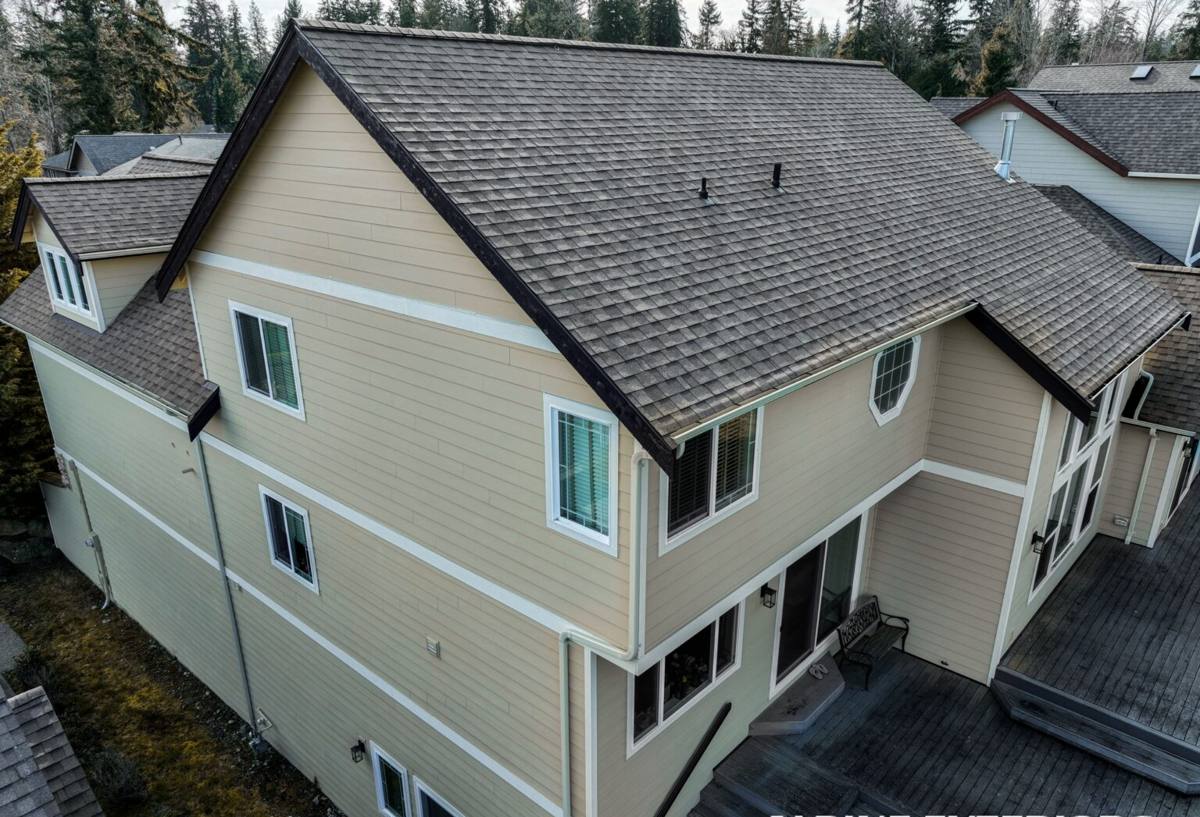
Signs Your Birch Bay Home Needs Siding Repair
Most siding repair calls we get in Birch Bay start with something small the homeowner noticed and didn't want to ignore. That instinct is usually right — small problems on this stretch of coast don't stay small for long.
- Soft or spongy spots when you press on the siding, especially near the bottom courses or around windows
- Visible gaps or separation at seams, corners, or trim boards
- Persistent moss or dark streaking that keeps coming back after cleaning
- Paint that's bubbling, peeling, or failing faster than it should in one area but not others
- Rust streaks below nail heads or metal flashing
- Warped, cupped, or visibly swollen boards
- A musty smell near an exterior wall, or moisture showing up on the interior side of that wall
- Cracked caulk lines that were never replaced after the last recaulk
Any one of these can be a contained, inexpensive fix if it's caught early. Left alone through another wet Whatcom County winter, most of them turn into sheathing and framing repairs, which cost several times more than the siding work alone.
What a Correct Siding Repair Actually Involves
It starts behind the siding, not at it
A repair that only addresses the visible board is a repair that will fail again. Before we touch replacement material, we pull the damaged section and look at what's underneath — the water-resistive barrier, the flashing, the sheathing. If water got behind the siding, something let it in, and that entry point has to be fixed or the new piece will fail the same way the old one did.
Matching the existing product correctly
If your home was originally sided with fiber cement, a proper repair uses fiber cement back — matched in profile, exposure, and as close to color as the existing ColorPlus finish allows. Mixing materials, or patching fiber cement with a different product, creates a seam that behaves differently in the weather and often looks different within a year or two.
Fastening and flashing done to spec
A lot of the failures we see in Birch Bay trace back to fasteners driven at the wrong angle, corner flashing that was skipped to save time, or caulk used in place of proper flashing. We fasten and flash to manufacturer spec, not to whatever was faster on the original install.
Sealing the right joints — and only the right joints
Not every seam should be caulked. Some need to breathe or drain. Sealing the wrong joint can trap water instead of keeping it out. We seal where the manufacturer's install guide calls for it, and leave drainage paths open where they're supposed to stay open.
Repair or Replace? How We Help You Decide
Not every damaged section means the whole wall needs new siding. But sometimes a repair is a temporary patch on a system that's already failing broadly, and it's a disservice to sell that as a fix. Here's how we think through it.
| Factor | Points Toward Repair | Points Toward Replacement |
|---|---|---|
| Extent of damage | Isolated to one or two areas | Spread across multiple walls or elevations |
| Underlying sheathing | Dry and sound once opened up | Soft, delaminated, or water-stained |
| Siding material and age | Sound fiber cement, matchable | Failing wood, vinyl, or old fiber cement near end of life |
| Cause of damage | One identifiable failure point (flashing, caulk, impact) | Systemic issue — original install quality, wrong material for exposure |
| Home's overall exterior condition | Rest of the siding performing well | Other sections already showing similar wear |
We'll tell you honestly which side of that table your home falls on. If a repair will genuinely hold, that's what we recommend — there's no reason to sell a full re-side when a targeted fix does the job.
Why We Repair Using James Hardie Fiber Cement
We only install James Hardie fiber cement siding, and that includes repair work. When we're patching into an existing Hardie wall, we're matching material that was already engineered for this kind of exposure. Hardie's HZ5 product line, in particular, is formulated for the Pacific Northwest's wet climate zones, with moisture and freeze-thaw performance that general-purpose siding wasn't built for.
When we're asked to repair or replace sections of a different material — vinyl, LP SmartSide, cedar, primed spruce — we'll be straight with you about what we're seeing. Vinyl can crack and warp under UV and temperature swings and doesn't hold paint if you ever want to change the color. Engineered wood products depend heavily on unbroken factory sealant to resist moisture, and once that seal is compromised at a cut edge or fastener hole, swelling can spread. Cedar and primed spruce need ongoing maintenance — repainting, resealing — to keep salt air and driving rain from getting into the wood grain. None of these are junk products; they're just not what we've chosen to stand behind, because fiber cement holds up to marine exposure with less maintenance and a stronger track record over the long haul. If your home isn't already Hardie, that's a conversation worth having honestly rather than pretending the material isn't relevant to the repair.
ColorPlus finish and repair matching
One advantage of Hardie's ColorPlus factory finish is consistency — it's baked on at the factory, not field-applied, so a well-matched repair blends far better than trying to match a hand-painted finish years after the original install. We keep current on Hardie's color and product lines so a repair section doesn't stand out like a patch.
Our Process for a Birch Bay Repair
- On-site assessment. We look at the damaged area and open it up enough to see what's happening behind the siding — not just what's visible from the driveway.
- Honest diagnosis. We tell you what caused the failure, whether it's contained, and whether repair or a broader fix is the right call.
- Material match. We source matching Hardie product — profile, exposure, and color — so the repair reads as part of the wall, not a patch on it.
- Correct install. Flashing and fastening to spec, drainage paths preserved, sealant only where it belongs.
- Walkthrough. We show you what we found and what we did before we consider the job finished.
What Happens When Repairs Get Put Off
The reason we push a little on timing for Birch Bay homes specifically is the exposure. A gap or soft spot that would take years to become a real problem in a sheltered inland location can progress much faster this close to the water, especially through a wet Whatcom County winter with wind-driven rain hitting the wall directly. Moisture that gets behind siding and stays there — because salt air keeps things damp longer and moss holds water against the surface — moves from a siding repair to a sheathing repair to, eventually, a framing repair. Each step up costs more and takes longer to fix. Catching it at the siding stage is the cheapest and least disruptive point to deal with it.
Why a Crew That Already Works Birch Bay Matters
Siding repair isn't just carpentry — it's diagnosing why something failed in this specific environment and fixing it so it doesn't fail the same way again. A crew that regularly works Birch Bay and the surrounding Bellingham coastline has already seen how salt air corrodes fasteners, where wind-driven rain tends to find gaps, and how aggressively moss establishes itself on shaded, damp elevations here. That's not something you can fully learn from a general siding background inland — it comes from doing the work in this specific microclimate, repeatedly.
We're a Bellingham-based crew, and Birch Bay is part of our regular service area, not an occasional trip. That means when we tell you a repair will hold, it's based on what we've actually seen hold up — and fail — in homes facing the same wind and water yours does.
Get a Straight Answer on Your Repair
If you're seeing soft spots, gaps, persistent moss, or paint failure on your Birch Bay home's siding, it's worth getting eyes on it before another wet season passes. We'll give you a clear, no-pressure assessment of what's actually going on and what it will take to fix it right — reach out below for a free estimate.