 Bellingham Siding
 Siding Installation in Barkley: A Different Kind of Job
Barkley sits inland from Bellingham Bay, but "inland" in Whatcom County doesn't mean dry. Homes here still take on salt-tinged air carried up from the water on prevailing winds, months of driving rain that comes in sideways more often than straight down, and a moss season that can run from October clear through May. Siding installation in this neighborhood isn't the same job as siding installation in a dry inland climate, and it shouldn't be treated that way. The material, the flashing details, and the drainage plane behind the siding all have to be chosen and built for a marine climate that stays damp for most of the year.
We install siding in Barkley the way we install it everywhere in the Bellingham area: with the assumption that water will find its way to the wall at some point, and the job of the installation is to make sure that water has somewhere to go besides into your sheathing and framing.
What Bellingham's Climate Actually Does to Siding
Salt Air and Coastal Moisture
Bellingham Bay is close enough that airborne salt and moisture reach homes well inland from the water. Salt-laden moisture accelerates corrosion on fasteners, trim, and any metal flashing that isn't rated for coastal exposure, and it keeps siding surfaces damp longer after rain than they would stay in a drier climate. Over years, that constant damp-dry cycle is hard on siding materials that aren't dimensionally stable or that absorb moisture readily.
Driving Rain
Whatcom County storms frequently push rain horizontally, which means water gets driven up under laps, around window and door openings, and into any gap in the building envelope that a calmer climate might never test. Siding that relies on caulk alone to keep water out, rather than proper flashing and a drainage plane, tends to fail first at these pressure-driven entry points.
Moss and Algae Season
Shade, humidity, and mild temperatures make Whatcom County prime territory for moss and algae growth on exterior surfaces, especially on north- and west-facing walls and anywhere tree cover blocks sun and airflow. Moss holds moisture directly against a wall for extended periods, which is a slow but real threat to any siding material that isn't resistant to sustained dampness.
What Correct Installation Involves
A siding job that looks right from the curb can still be wrong underneath. The parts that actually determine how a Barkley home holds up over the next twenty or thirty years are mostly invisible once the job is done.
- Drainage plane and rainscreen gap: a ventilated gap behind the siding lets any moisture that gets past the cladding drain and dry out instead of sitting against the sheathing.
- Weather-resistive barrier, correctly lapped: housewrap or building paper installed shingle-style, top over bottom, so water sheds outward rather than behind the barrier.
- Window and door flashing: proper head, jamb, and sill flashing, integrated with the weather-resistive barrier so water is directed out and away from openings, not trapped behind them.
- Kick-out flashing: at roof-to-wall intersections, to divert roof runoff away from the siding instead of letting it run down the wall face.
- Clearances: siding held roughly 6 inches above grade and 2 inches above roofing, decks, and other horizontal surfaces, so it isn't sitting in standing water or splash-back.
- Fastener placement and nailing pattern: following the manufacturer's specified pattern and fastener type, not a generalized approach, since incorrect nailing is one of the most common causes of early siding failure.
- Sealed cut edges: factory-primed edges get field-sealed at every cut, so exposed material doesn't wick moisture at seams and corners.
Skip any one of these and the siding may look fine for a few years before problems show up as staining, buckling, or soft sheathing underneath. In a climate as wet as Bellingham's, those shortcuts show up sooner rather than later.
Why We Install Only James Hardie Fiber Cement
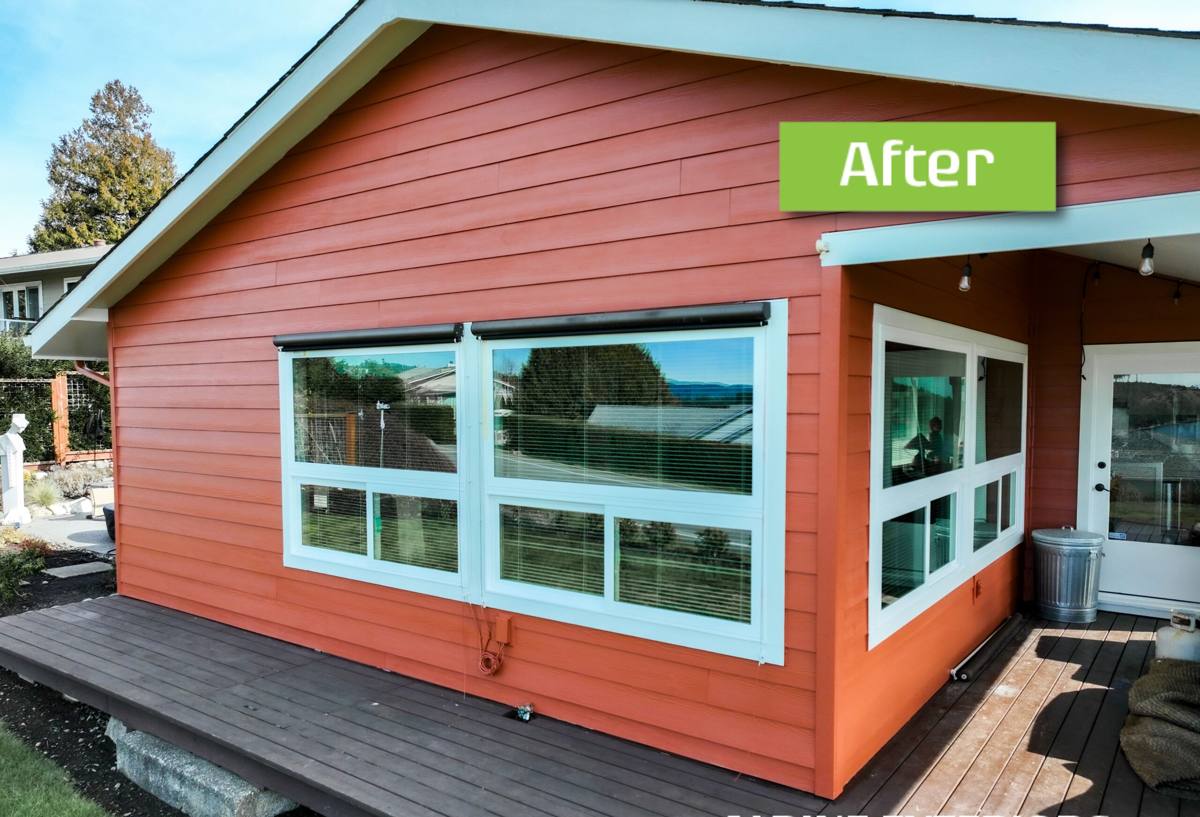
We standardized on James Hardie fiber cement siding for every job we do, including Barkley, and we don't install vinyl, LP SmartSide, Cemplank, Allura, primed spruce, or cedar. That's not a marketing position — it's a decision about what holds up to the specific conditions this region throws at a house year after year.
Fiber cement is non-combustible, dimensionally stable in wet-dry cycling, and doesn't feed moisture into the wall assembly the way wood-based products can if a seal fails. James Hardie's HZ5 product line is engineered specifically for climates with the freeze-thaw and moisture exposure profile of the Pacific Northwest, which is the zone Whatcom County falls into. The ColorPlus factory finish is baked on in a controlled environment rather than field-applied, which matters in a climate where field-painted surfaces get less drying time between rain events and tend to show wear at the finish line sooner.
We're not going to tell you every other product is unusable — vinyl and engineered wood both have legitimate uses and plenty of installed examples around Bellingham. What we will say is that after years of doing this work in this specific climate, we decided fiber cement was the only material we were comfortable standing behind with our own crew and our own name on the job. If you want the fuller comparison of why we passed on vinyl or engineered wood siding specifically, that's covered in more detail elsewhere on our site — this page is about what a correct Hardie installation looks like in Barkley.
Signs Your Barkley Home's Siding Needs Replacing
| What You're Seeing | What It Usually Means |
|---|---|
| Persistent moss or algae staining that returns after cleaning | Wall surface is staying damp longer than it should, often from poor drainage or ventilation behind the siding |
| Soft or spongy spots when pressed | Moisture has reached the sheathing, usually through failed caulk joints or missing flashing |
| Paint or finish failing faster than expected | Field-applied finishes weathering under repeated wet-dry cycling; common on older wood or engineered wood siding |
| Visible buckling, warping, or gaps at seams | Material movement from moisture absorption or incorrect original installation |
| Rust streaks near fasteners or flashing | Hardware not rated for coastal-influenced moisture and salt exposure |
Any one of these on its own might just need a repair. Several at once, especially on a home more than 15-20 years old, usually means it's time to talk about full replacement rather than patching around the edges.
Our Process for a Barkley Siding Installation
- On-site assessment — we look at the existing siding, sheathing condition, drainage detailing, and any trouble spots specific to your home's exposure and shading.
- Tear-off and sheathing check — old siding comes off and we inspect what's underneath before covering it back up, since that's the only chance to catch hidden moisture damage.
- Weather barrier and rainscreen installation — housewrap, flashing, and drainage gap go in before a single piece of Hardie touches the wall.
- Flashing at every penetration — windows, doors, vents, and roof intersections get flashed and integrated with the drainage plane.
- James Hardie siding installation — installed to manufacturer nailing and clearance specifications, in the profile and ColorPlus finish you've chosen.
- Trim, caulking, and final detailing — limited to the joints that should be caulked, not used as a substitute for flashing.
- Final walkthrough — we go over the finished job with you before calling it done.
What Drives Cost on a Barkley Siding Job
| Factor | Why It Matters |
|---|---|
| Home size and number of stories | More square footage and multi-story elevations mean more material, labor, and staging/scaffolding |
| Tear-off vs. installing over existing siding | Full tear-off costs more up front but lets us inspect and correct the sheathing and drainage plane underneath |
| Sheathing or framing repair | Any moisture damage found during tear-off needs to be repaired before new siding goes on |
| Siding profile and trim complexity | Lap width, panel vs. plank, and detailed trim work all affect material and labor time |
| ColorPlus finish selection | Factory-finished color is included in material cost but varies slightly by color and product line |
We give straightforward, honest estimates after seeing the home in person — we don't think broad online price ranges are useful enough to be worth guessing at here, since every Barkley home's exposure, existing condition, and layout is different.
Why It Matters That We Already Work in Barkley
A crew that already does regular work around Bellingham knows what Whatcom County weather does to a wall assembly without having to relearn it on your house. That means recognizing which elevations in Barkley's mix of mature-tree and open-lot properties are going to hold moss longer, knowing how much clearance to leave given the region's rainfall totals, and not treating flashing and drainage details as optional line items to save time. It also means we're a known, findable local business if you ever have a question about your siding five or ten years after installation — not a crew that did one job in the neighborhood and moved on.
Caring for Your New Siding
James Hardie siding installed correctly needs very little upkeep, but a few habits go a long way in this climate:
- Rinse the exterior gently once or twice a year, focusing on shaded or north-facing walls where moss and algae are most likely to take hold
- Keep gutters clean and check that downspouts are directing water away from the foundation and siding base
- Trim back shrubs and tree limbs so siding gets airflow and isn't in constant contact with wet vegetation
- Inspect caulk joints at trim and penetrations every year or two and have any cracked or missing caulk addressed promptly
- Watch for any soft spots, staining, or gaps and have them looked at early rather than waiting
If you're weighing a siding replacement for a home in Barkley, we're happy to take a look and give you a straightforward, no-pressure estimate — no obligation, just an honest read on what your home needs.