 Bellingham Siding
 Window Replacement Built for Lynden's Weather
Lynden sits inland from Bellingham Bay, up in the Nooksack River valley near the Canadian border, and that changes the conversation about windows a little from what you'd have on a house right on the water. You get less direct salt exposure out here, but you make up for it with valley fog that sits low on winter mornings, driving rain that comes sideways off open farmland with nothing to break the wind, and long stretches of damp, gray weather that keep humidity high for months at a time. Whatcom County's climate doesn't punish windows with any single dramatic event — it wears them down slowly, through condensation, wood rot at the sill, and seals that give out a few years before they should.
Older Lynden homes, especially the farmhouses and early-1900s Dutch-heritage houses scattered through town and the surrounding county roads, were often built with single-pane wood windows that were never designed for this kind of sustained moisture load. Newer homes from the last few decades usually have vinyl or aluminum windows that are starting to hit the end of their seal life. Either way, the fix isn't just "put in a new window" — it's understanding why the old one failed and making sure the replacement doesn't fail the same way.
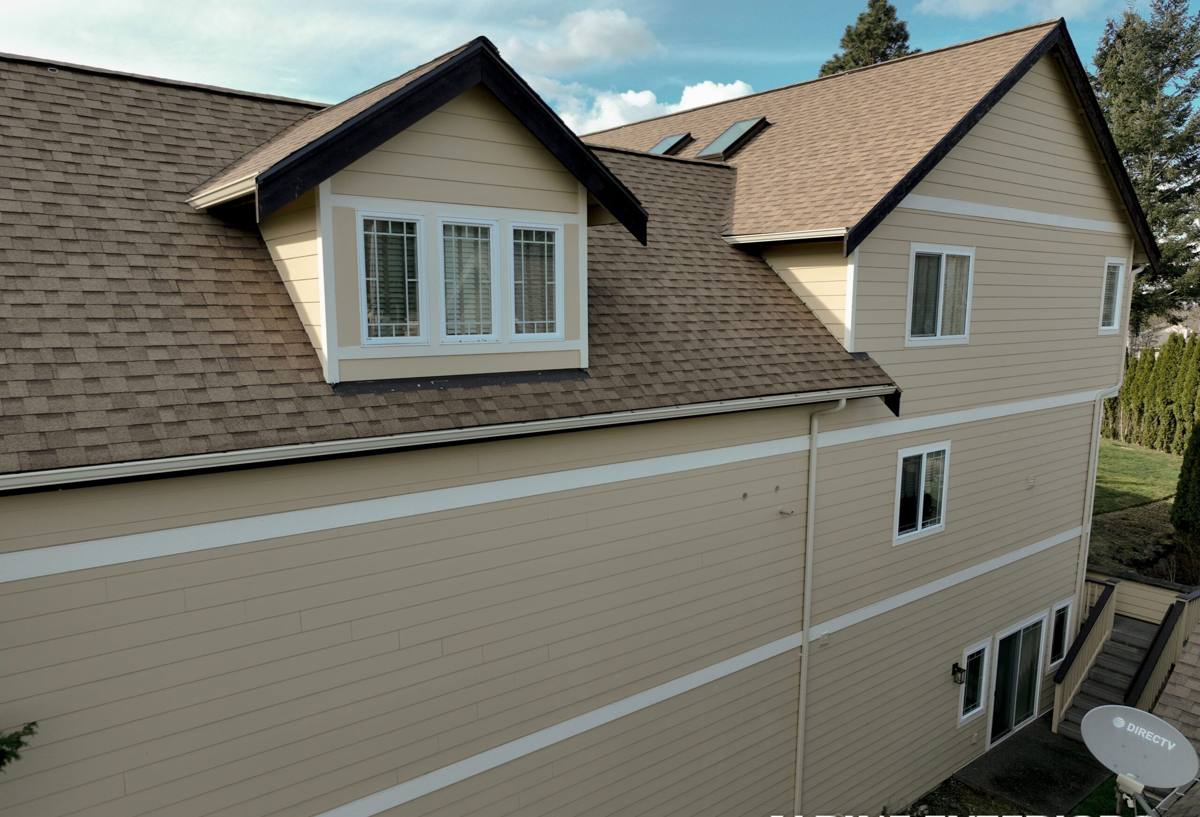
What a Correct Window Replacement Actually Involves
A window that looks right on install day and a window that's still performing in ten years are two different things. The visible part — trim, caulk lines, a clean reveal — is maybe 20% of the job. The part that actually determines whether you get a leak-free window is almost entirely hidden once we're done.
The parts nobody sees
- Sill pan flashing that gives any water that gets past the window a way out, instead of a place to pool and rot the framing
- Proper integration with the existing weather-resistive barrier so water sheds down and out, not behind the siding
- Correct shimming and fastening so the window operates square and the seals aren't stressed from day one
- Insulation in the gap between the window frame and the rough opening — not stuffed so tight it bows the frame, not left hollow so it drafts
- Interior and exterior sealant matched to the substrate, not just whatever caulk is on the truck
Skip any one of these and the window can still look fine for a year or two before the problem shows up as a soft spot on the sill, a musty smell in the wall cavity, or fogging between the panes. In a climate that stays wet as long as this one does, shortcuts here show up faster than they would somewhere drier.
Choosing the Right Window Material
There's no single "best" window — there's a best window for your house, your budget, and how exposed that particular wall is to weather. Here's how the common options actually compare for a place like Lynden:
| Material | Moisture Resistance | Maintenance | Typical Cost Range | Best For |
|---|---|---|---|---|
| Vinyl | Very good — won't rot, minimal expansion issues in our mild temperature swings | Low — occasional cleaning | Lower | Most homes prioritizing value and low upkeep |
| Fiberglass | Excellent — dimensionally stable, handles wet-dry cycling well | Low | Mid to upper | Homes wanting a longer service life and paintable finish |
| Wood-clad | Good on the exterior clad face; interior wood needs protection from condensation | Higher — interior finish needs occasional attention | Upper | Historic or high-end homes where interior wood trim matters |
| Aluminum | Poor thermal performance, prone to condensation in our humidity | Low, but condensation issues are recurring | Lower | Generally not what we recommend for this climate |
We steer most Lynden homeowners toward vinyl or fiberglass. Both handle the freeze-thaw and wet-dry cycling of a Whatcom County winter without the maintenance burden of exposed exterior wood, and both come in energy ratings that make a real difference on a heating bill once the fog rolls in for the season.
Glass packages worth asking about
For this climate, we typically recommend double-pane, low-E glass with argon fill as the baseline — it's a solid balance of cost and performance. Triple-pane adds real value on north-facing walls, rooms over unheated garages, or homes right up against open fields where wind exposure is higher, but it's not always worth the added cost on a sheltered south wall. We'll walk through where triple-pane earns its keep on your specific house rather than upselling it across the board.
Signs a Window Needs Replacing, Not Repairing
Not every window on a Lynden house needs full replacement — sometimes a repair, re-caulk, or hardware fix solves the problem. Here's a quick gut check before you commit to replacement:
- Fogging or moisture trapped between panes (the seal has failed — this isn't cleanable, it's a broken unit)
- Soft or spongy wood at the sill or lower frame corners
- Windows that won't stay open, won't latch, or have visibly warped out of square
- Noticeable draft or cold spot near the frame even with the window closed and locked
- Paint or finish peeling from the inside out — often a sign of moisture working through from the exterior
- Condensation forming on the interior glass regularly, even in a well-ventilated room
If you're only seeing one or two of these on an otherwise sound window, a repair might buy you several more years. If you're seeing several of these across multiple windows, that's usually a sign the whole set is reaching the end of its service life together — which is common, since most homes have windows installed in the same era.
How Our Process Works
- On-site assessment. We look at each window individually — not every window on a house is in the same condition, and we're not going to tell you to replace ones that don't need it.
- Product selection. We talk through material, glass package, and grille style based on your home's age and style, not just what's cheapest or what's on the truck.
- Accurate measurement. Every opening gets measured individually — older homes especially are rarely perfectly square, and a window ordered off a rough estimate is a window that won't seal right.
- Removal and inspection of the opening. Once the old window is out, we check the framing and sheathing underneath for any rot or damage before anything new goes in. This is the point where hidden problems get caught — and fixed — instead of sealed over.
- Installation with proper flashing and sealing. Sill pan, barrier integration, insulation, and sealant done in the right order, every time.
- Cleanup and walkthrough. We confirm every window operates correctly and locks properly before we consider the job done.
Permits and Local Considerations
Straight window replacements that don't change the size of the opening typically don't require a permit, but enlarging an opening, adding an egress window in a bedroom, or working on a designated historic structure can trigger permit requirements through Whatcom County or the City of Lynden depending on where the property sits. We'll tell you upfront if your project needs a permit rather than letting you find out after the fact — it's a straightforward check, and skipping it when it's required just creates problems at resale.
Why a Crew That Already Works Lynden Matters
Lynden isn't Bellingham, and it isn't the coast. It's a smaller, tighter-knit town with its own mix of building stock — century-old farmhouses, mid-century ranch homes, and newer developments on the edges of town — plus a rural layout where jobs are spread across county roads instead of clustered in dense neighborhoods. A crew that regularly works out this way already knows the difference between what a 1920s farmhouse window opening needs versus a 2005 subdivision home, has a feel for how exposed a given wall is based on which direction it faces across open farmland, and isn't learning the local permit process on your project.
That familiarity matters more than it sounds like it should. It means fewer surprises mid-job, a more accurate estimate up front, and a crew that isn't treating your house as their first look at how Lynden weather and Lynden building styles interact.
Get a Straight Answer on Your Windows
If you're not sure whether your windows need full replacement or just some attention, we'll tell you honestly either way. Reach out for a free, no-pressure estimate — we'll look at what you've got, explain what we see, and give you options that fit your home and your budget, not a one-size-fits-all pitch.