 Bellingham Siding
 Why Sunnyland Roofs Wear Differently
Sunnyland sits close enough to Bellingham Bay that salt-laden air is a real factor in how roofing materials age here, not just a talking point. Combine that with the driving rain that comes off the water during fall and winter storms, and a roof in this neighborhood is working harder than a roof in a drier, inland part of Whatcom County. Add a moss season that can run from late fall through spring in a wet Pacific Northwest year, and you've got three separate stresses — salt, wind-driven moisture, and organic growth — all acting on the same roof at the same time.
None of that means Sunnyland homes need exotic solutions. It means roof repair here has to account for how water actually moves across a roof in this climate, not just patch the spot where it's currently showing up inside the house. A repair that ignores moss buildup in a valley, or flashing that's been slowly corroding from salt exposure, tends to fail again within a season or two.
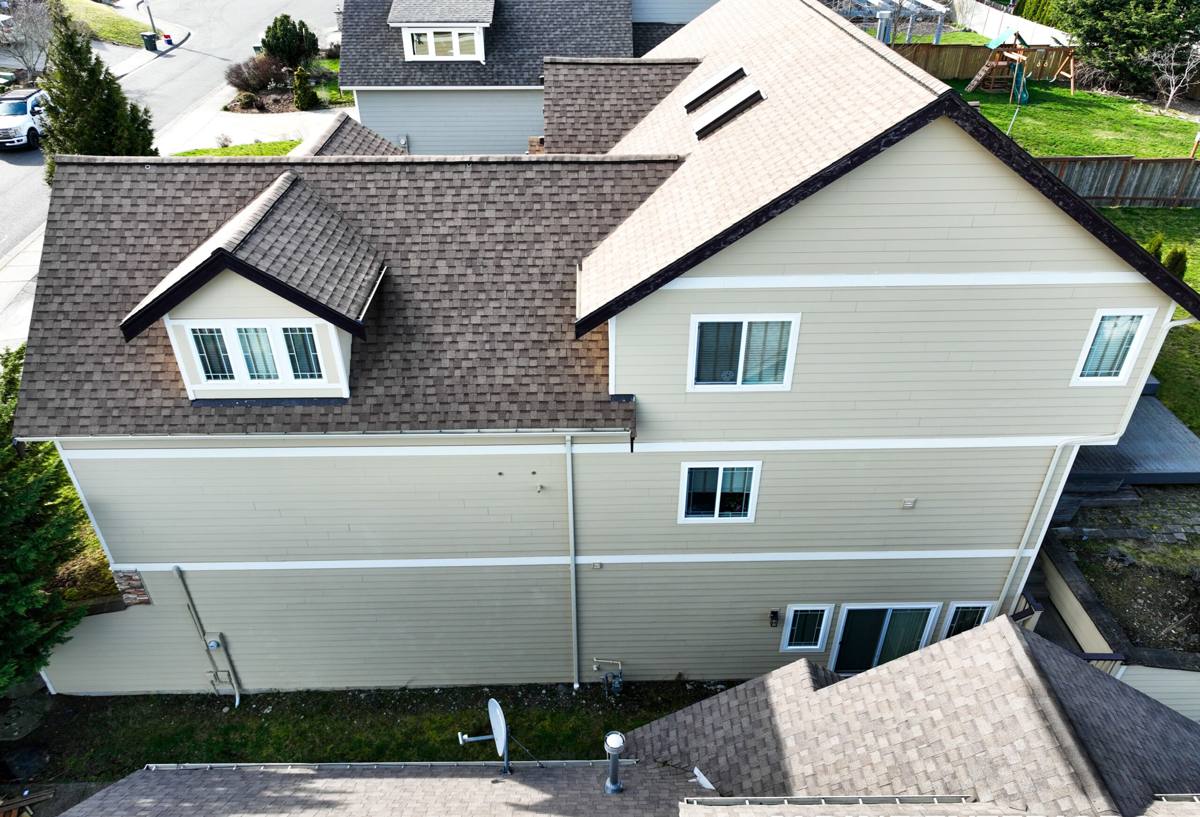
Signs a Sunnyland Roof Needs Repair, Not Just a Look
Most roof problems in this area don't announce themselves with a dramatic leak on day one. They start small and get worse through a wet winter. Homeowners in Sunnyland should treat any of the following as a reason to have the roof looked at, even if nothing is dripping yet:
- Dark streaking or thick moss mats on north-facing slopes or in shaded valleys
- Granules collecting in gutters or at downspout outlets
- Soft or spongy spots when walking the roof (a sign of decking damage underneath)
- Water stains on interior ceilings, especially near chimneys, skylights, or where two rooflines meet
- Curling, cracked, or missing shingles after a windstorm
- Rust streaks or gaps around metal flashing at chimneys, vents, or wall intersections
- Daylight visible through the roof deck from inside an attic
- Ice or heavy moss holding standing water against the surface for days at a time
Any one of these on its own might be minor. Two or three together usually means water has already found a way past the surface layer, and the repair needs to address the underlying cause, not just the symptom.
What a Correct Roof Repair Actually Involves
A roof repair that holds up through a Whatcom County winter is not just swapping a shingle or squeezing in a bead of sealant. Done right, it involves a few distinct steps, and skipping any one of them is usually why a "fixed" roof leaks again the next season.
Finding the Real Source
Water rarely enters where it shows up inside. It can travel along rafters or decking for several feet before dripping through drywall. A proper repair starts by tracing the path back to the actual entry point — often a failed flashing seam, a cracked pipe boot, or a nail that's backed out and left an open hole.
Checking the Decking
Once the surface layer is pulled back, the plywood or plank decking underneath needs to be checked for soft spots, delamination, or rot. Salt air and prolonged moisture exposure accelerate this kind of decay. Replacing damaged decking before re-covering it is not optional — laying new shingles over compromised wood just hides the problem for a little while.
Flashing and Transitions
The majority of roof leaks in this region start at a transition point: chimney, skylight, wall step-flashing, or a valley where two roof planes meet. These are the areas most exposed to driving rain and most likely to show early corrosion from salt exposure. A repair that doesn't address flashing condition is treating a symptom, not the cause.
Matching Materials
Where shingles are being replaced rather than the whole slope redone, matching the existing material in weight, profile, and as close to color as reasonably possible keeps the repair from standing out and keeps the roof's water-shedding pattern consistent.
Common Repair Types We See in Sunnyland
Every roof is different, but certain repair categories come up again and again in this neighborhood. Rough cost ranges below are for general orientation only — actual pricing depends on roof pitch, access, material, and extent of hidden damage found once we're up there.
| Repair Type | Typical Cause in This Climate | General Cost Range |
|---|---|---|
| Flashing repair/replacement | Salt-air corrosion, sealant breakdown at chimneys and valleys | Low to moderate |
| Localized shingle replacement | Wind damage, granule loss, isolated wear | Low |
| Decking repair | Prolonged moisture intrusion, hidden rot | Moderate to higher |
| Moss and debris removal with treatment | Long moss season, shaded north-facing slopes | Low |
| Valley or pipe boot resealing | UV and moisture cycling breaking down old sealant | Low |
Decking repair is usually the largest jump in cost because it's the one category where the real scope isn't known until the old roofing is pulled back. We always show a homeowner what we find before proceeding, rather than assuming the worst up front.
Our Roof Repair Process
- On-site inspection. We walk the roof (weather permitting) and check the attic from inside, looking for the actual water path rather than just the visible symptom.
- Written scope and estimate. Before any work starts, you get a clear explanation of what's damaged, what's causing it, and what it will take to fix — with photos where useful.
- Repair. Damaged decking, flashing, and roofing material are replaced to match the surrounding roof as closely as possible.
- Moss and debris clearing. If moss or built-up debris contributed to the failure, we clear it as part of the job so the repair isn't undermined again within a season.
- Final check. We confirm the repair area sheds water correctly and walk you through what we did and why.
Repair vs. Replacement — How We Decide
Not every roof problem calls for a full replacement, and not every leak can be permanently fixed with a patch. We look at the roof as a whole before recommending either path.
| Factor | Repair Usually Makes Sense | Replacement Usually Makes Sense |
|---|---|---|
| Roof age | Well within expected material lifespan | Nearing or past the end of its service life |
| Damage extent | Isolated to one section or detail | Widespread across multiple slopes |
| Decking condition | Sound, no rot found | Significant rot or repeated water damage |
| Number of past repairs | First or second issue on this roof | Recurring leaks in different spots year after year |
| Underlayment condition | Still intact and functional | Failing broadly, not just at the leak point |
We'll always tell you honestly if a repair is a reasonable near-term fix versus a stopgap on a roof that's genuinely at the end of its life. A repair that's likely to fail again within a year or two isn't a good use of your money, and we'll say so.
Materials and Why We Use What We Use
Most Sunnyland roofs are composition (asphalt) shingle, and for repair work, matching that existing material is almost always the right call — it keeps the roof performing as a consistent system rather than mixing materials with different expansion rates, water-shedding behavior, or aging patterns. For flashing, we favor corrosion-resistant metal appropriate to salt-air exposure, and we're careful with sealant choice, since lower-grade sealants break down faster under the UV and moisture cycling typical of a Whatcom County winter-to-summer swing.
Where a homeowner is considering a different roofing product for a future full replacement, we're glad to walk through the honest trade-offs — installation sensitivity, long-term maintenance, moisture behavior, and warranty structure — rather than just recommending whatever's easiest to install. That conversation belongs with a replacement estimate, but it's worth mentioning here because a repair strategy today should account for what the roof's long-term plan looks like.
Moss: A Long-Term Maintenance Note, Not Just a Repair Item
Because Bellingham's moss season runs long, moss control is one of the few maintenance items that genuinely prevents future repair calls rather than just addressing a current one. Moss holds moisture against the roof surface, lifts shingle edges as it grows, and shades the surface in ways that slow drying after every rain. Left unaddressed, it turns a roof that would otherwise last its full expected lifespan into one needing repairs years early.
We recommend periodic moss and debris clearing as routine maintenance for Sunnyland homes — not as an upsell, but because it genuinely changes how often you need repair work in the first place. Zinc or copper strips at the ridge can help slow regrowth on shaded slopes, though they work best as one part of a maintenance routine rather than a standalone fix.
Why a Crew That Already Works Sunnyland Matters
Roofing crews who work regularly in this specific part of Bellingham know which details tend to fail first in this microclimate — the flashing style that holds up better against salt air, the valley design that sheds moss-laden runoff instead of trapping it, and the local permitting expectations for roof work in Whatcom County. That local familiarity translates into fewer surprises during a repair and a more accurate first estimate, because we're not learning the neighborhood's roofing quirks on your job.
It also means we're accountable locally. We're not a crew passing through — if a repair doesn't hold up the way it should, we're a short drive away, not a phone number that stops answering after the invoice is paid.
Get a Straightforward Look at Your Roof
If you're seeing any of the warning signs above, or it's just been a while since your Sunnyland roof was checked, we're happy to come take a look. The estimate is free, there's no pressure attached to it, and you'll get a plain-English explanation of what we find and what we'd recommend — repair or otherwise.