 Bellingham Siding
 Decking Built for Sudden Valley's Conditions
Sudden Valley sits on the south shore of Lake Whatcom, and that location shapes everything about how a deck ages out here. Tree cover is heavy, humidity lingers longer than it does on more open lots closer to town, and a lot of homes back up to slopes or wooded buffers that keep decks shaded well into the afternoon. Add in Whatcom County's long wet season and the moss and algae pressure that comes with it, and you've got a set of conditions that punishes the wrong decking choice fast. We've built and replaced decks throughout this neighborhood, and the pattern is consistent: whatever goes on the deck needs to handle standing moisture, resist organic growth without constant scrubbing, and hold its footing on framing that's often working harder than it looks.
This page is about composite decking specifically for Sudden Valley homes — what the climate demands, what a correct installation actually involves, and why local experience with this exact neighborhood matters more than it would in a drier, more exposed part of the county.
Why Composite Makes Sense Here
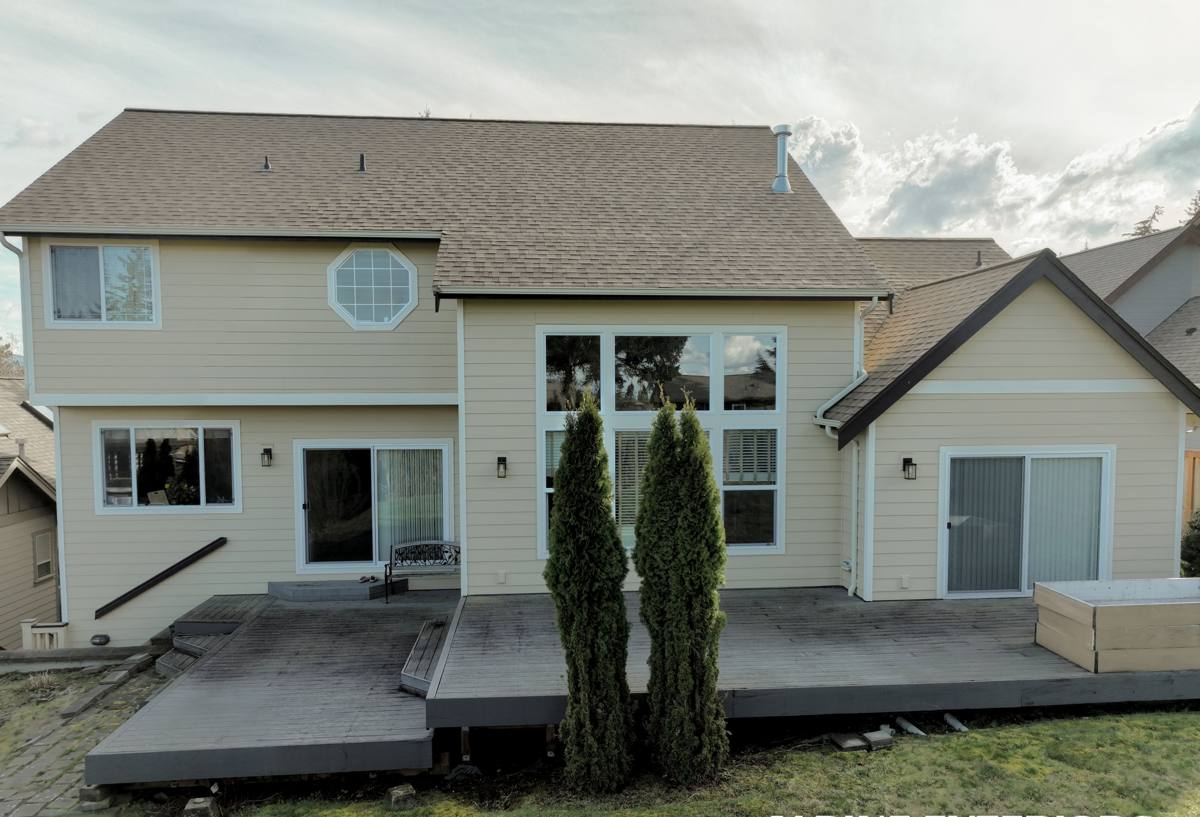
Wood decking isn't a bad product — it's a maintenance product. In a shaded, moisture-retentive setting like Sudden Valley, that maintenance schedule gets tighter than most homeowners want to keep up with: annual cleaning, periodic sealing, and watching for the graying, splintering, and moss colonization that comes from boards that don't dry out between rains. Composite decking was developed largely to solve exactly this problem. It doesn't absorb water the way wood fibers do, it doesn't need yearly staining, and its surface resists the kind of organic growth that turns a shaded deck green by midsummer.
That doesn't mean composite is maintenance-free — we're straight with every customer about that. It still needs regular cleaning to stay ahead of pollen, needles, and surface algae, especially under a tree canopy. But the difference is the type of maintenance: rinsing and occasional scrubbing instead of sanding, stripping, and re-sealing.
What Salt Air and Driving Rain Do to a Deck
Bellingham's marine climate brings wind-driven rain that gets under fascia boards, into end-grain cuts, and around fastener heads if a deck isn't detailed correctly. Salt-laden air off the Sound accelerates corrosion on lower-grade hardware faster than most homeowners expect. Composite boards themselves aren't vulnerable to this the way wood is, but the fasteners, joist tape, flashing, and structural framing underneath absolutely are — which is why the hidden parts of the job matter as much as the decking material itself.
What a Correct Installation Involves
A composite deck is only as good as what's under it. We see failures in this area that trace back to shortcuts in the framing and moisture management, not the decking boards themselves. Here's what we consider non-negotiable on every job:
- Pressure-treated framing rated for ground contact where it's close to grade, sized and spaced to the composite manufacturer's span tables — composite flexes differently than wood and needs tighter joist spacing in most cases
- Joist tape over all framing to stop water intrusion at the fastener line, which is where rot starts first
- Proper flashing at the ledger board where the deck meets the house — this is the single most common point of hidden water damage on older Sudden Valley decks we've opened up
- Hidden fastener systems or coated screws rated for composite, not standard deck screws that can react with the board material or corrode in salt air
- Grading and drainage under the deck so water has somewhere to go, especially on the sloped lots common in this neighborhood
- Ventilation gaps between boards and around the perimeter so the structure can dry out between rain events
Skip any of these and you can still end up with a deck that looks fine on top while the framing underneath is failing — which defeats the entire point of upgrading to composite in the first place.
Choosing the Right Composite Product
Not all composite decking is built the same way, and the right choice depends on budget, sun exposure, and how much of a wood look you want to keep. We walk homeowners through the real trade-offs rather than pushing one line:
| Factor | Capped Composite | Uncapped Composite | PVC Decking |
|---|---|---|---|
| Moisture resistance | Very good — protective shell resists staining and swelling | Fair — more prone to moisture absorption over time | Excellent — no wood fiber content |
| Moss/algae resistance | Good with regular rinsing | Weaker, especially in full shade | Very good |
| Appearance | Realistic wood-grain look | Wood-grain look, fades faster | More uniform, less wood-like |
| Relative cost | Mid-range | Lower upfront cost | Higher upfront cost |
| Best fit for shaded lots | Strong fit | Workable with more upkeep | Strong fit |
For most of the shaded, moisture-heavy lots we see in Sudden Valley, capped composite is the sweet spot between cost and long-term performance. On decks that get almost no direct sun for most of the day, we sometimes steer homeowners toward PVC instead, simply because it handles constant damp conditions with the least fuss. We'll always give you our honest read on your specific lot rather than a one-size answer.
A Note on Warranty Structure
Composite manufacturers typically offer strong material warranties, but those warranties usually require installation according to their specifications — correct joist spacing, approved fasteners, proper ventilation. An installer who doesn't follow the manufacturer's install guide can void that warranty even if the product itself is fine. This is one more reason the installation details matter as much as the material choice.
Substructure and Site Considerations Specific to Sudden Valley
Several things come up repeatedly on decks in this neighborhood:
Slope and Elevation
A lot of lots here are built on grade changes near the lake basin, which means deck framing often needs additional footings or engineered support rather than a simple ledger-and-post setup. We check this on every quote — it affects both cost and timeline.
Tree Cover and Debris
Heavy tree canopy means needles, cones, and leaf debris collect between boards and in corners. We factor board spacing and drainage design around this, and we talk to homeowners about realistic seasonal cleaning expectations rather than promising a set-it-and-forget-it surface.
Access for Older Decks
Many homes in this area have decks original to construction. When we replace one, we open up the framing to check for hidden rot before we ever set a new board — this is standard practice for us, not an upsell.
Our Process
- On-site assessment — we inspect the existing deck or build site, check framing condition, grade, and sun/shade exposure, and take real measurements
- Material walkthrough — we go over composite options with actual samples so you can see color and texture in your own lighting, not a screen
- Written estimate — clear scope, material selection, and a straightforward price range with no vague allowances
- Framing and structural work — including any footing, ledger, or flashing corrections needed before decking goes down
- Composite installation — manufacturer-spec fastening, spacing, and ventilation
- Final walkthrough — we go over care and cleaning expectations specific to your lot's sun and tree exposure
Why a Local Crew Matters for This Neighborhood
Sudden Valley isn't a generic Bellingham lot. The combination of lake-basin humidity, slope, tree cover, and access considerations means a crew that hasn't worked this specific area can miss things — under-sizing footings for a sloped yard, missing a flashing detail that matters more here than on a drier lot across town, or recommending a decking product that looks fine on a spec sheet but struggles under constant shade. We've done deck work throughout Whatcom County and specifically in this community, and that experience shapes every recommendation we make, from framing details to which composite line actually holds up under your trees.
What to Check Before You Hire
- Do they inspect and open up existing framing before quoting a replacement, or just measure the surface?
- Do they follow the composite manufacturer's span and fastener specifications, or use standard wood-deck spacing?
- Do they detail ledger flashing and joist tape as standard practice, not an add-on?
- Can they explain the trade-offs between capped composite, uncapped composite, and PVC in plain terms?
- Are they licensed, insured, and willing to put the scope of work in writing?
- Do they have direct experience with sloped, shaded lots like the ones common around Lake Whatcom?
If you're planning a new deck or replacing an aging one in Sudden Valley, we're glad to take a look and give you a straight, no-pressure estimate — what your lot actually needs, what it'll cost, and why. Reach out through the form below to get started.