 Bellingham Siding
 Birch Bay Roofs Take a Different Kind of Beating
Birch Bay sits right on the water, and that changes what a roof has to survive compared to a house a few miles inland in Bellingham. Wind off the Salish Sea hits these roofs with fewer trees and buildings to break it up, driving rain sideways under shingle edges that would stay dry elsewhere, and carrying fine salt spray that settles on every exposed surface. Add in Whatcom County's long, wet moss season, and you've got three separate forces working against the same roof at the same time: wind, water, and slow corrosion.
None of that means Birch Bay roofs fail faster by default. It means storm damage here often looks different than storm damage inland, and a repair that doesn't account for the coastal exposure tends to fail again within a season or two. We've repaired enough roofs along this stretch of coast to know which failure patterns show up here specifically, and we build every repair around them instead of treating Birch Bay like any other Whatcom County neighborhood.
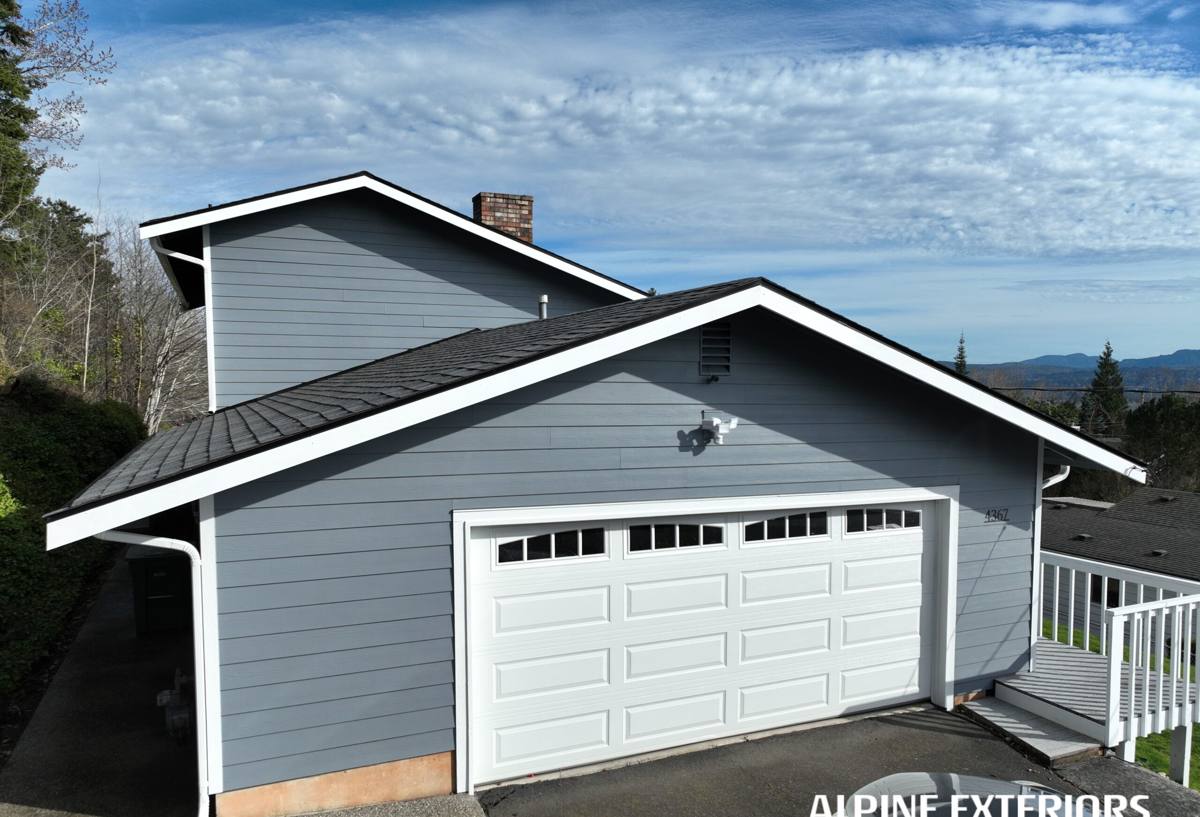
How Storm Damage Actually Shows Up Here
After a windstorm or a hard rain event, damage isn't always as obvious as missing shingles scattered across the yard. Some of the most costly problems start small and stay hidden until they've soaked into decking or framing. Walk your roofline and gutters after any significant storm and look for:
- Shingles that are lifted, curled, or creased but still attached — a sign of wind uplift that will get worse with the next storm
- Granules collecting in gutters or at downspout outlets, which points to shingle wear accelerated by wind and salt exposure
- Flashing around chimneys, vents, and roof-to-wall transitions that looks bent, lifted, or corroded
- Soft or discolored ceiling patches inside the home, especially near exterior walls or skylights
- Moss or dark streaking concentrated on the north- or shade-facing slopes
- Fasteners or nail heads that have started to rust or back out of the decking
- Debris, branches, or sand and grit buildup in valleys where water is supposed to flow freely
Any one of these on its own might not be an emergency. Several at once, or any sign of active water intrusion inside the house, means it's time for an inspection before the next weather system comes through.
Salt Air, Rain, and Moss: Three Problems, One Roof
Salt Air and Metal Fatigue
Salt-laden air corrodes exposed metal faster than it does a few miles inland — fasteners, flashing, and vent stacks are the first components to show it. A repair that reuses corroded flashing or standard fasteners because they look "close enough" is a repair that will need to be redone sooner than it should.
Driving Rain and Wind-Driven Water
Storms coming off the water don't just drop rain straight down — they push it sideways and up under shingle laps, especially at eaves, rakes, and low-slope transitions. Underlayment and ice-and-water membrane at these vulnerable points matter more here than on a sheltered inland roof.
Moss and Moisture Retention
Whatcom County's mild, wet winters give moss a long growing season. Moss holds moisture against the roof surface, works its way under shingle tabs, and can lift edges just enough for wind to finish the job during the next storm. A roof that already has heavy moss growth going into storm season is at higher risk of wind damage, not just cosmetic wear.
Patch Job vs. Proper Storm Repair
After a storm, it's tempting to go with whoever can slap a tarp up fastest and call it fixed. The difference between a quick patch and a correctly done repair usually isn't visible from the ground — it shows up two winters later.
| Step | Quick Patch Approach | Proper Storm Repair |
|---|---|---|
| Damage assessment | Visual check of the obvious damage only | Full roof inspection, including flashing, decking, and adjacent slopes |
| Shingle replacement | New shingles set over existing nail holes and old sealant | Damaged area cleared back to sound material, new underlayment where needed |
| Flashing | Reused if it "still looks fine" | Replaced if corroded, bent, or undersized for the exposure |
| Fasteners | Whatever's on the truck | Corrosion-resistant fasteners rated for coastal exposure |
| Decking check | Skipped unless visibly rotted | Probed and replaced if soft from prior water intrusion |
| Documentation | None | Photos and notes for insurance and future reference |
Both approaches can look identical from the driveway. Only one of them holds up through the next few storm seasons.
Emergency Tarping and Temporary Protection
When a storm has opened up a section of roof, the first priority isn't the permanent repair — it's stopping active water intrusion before it reaches the decking, insulation, or ceiling below. A proper temporary tarp job means:
- Covering well beyond the damaged area, not just the visible hole
- Securing the tarp with battens or fasteners that won't tear loose in the next wind event
- Directing water off the tarp and away from any remaining vulnerable seams
- Checking attic or ceiling areas below for water that may have already gotten in before the tarp went up
A rushed or undersized tarp job is one of the most common reasons a storm claim turns into a mold or rot problem weeks later. If you're waiting on an insurance adjuster or a repair scheduling window, the tarp needs to be right, not just fast.
The Inspection and Insurance Claim Process
Most storm damage repairs in this area involve an insurance claim, and the process goes smoother when the paperwork and the roof work line up. Our process typically runs:
- On-site inspection to document the damage — photos, measurements, and a written scope
- A conversation about whether the damage is likely to be covered and what the claim process usually involves
- Temporary protection (tarping) if the roof is actively leaking, done before any claim paperwork is finalized
- Coordination with your adjuster if requested, including being present for the adjuster's visit
- A written repair estimate broken out by scope, so you know exactly what's being replaced and why
- The repair itself, followed by a final walkthrough
We're not an insurance company and we don't promise claim outcomes — that's between you and your carrier. What we can do is document the damage accurately and make sure the scope reflects what the roof actually needs, not just what's easiest to write up.
Materials That Actually Hold Up on This Coastline
Not every roofing product performs the same way a few hundred feet from saltwater. When we're repairing storm damage in Birch Bay, material choice matters as much as workmanship.
| Component | Standard Choice | Better for Birch Bay's Exposure |
|---|---|---|
| Fasteners | Standard galvanized | Stainless or hot-dip galvanized rated for coastal/marine exposure |
| Flashing | Basic aluminum | Heavier-gauge or corrosion-resistant flashing at all penetrations |
| Shingles | Standard architectural shingle | Algae-resistant shingle rated for the region's moisture and moss exposure |
| Underlayment | Standard felt | Synthetic underlayment with ice-and-water membrane at eaves and valleys |
| Ventilation | Minimal or blocked vents | Balanced intake and exhaust ventilation to reduce trapped moisture |
None of these upgrades are about chasing the most expensive option — they're about matching the material to the actual conditions the roof sits in. A fastener that's fine on a sheltered inland roof isn't necessarily the right call fifty yards from the bay.
What Storm Damage Means for Your Siding and Trim Too
Wind that's strong enough to lift shingles or tear flashing loose is often strong enough to affect siding, fascia, and soffits at the same time, especially on the windward side of the house. Driving rain that finds a gap in roof flashing frequently shows up as staining or rot at the top of the wall below it before it's ever noticed on the roof itself. When we inspect storm damage, we look at where the roof meets the walls — not just the roof in isolation — because that's usually where water actually gets into a house.
Why Local Experience in Birch Bay Matters
A contractor who mostly works sheltered inland neighborhoods and only occasionally comes out to the coast doesn't always know which details matter here. Storm patterns off the water, the specific corrosion issues that come with salt exposure, and the moss cycle that runs longer on this coastline than it does even a few miles inland — those are things you learn from doing the work here repeatedly, not from a general roofing checklist. We work throughout Whatcom County, including Bellingham and the surrounding coastal communities, and we treat Birch Bay's exposure as a factor in every repair, not an afterthought.
If your roof took a hit in the last storm, or you want it checked before the next one rolls in, we're happy to come out, walk the roof, and give you a straight answer about what it actually needs — no pressure, no inflated scope. Reach out for a free estimate using the form below.