 Bellingham Siding
 Why Sehome's Climate Is Hard on Siding
Sehome sits on a wooded hillside in central Bellingham, close enough to Bellingham Bay to catch the salt-laden air that moves in off the Salish Sea, and shaded enough by mature tree canopy near Sehome Hill Arboretum that many homes never get a full day of direct sun on their north and east walls. That combination is tough on exterior materials. Salt air speeds up corrosion on fasteners, trim, and finishes. Tree cover holds moisture against siding long after a storm has passed. And Whatcom County's wet season — which can run seven or eight months out of the year — means siding here spends most of its life damp, not dry.
Add in the driving rain that comes with fall and winter storms off the water, and you get an environment where siding doesn't just get dirty, it gets worked. Paint fails early. Moss and algae take hold on shaded walls and keep coming back after a wash. Wood-based products swell, crack, and rot from the inside before problems ever show on the surface. None of this is unique to any one street in Sehome — it's the reality of building on a wooded slope in a marine climate, and it's the starting point for every siding decision we make on homes here.
Signs a Sehome Home's Siding Has Reached the End
Most homeowners call us after noticing one or two of these, not because they've read a maintenance manual — but taken together, this list is a good gut check for whether you're looking at a repair or a full replacement.
- Boards that feel soft, spongy, or give slightly when pressed near the bottom edges or around windows
- Paint that's peeling, bubbling, or needing a repaint every two to three years instead of every seven to ten
- Moss or dark staining on shaded walls that returns within a season or two of cleaning
- Visible gaps opening up at seams, corners, or butt joints
- Panels that are warping, cupping, or separating slightly from the wall
- A noticeable jump in heating bills, which can point to wet, compromised insulation behind the siding
- Siding that sounds hollow or crumbles when tapped near the ground line
Any one of these on its own might be a repair. Several at once, especially combined with visible rot at trim or corner boards, usually means the water has been getting behind the siding for a while — and that's a replacement conversation, not a caulk-and-patch job.
What We Install Instead, and Why
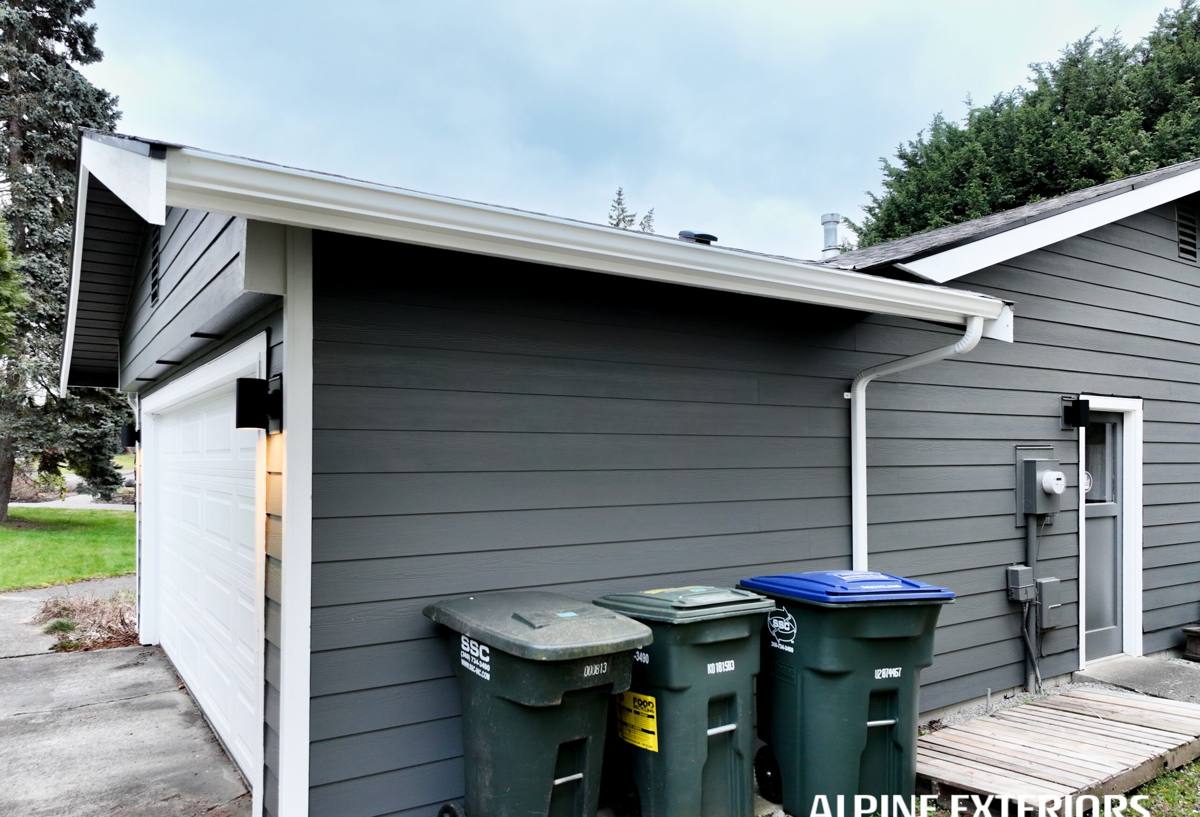
We install James Hardie fiber cement siding exclusively. We don't install vinyl, LP SmartSide, Cemplank, Allura, primed spruce, or cedar. That's a deliberate standard, not a lack of options.
Vinyl is inexpensive and low-maintenance in mild, dry climates, but it expands and contracts with temperature swings, can crack in impact, and doesn't hold paint if a homeowner ever wants a different look down the road. Wood products like cedar and primed spruce look great fresh off the truck, but they need real upkeep — recoating, caulking, and vigilant moisture management — to survive a climate as wet as this one, and Sehome's tree cover makes that upkeep even more demanding. Engineered wood products such as LP SmartSide perform reasonably well when installation is flawless, but they're sensitive to exactly the kind of prolonged moisture exposure this region delivers, and the margin for installation error is thinner than most homeowners realize.
James Hardie's fiber cement is non-combustible, dimensionally stable, and factory-finished with their ColorPlus coating, which holds color far longer than field-applied paint and cuts down on the repainting cycle that's such a headache in a marine climate. Hardie also engineers specific product lines by climate zone — the HZ5 formulation is built for regions with freeze-thaw cycling and sustained moisture, which describes Whatcom County well. It's backed by a strong, transferable manufacturer warranty when installed to spec, which matters most in exactly the conditions Sehome sees.
What a Correct Installation Actually Involves
Fiber cement siding is only as good as the installation behind it. Most of the siding failures we get called out to inspect trace back to shortcuts taken during install, not a flaw in the material itself.
Full Tear-Off, Not an Overlay
We don't install new siding over old. Siding over siding traps whatever moisture and damage is already in the wall, and it makes it impossible to inspect the sheathing and weather-resistant barrier underneath — which is exactly where problems hide in a climate this wet.
Weather-Resistant Barrier and Flashing
Once the old siding is off, we inspect the sheathing and house wrap for rot or compromised sections, repair or replace as needed, and pay close attention to flashing at every window, door, roofline, and deck ledger. Flashing failures at these transition points are the single most common cause of hidden rot we find in older Bellingham-area homes, and they're the detail that separates a job that lasts twenty-plus years from one that fails in five.
Fastening and Clearances to Spec
James Hardie publishes specific fastening patterns, nail penetration depths, and minimum clearances from grade, roof lines, and decks. Those clearances exist to keep water from wicking up into the bottom edge of the siding — a real risk on shaded, damp lots — and skipping them is one of the fastest ways to void the manufacturer warranty and create a callback.
Our Process, Start to Finish
- Free on-site walk-through — we look at your current siding, trim, and any visible moisture damage, and talk through what you want out of the replacement.
- Written estimate — a clear scope of work, product line, and color options, no vague allowances.
- Permitting — we handle the City of Bellingham permit requirements for the project before work starts.
- Tear-off and inspection — old siding comes off, sheathing and framing get inspected, and we talk to you directly before any rot repair proceeds so there are no surprise change orders.
- Weather barrier and flashing — repaired or new WRB, correctly lapped and taped, with flashing detailed at every penetration and transition.
- Hardie installation — siding installed to manufacturer fastening and clearance specifications.
- Trim, caulking, and final walkthrough — finish details completed and reviewed with you on-site before we call the job done.
What Drives the Cost of a Siding Replacement
Every home is different, but these are the main factors that move the price on a Sehome siding replacement job. We give exact numbers only after a walk-through — broad ranges before that aren't useful to you.
| Factor | Why It Matters | Sehome-Specific Note |
|---|---|---|
| Home size and wall complexity | More square footage and more corners, gables, and dormers mean more material and labor | Common on the mix of older and newer homes in the neighborhood |
| Substrate condition | Rotted sheathing or framing found during tear-off has to be repaired before new siding goes on | More likely on older homes with a long history of shaded, damp walls |
| Access and lot slope | Steep or sloped lots need more staging, scaffolding, or ladder work | Relevant on Sehome's hillside terrain |
| Product line and profile | Lap siding, shingle-style panels, and trim board choices carry different material costs | Homeowner preference, no climate constraint either way |
| Trim and detail work | Window and door trim, corner boards, and fascia detailing add labor time | Older homes often have more original trim detail to match or replace |
Why a Crew That Already Works in Sehome Matters
Siding contractors who mostly work outside Whatcom County have to relearn local permitting, inspection expectations, and typical construction details every time they take on a job here. A crew that already works in and around Bellingham doesn't lose time on that learning curve — we know the City's permit process, we know what inspectors here are looking for, and we've seen how this specific climate treats siding on hillside, tree-covered lots like the ones common in Sehome.
There's also a practical side to it: being local means faster response if you have a question mid-project or a small punch-list item after the crew has moved on, without waiting on a contractor who has to drive in from out of the county.
What to Expect After Installation
Correctly installed Hardie siding is genuinely low-maintenance, but "low-maintenance" isn't "no-maintenance," especially in a climate that stays wet as long as this one does.
- Rinse the siding once or twice a year with a garden hose to keep moss and pollen from building up, especially on shaded walls
- Inspect caulking at trim and penetrations annually and touch up as needed
- Avoid pressure washing directly at the siding seams — it can force water behind the panels
- Keep gutters clear so water isn't sheeting down the wall face during heavy rain
- Trim back vegetation and tree limbs that are keeping any section of the wall in constant shade or contact
If you're seeing early signs of wear on your current siding, or you're just planning ahead for a home in Sehome, we're happy to come take a look. The estimate is free, there's no pressure, and you'll get a straight answer about whether you're looking at a repair or a replacement.