 Bellingham Siding
 Siding Repair in South Hill: A Different Kind of Job Than Downtown or the Waterfront
South Hill is one of Bellingham's oldest, most established neighborhoods, and that shows in its housing stock. Mature trees, hillside lots, and a mix of early-and-mid-century homes with newer infill mean siding here ages differently than it does on a flat, open lot across town. Shade and elevation change how fast siding dries out after a storm, and that single factor drives most of the repair calls we get in this part of Bellingham.
Siding repair sounds like a simple job — patch a crack, replace a board, caulk a gap — but done wrong, a "repair" just delays a bigger problem and hides it behind fresh paint. Done right, it stops water intrusion at the source and buys the rest of your siding real years of life. This page is about what that looks like specifically for South Hill homes.
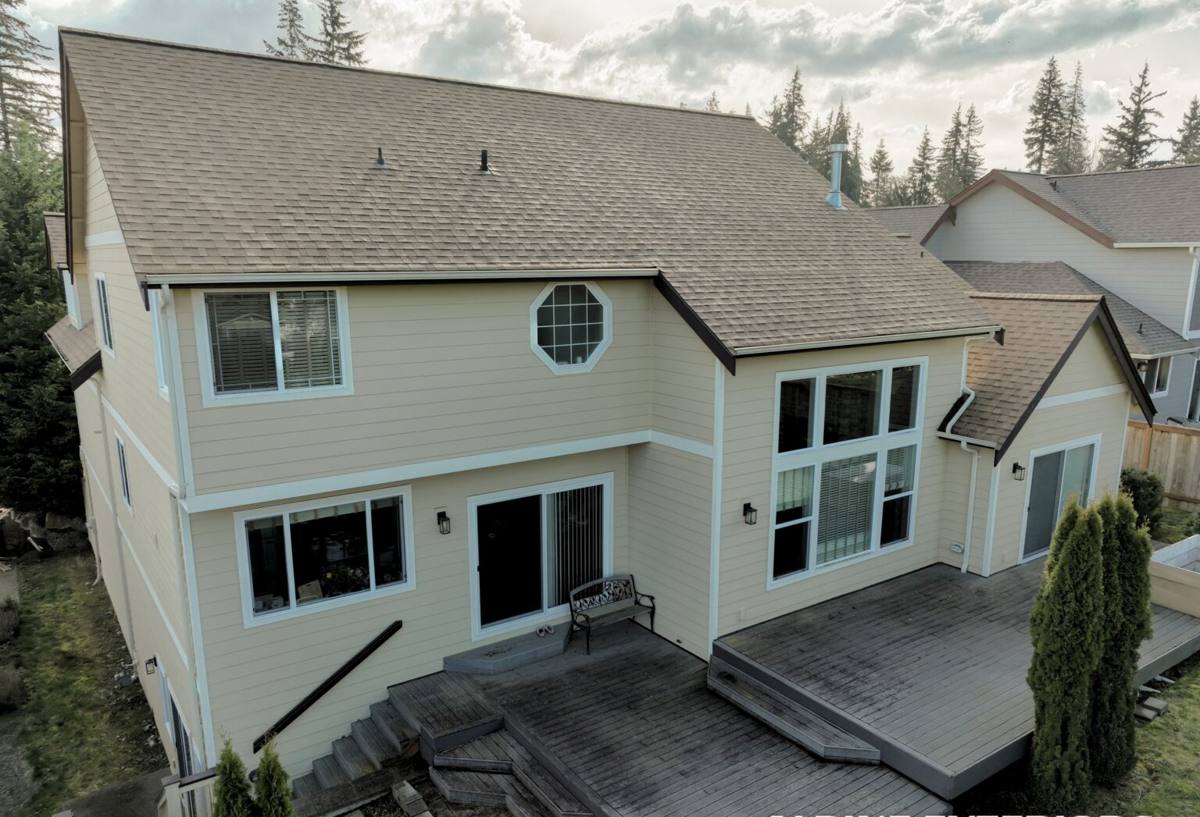
What Whatcom County's Climate Does to Siding Over Time
Bellingham sits on Puget Sound, and every home in Whatcom County deals with some version of the same three stressors: salt-laden air off the bay, driving wind-blown rain, and a moss season that can run from fall through spring. South Hill's terrain and tree cover change how those stressors show up on a given house.
Salt Air and Slow Corrosion
Homes closer to Bellingham Bay take on airborne salt that settles on siding, trim, and especially fasteners. Over years, that salt film holds moisture against the surface longer than plain rain would, accelerating corrosion on exposed nails and staples and breaking down paint film faster than inland homes experience. It's rarely dramatic — it's a slow, cumulative wear pattern that shows up as rust streaking and premature paint failure around fastener heads.
Wind-Driven Rain and Water Intrusion
Rain in this region doesn't just fall — it's frequently pushed sideways by wind off the Sound, which drives water into laps, seams, and butt joints that would stay dry in calmer weather. On hillside lots, wind patterns can funnel and intensify around a house in ways that are hard to predict from the street. The joints and penetrations we check first on a South Hill repair call are the ones most exposed to that wind-driven pattern.
Moss Season and Trapped Moisture
South Hill's mature tree canopy is part of what makes the neighborhood attractive, but it also means more shade, more falling debris, and slower drying after every rain. Moss and algae take hold fastest in siding sections that stay damp longest — north-facing walls, areas under overhanging branches, and spots where debris collects in a joint or behind a downspout. Left alone, that trapped moisture works its way into seams and fastener holes long before you'd notice a visible problem.
Warning Signs South Hill Homeowners Shouldn't Ignore
Most siding damage doesn't announce itself. It starts small and stays hidden until it isn't. These are the signs we tell South Hill homeowners to watch for between our visits:
- Soft or spongy spots when you press on the siding, especially near the bottom courses or under windows
- Visible cracking, splitting, or buckled boards, particularly after a hard freeze or wind event
- Persistent moss or algae growth that keeps coming back even after cleaning
- Paint that's bubbling, peeling, or flaking in patches rather than evenly across a wall
- Rust streaking below fastener heads or trim joints
- Gaps opening up at butt joints, corners, or where siding meets trim, window, or door casing
- Interior signs — a musty smell, discoloration, or soft drywall on an exterior wall
- Increased pest activity around siding edges, which often means there's rot underneath
Any one of these on its own might be minor. Two or three together, especially on a wall that gets little sun, usually means water has been getting in for a while.
Repair or Replace? How We Actually Make That Call
Not every problem needs a full re-side, and we're not going to tell you it does. But repair only makes sense when the damage is contained and the material underneath is sound. Here's the honest breakdown we walk South Hill homeowners through:
| Factor | Repair usually makes sense | Replacement is the better call |
|---|---|---|
| Extent of damage | Isolated to a few boards or one wall section | Spread across multiple walls or the whole exterior |
| Underlying sheathing | Dry and structurally sound once opened up | Soft, rotted, or already compromised |
| Siding material | Original material is still available or closely matchable | Discontinued, mismatched, or a product we don't stand behind long-term |
| Age of siding | Well within its expected service life | Already near or past the manufacturer's expected lifespan |
| Recurrence | First time this section has had a problem | Same area has been patched more than once already |
We'll always give you the repair option when it's a legitimate fix — not just a temporary cover for a bigger issue we'd rather sell you on. If a repair genuinely won't hold, we say so and explain why.
What a Correct Repair Actually Involves
Diagnosing the Root Cause, Not Just the Symptom
A crack in a board or a bubble in the paint is the symptom, not the problem. Before we touch anything, we look at what's feeding that damage — a failed flashing detail, a caulk joint that's given out, a downspout dumping water where it shouldn't, or trapped moisture from shade and debris. Replacing a board without fixing the water source just means the same repair shows up again in a year or two.
Removing Damage Cleanly
We open up the affected area enough to see the full extent of the problem, including checking the water-resistive barrier and sheathing behind it. If we find soft sheathing, we tell you before we close anything back up — that's a conversation, not a surprise on the invoice.
Matching Material and Finish
When the existing siding is James Hardie fiber cement, repairs are straightforward: we replace the damaged section with matching Hardie product and ColorPlus finish so the repair blends in rather than standing out as an obvious patch. When a home has a different siding material, we'll be upfront that an exact match may not be available, and depending on the extent of the damage, a full section or wall replacement in Hardie may be the more sensible long-term fix rather than chasing a mismatched patch.
Sealing and Flashing Correctly
Most repair failures we see come back to bad flashing or caulking, not bad siding. We re-flash any penetration or joint in the repair area to shed water properly, rather than relying on caulk alone to do a flashing detail's job. This is the step that's easy to skip and the one that determines whether a repair lasts five years or fifteen.
Why We Repair With James Hardie
Our company installs James Hardie fiber cement siding exclusively — we don't install vinyl, LP SmartSide, or cedar, and that standard carries through to repair work. Hardie's ColorPlus factory finish is engineered to hold color and resist the kind of paint failure that salt air and constant damp accelerate on painted wood or lower-grade products. It's also non-combustible, which matters to a lot of homeowners regardless of the repair at hand.
When we repair Hardie siding, we're not guessing at compatibility — we know how the product handles moisture, how it should be flashed, and how the factory finish is meant to be maintained. That familiarity is part of why repairs on Hardie homes tend to be simpler, cleaner, and less likely to need a second visit.
Our Process for South Hill Repair Calls
1. Inspection
We walk the exterior, check the areas you're concerned about, and look at everything else while we're there — shaded walls, low corners, anywhere debris or moss tends to collect. Hillside lots and mature tree cover mean problems sometimes hide on walls a homeowner rarely looks at closely.
2. Straightforward Estimate
You get a clear explanation of what we found, what's causing it, and what fixing it actually involves — repair, partial replacement, or full replacement, whichever honestly fits. No pressure to upsize the job.
3. The Work Itself
We remove only what needs removing, correct the water source, and match materials and finish as closely as the situation allows. Work areas are protected and cleaned up daily, not left open to the weather overnight if it can be avoided.
4. Walkthrough
Before we call it done, we walk the repair with you so you can see exactly what was fixed and why, and what to watch for going forward.
Why a Crew That Already Works South Hill Matters
Siding repair isn't just a materials question — it's a site-conditions question. A crew that already works this neighborhood knows that a house tucked under mature trees needs a different look at moisture patterns than one on an open lot, and that hillside grading affects how water moves around a foundation and up a wall. That local familiarity means less time spent figuring out the site and more time actually fixing the problem.
It also means accountability. We're not driving in from out of the area for a one-time job — we live and work in Whatcom County, and a repair with our name on it needs to hold up, because we'll be back in this neighborhood next month either way.
Get a Free, No-Pressure Estimate
If you're seeing cracking, soft spots, recurring moss, or paint that won't hold on your South Hill home, it's worth having a second set of eyes on it before the damage spreads. Use the form below to request a free estimate — we'll give you an honest read on whether it's a repair, a partial fix, or something bigger, with no pressure either way.