 Bellingham Siding
 Why Edgemoor Roofs Face a Different Set of Problems
Edgemoor sits close enough to the water that salt-laden air is a daily fact of life, not an occasional nuisance. Add in Bellingham's long wet season and the deep shade thrown by mature evergreens on many lots, and you get a roofing environment that's genuinely tougher than what a lot of manufacturers design for on paper. A roof that performs fine in a drier part of Whatcom County can fail early here if it wasn't specified and installed with this particular combination of exposure in mind.
Metal roofing is a strong fit for this neighborhood when it's done right, because it resists the two things that do the most damage locally: sustained moisture and organic growth. But "metal roofing" isn't one product — panel type, coating, fastening method, and underlayment all matter, and getting any one of them wrong shows up as a problem within a few years, not decades.
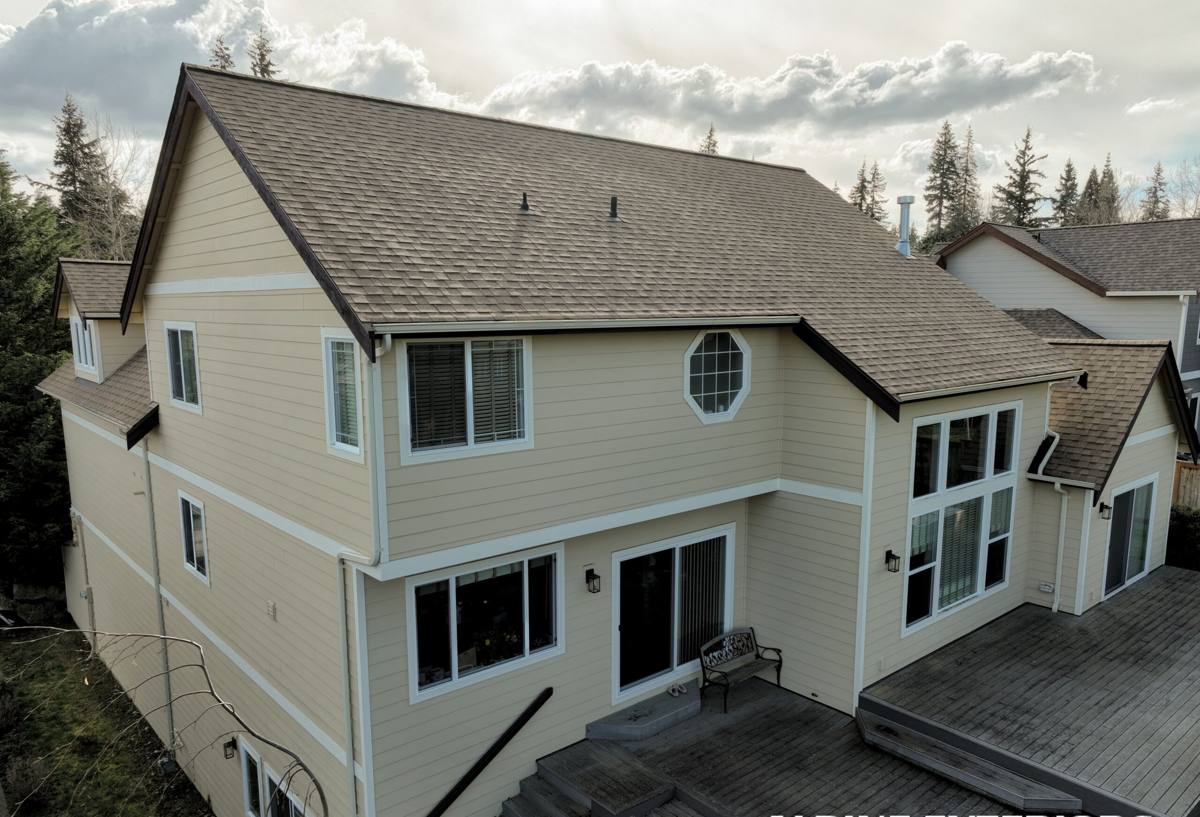
What Salt Air, Driving Rain, and Moss Actually Do to a Roof
Salt Air and Corrosion
Airborne salt accelerates corrosion at fasteners, cut edges, and any point where a coating is thin or scratched. On a home with a water-facing exposure, this isn't cosmetic — it's the difference between a roof that holds its warranty for its full term and one that starts showing rust streaks at the panel seams within five or six years.
Driving Rain
Bellingham's rain doesn't just fall, it blows — sideways rain during winter storms tests every lap, seam, and penetration on a roof. Flat or low-slope sections and complex rooflines (dormers, valleys, chimney flashing) are where driving rain finds weaknesses that a calm-weather inspection would never reveal.
Moss and Organic Growth
Shaded, north-facing slopes and roofs under tree cover hold moisture longer, which is exactly what moss needs to establish. Moss doesn't just look bad — it lifts material at the edges, traps water against the roof surface, and on the wrong substrate can work into seams over time. Metal roofing resists moss far better than composition shingle, but it isn't immune, and the way panels and trim are detailed affects how much moss ever gets a foothold in the first place.
Choosing the Right Metal Roofing System for This Climate
Not every metal roofing product handles Edgemoor's conditions equally well. We generally point homeowners here toward standing seam systems over exposed-fastener panels, for reasons that come down to long-term moisture control rather than upfront cost.
| System | How It Handles Moisture | Maintenance Burden | Typical Lifespan Here |
|---|---|---|---|
| Standing seam (concealed fastener) | Seams are mechanically locked and raised above the water line — no exposed screw penetrations for water or salt to attack | Low — no gasket replacement needed | 40+ years with proper install |
| Exposed-fastener panel | Relies on rubber washers at each screw; washers degrade faster in salt air and UV exposure | Moderate — washers typically need attention within 10-15 years | 25-35 years, shorter if washers aren't maintained |
| Metal shingle/shake panels | Good moisture shedding, more seams and overlaps than standing seam | Low to moderate | 30-40 years |
We don't install exposed-fastener panels as our standard recommendation for water-exposed Edgemoor properties — not because the product is bad, but because the washer-dependent seal is the first thing to fail in salt air, and replacing hundreds of washers on a roof is a maintenance task most homeowners would rather avoid entirely. Standing seam costs more upfront and earns that cost back in decades of lower maintenance.
Coating and Finish
Coating matters as much as panel style. A quality Kynar-based (PVDF) finish holds its color and resists chalking far longer than a basic polyester coating, and that matters more here than in drier inland areas because the combination of UV, salt, and moisture accelerates finish breakdown. Galvalume or aluminum substrates generally outperform bare steel in salt air — aluminum in particular resists corrosion even where the coating gets scratched.
What a Correct Installation Actually Involves
Metal roofing looks straightforward from the ground, but a correct install on an Edgemoor home involves several layers most people never see:
- A synthetic underlayment rated for the full exposure period, not a builder-grade felt that degrades under sustained moisture
- Ice-and-water shield at eaves, valleys, and penetrations, since these are where driving rain concentrates
- Correct panel overlap and seam direction relative to prevailing wind and water flow off the roof
- Stainless or coated fasteners matched to the panel metal to avoid galvanic corrosion between dissimilar metals
- Properly flashed penetrations at every vent, chimney, and skylight — the majority of roof leaks start at a penetration, not the field of the roof
- Continuous ridge and soffit ventilation so moisture doesn't get trapped under the deck, which both rots sheathing and feeds moss growth from underneath
- Clean panel cuts with sealed edges, since raw cut edges are where corrosion starts fastest
Skipping or shortcutting any one of these doesn't usually cause an immediate problem — it causes a problem in year six or year twelve, after the crew that installed it is long gone. That's the real cost of a cheap metal roof install in this climate: not a bad roof on day one, but a roof that doesn't make it to its expected lifespan.
Metal Roofing and Moss: What Actually Reduces It
Metal panels themselves shed moss far better than composition shingle because there's no granulated surface for spores to grip. But moss can still establish in valleys, at panel laps, and anywhere debris collects — especially on shaded roof sections common on wooded Edgemoor lots. A few details reduce this significantly:
- Smooth, properly lapped seams that don't create debris-catching ledges
- Keeping gutters and valleys clear so standing water and organic debris don't sit against the panel
- Trimming back overhanging branches where practical, since dropped needles and leaves are what moss actually feeds on
- Choosing panel colors and finishes that don't hide early growth, so it gets addressed before it spreads
We don't recommend zinc or copper strips as a first-line moss strategy on metal roofing — they're more relevant to shingle roofs, and on a metal roof the seam design and drainage detailing do more work than a strip ever will.
Our Process on an Edgemoor Metal Roof Project
We start with an on-site inspection of the existing roof structure, decking condition, and any problem areas — this is where we catch decking rot from long-term moisture, inadequate ventilation, or flashing issues that need to be corrected before new panels go on, not after. From there we walk through panel and finish options with actual cost and maintenance trade-offs, not just a single default recommendation.
Installation itself typically runs faster than a full tear-off shingle job once underlayment and flashing work is complete, but we don't rush the parts that determine whether the roof lasts: penetration flashing, seam work, and ventilation. We do a final walk-through with the homeowner before we consider the job finished, and we stand behind the workmanship separately from the manufacturer's material warranty, so you know who to call if something needs attention down the road.
Cost Factors Homeowners Should Understand
| Factor | Why It Changes the Price |
|---|---|
| Panel type and finish | Standing seam with a premium PVDF coating costs more per square foot than exposed-fastener panels, but requires far less maintenance over its life |
| Roof complexity | Valleys, dormers, and multiple penetrations require more flashing labor than a simple gable roof |
| Tear-off vs. overlay | Removing an old roof to inspect and repair decking adds cost but prevents hidden rot from being sealed in under new panels |
| Ventilation upgrades | Adding proper ridge/soffit venting where it's missing is an added cost that pays for itself in roof lifespan |
| Access and site conditions | Steep pitches, tree cover, and limited staging area on wooded lots can affect labor time |
We give straightforward, itemized estimates so you can see what you're actually paying for — material, labor, and any decking or ventilation work — rather than a single lump number.
Why Local Experience with Edgemoor Homes Matters
A crew that regularly works this specific area already knows which rooflines catch the worst of the winter storms, which lots hold shade and moisture longest, and how salt exposure varies even within a few blocks depending on elevation and tree cover. That experience shapes real decisions — underlayment choice, fastener material, ventilation design — before a single panel goes up, rather than being figured out through a callback after a leak shows up.
It also means we're a known, reachable local business if you ever need warranty service or a maintenance check, not a crew that worked the region for one season and moved on. For a roofing system meant to last decades in a demanding coastal climate, that kind of accountability is worth as much as the material specification.
Get a Straightforward Estimate
If you're weighing metal roofing for a home in Edgemoor, we're happy to take a look, walk you through what your specific roof needs given its exposure and layout, and give you a clear, no-pressure estimate. There's no obligation — just an honest read on what the job actually involves. Use the form below to get started.