 Bellingham Siding
 Why Birch Bay's Waterfront Climate Is Hard on Siding
Birch Bay sits right on the water in Whatcom County, and that location comes with a specific set of exterior problems that homes a few miles inland simply don't deal with as often. Salt air off the bay accelerates corrosion on fasteners, trim, and any siding material that isn't built to handle it. Wind-driven rain off the Strait doesn't just fall straight down — it gets pushed sideways into seams, laps, and corner trim, which means the details of an installation matter more here than they do on a sheltered lot. Add in a long, damp moss season that stretches through much of the fall, winter, and spring, and you've got a climate that's constantly testing whatever is on the outside of your house.
None of this is unusual for coastal Whatcom County. But it does mean that siding choices and installation quality that might get away with mistakes in a drier, inland climate will get exposed a lot faster in Birch Bay. We've built our process around that reality.
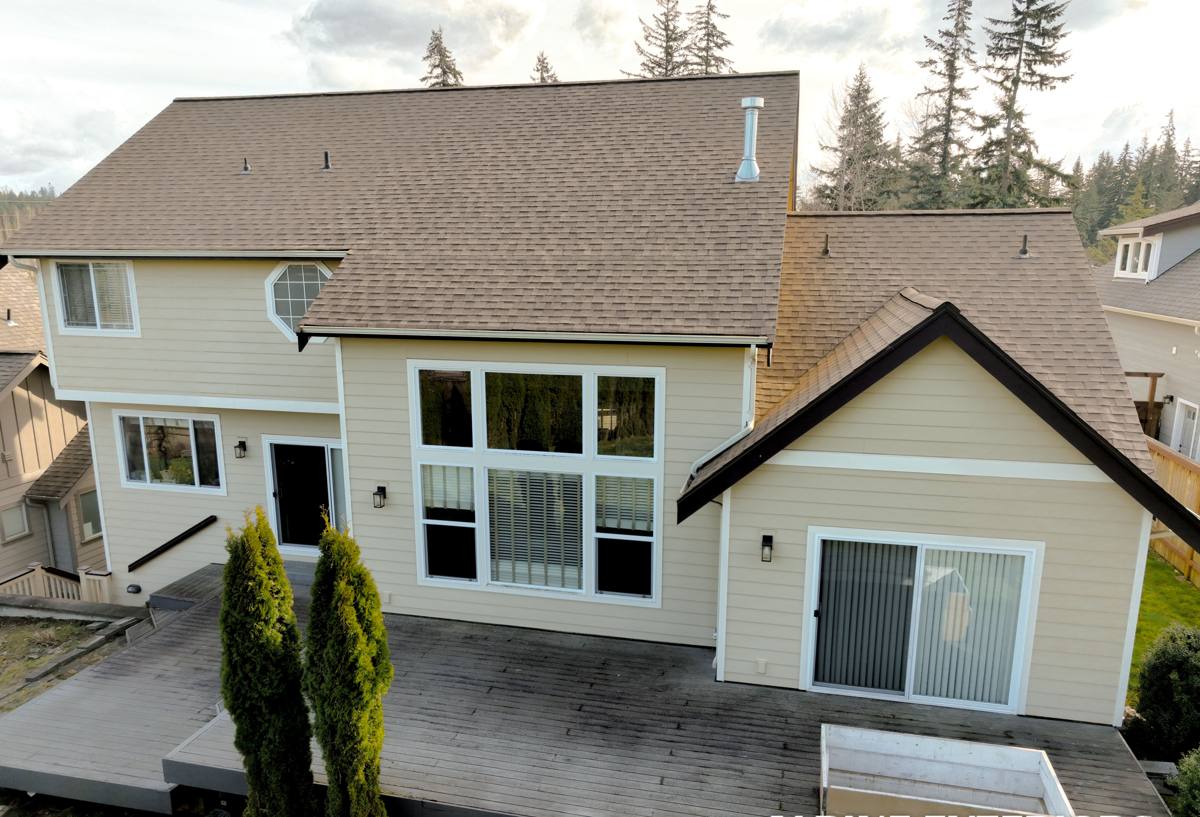
What Birch Bay Homes Actually Need From Their Siding
Strip away the marketing and a home on or near the bay needs siding that does a few things well, consistently, year after year:
- Resists moisture absorption and doesn't swell, cup, or delaminate when it stays damp for weeks at a time
- Holds paint or factory finish without repeated repainting cycles driven by salt exposure and UV
- Won't rot from the inside out where fasteners, laps, and trim meet moisture
- Stays dimensionally stable through the area's freeze-thaw swings and constant humidity changes
- Resists the moss and mildew growth that thrives in this level of shade and moisture
Wood-based products — cedar, primed spruce, and engineered wood siding like LP SmartSide — are organic materials at their core, and organic materials in a salt-air, high-moisture environment are fighting an uphill battle no matter how well they're finished. Vinyl holds up to moisture fine but expands and contracts significantly with temperature and takes wind-driven rain and gusts off the water harder than a heavier product. These aren't reasons to panic about what's currently on your house — plenty of homes in Birch Bay have gotten decades out of these materials with diligent maintenance. But when we're asked what we'd put on a home in this exact location, our answer is consistent.
Why We Only Install James Hardie
We install James Hardie fiber cement siding exclusively. We don't install vinyl, LP SmartSide, Cemplank, Allura, primed spruce, or cedar. That's a deliberate standard, not a sales preference, and it's worth explaining why.
Fiber cement is cement, sand, and cellulose fiber — it's non-combustible, it doesn't feed moss and mildew the way wood fiber does, and it doesn't expand and contract with temperature the way vinyl does. James Hardie's HZ product lines are specifically engineered for different climate zones, which matters in a place like Birch Bay where wind-driven rain and sustained moisture are the primary threat rather than extreme heat or wildfire exposure that might be the priority elsewhere. The ColorPlus factory finish is baked on in a controlled environment rather than field-applied, which means better adhesion and a finish that's engineered to hold color and resist fading from years of salt air and UV — with a warranty backing that finish specifically, not just the substrate.
We're not going to tell you cedar looks bad or that vinyl is garbage — they're both legitimate products with real upsides, and homeowners who choose them and maintain them diligently often do fine. What we will tell you is that after years of doing exterior work on the water in Whatcom County, we stopped installing products that ask a homeowner to fight the climate every few years, and started installing the one we trust to hold up with normal maintenance instead of constant intervention.
James Hardie Product Lines for a Birch Bay Home
| Hardie Product | Best Use | Why It Fits This Climate |
|---|---|---|
| HardiePlank lap siding | Primary wall cladding, most home styles | Widest color and texture range; engineered lap profile sheds wind-driven rain when installed with correct overlap |
| HardieShingle | Accent gables, Cape Cod and cottage-style homes | Staggered or straight-edge look without the moisture vulnerability of real wood shingle |
| HardiePanel | Modern or board-and-batten facades | Large-format vertical coverage with fewer horizontal seams for water to find |
| HardieTrim | Corners, window and door surrounds, fascia | Matches the siding's moisture resistance so trim doesn't become the weak point |
What Correct Installation Involves Near the Water
James Hardie siding performs the way it's designed to only when it's installed to spec — and in a high-exposure location like Birch Bay, the installation details matter even more than the product choice itself. A rushed or generic install can undercut even the best siding material.
What we check on every Birch Bay job
- Weather-resistant barrier installed and lapped correctly behind the siding, with all penetrations sealed
- Proper starter strip at the base of the wall so the first course sits correctly and sheds water outward
- Correct minimum clearance between siding and grade, decks, and roof lines to keep splashback and ponding water off the material
- Fastener spacing, type, and depth matched to Hardie's published specs — corrosion-resistant fasteners given the salt air exposure
- Butt joints and seams flashed or sealed per manufacturer instructions rather than caulk alone
- Corner and trim details sealed against the wind-driven rain patterns typical of waterfront exposure
- Proper gap and sealant at penetrations — hose bibs, vents, light fixtures — where most real-world leaks start
This is also where the "why hire a crew that already works Birch Bay" question answers itself. A lot of these details are judgment calls that come from having installed on similarly exposed lots before — knowing where wind tends to drive rain on a bay-facing wall, how much clearance a particular deck ledger needs, or which corners on a two-story waterfront home take the worst of it. That's not something you get from reading a manufacturer's install guide once; it's something you get from doing the work in this specific environment repeatedly.
Our Process, Start to Finish
The process is straightforward, and we keep it that way on purpose:
- On-site evaluation. We walk the exterior, check the current siding and sheathing condition, note problem areas (moss buildup, past moisture damage, wind exposure on specific walls), and talk through product line and color options.
- Written estimate. A clear scope covering removal of existing siding, any sheathing repair needed, the Hardie product and color selected, trim work, and timeline.
- Prep and tear-off. Old siding comes off, and we inspect the sheathing underneath — this is often where hidden moisture damage from years of wind-driven rain shows up, and it needs to be addressed before anything new goes on.
- Weather barrier and flashing. This layer does as much work as the siding itself in a climate like this, and it's not something that gets shortcuts on our jobs.
- Hardie installation. Siding, trim, and accents installed to manufacturer spec with attention to the details above.
- Final walkthrough. We go over the finished work with you before calling the job complete.
What Affects the Cost
Every home is different, but the main cost drivers on a Birch Bay siding job are consistent:
| Factor | Why It Matters |
|---|---|
| Home size and wall complexity | More square footage and more corners, gables, and dormers mean more material and labor |
| Condition of existing sheathing | Moisture damage found during tear-off may need repair before new siding goes on |
| Product mix | Lap siding, panel, and shingle accents priced differently; mixing styles adds detail work |
| Trim and accent scope | Full trim replacement versus reusing sound existing trim changes the total |
| Access and site conditions | Waterfront lots, tight setbacks, or difficult staging can affect labor time |
We give honest, written numbers after seeing the actual house — not a generic per-square-foot quote that ignores the condition of what's underneath your current siding.
Why a Crew That Already Works Birch Bay Matters
Whatcom County's coastal communities aren't identical to inland Bellingham neighborhoods, and they're not identical to each other. A crew that regularly works Birch Bay specifically has already seen how wind off the water behaves against different home orientations, which walls take the worst of the driving rain, and how aggressively moss establishes itself on north-facing and shaded elevations in this particular microclimate. That experience shows up in small decisions — flashing details, fastener choices, where extra sealant attention goes — that don't show up on a spec sheet but do show up in how the siding performs ten years down the road.
It also matters for something more basic: knowing what actually needs fixing versus what's cosmetic. Moss staining on siding, for instance, often looks worse than the underlying damage actually is, while a small gap at a trim joint that looks minor can be the source of a much bigger moisture problem behind the wall. A crew with local reps has a better read on which is which.
Get a Straight Answer for Your Home
If you're dealing with aging, moss-covered, or moisture-damaged siding on a Birch Bay home, we're happy to take a look and give you a clear, honest assessment — including whether a full replacement is actually necessary or if targeted repair makes more sense first. Reach out for a free, no-pressure estimate using the form below.