 Bellingham Siding
 Building Decks That Actually Hold Up in Ferndale
Ferndale sits close enough to the water and open farmland that decks here take a different kind of beating than decks built twenty miles inland. Salt-laden air off the bay corrodes unprotected metal faster than most homeowners expect, driving rain gets pushed sideways into ledger boards and stair stringers, and the long gray stretch from October through April keeps wood surfaces damp enough for moss and algae to take hold and stay. A deck that isn't built with those three factors in mind will look fine for a year or two and then start showing problems all at once — soft spots, rust streaks, slick green film underfoot.
We build and repair decks throughout Whatcom County, and the ones that last in Ferndale aren't dramatically different in design from decks anywhere else in Western Washington. What's different is the attention paid to the parts you don't see once the project is finished: the fasteners, the flashing, the gap spacing, and the footing drainage. Get those right and a deck built for Ferndale conditions will outlast one built to a generic spec by a decade or more.
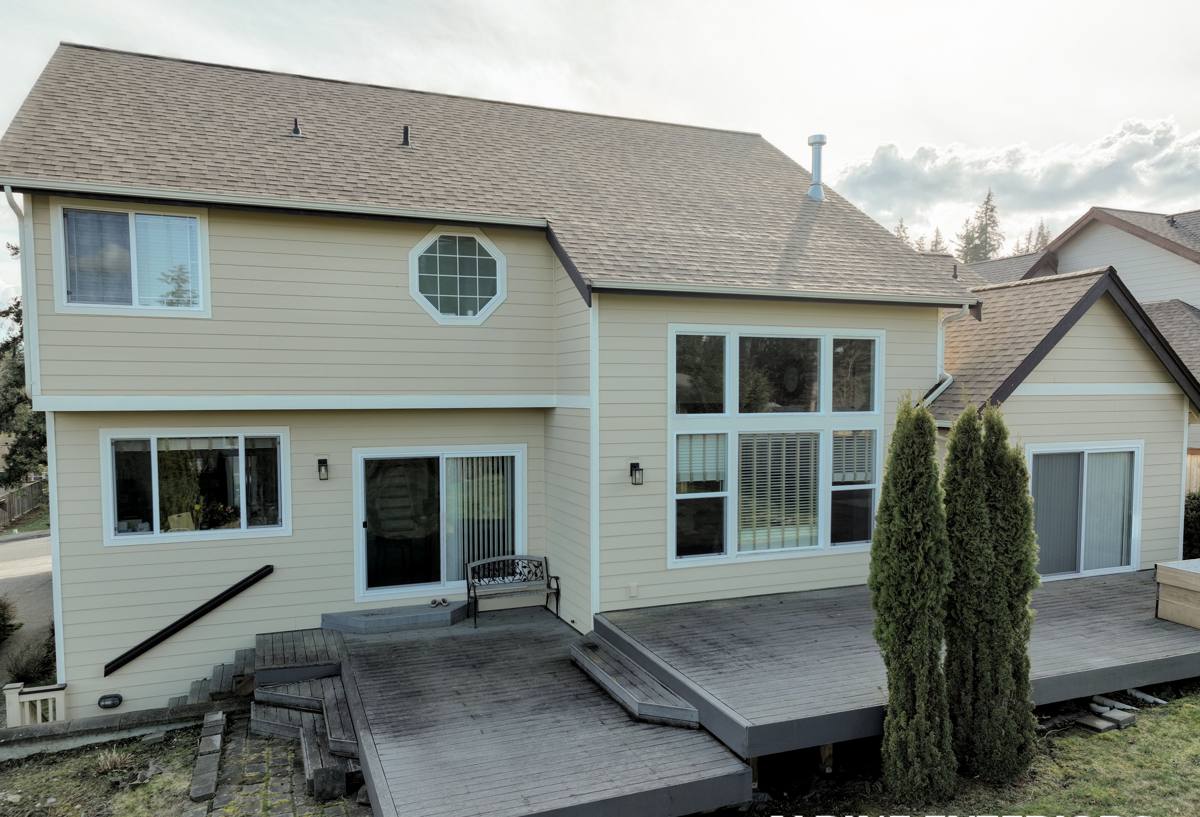
What Ferndale's Climate Actually Does to a Deck
Salt Air and Corrosion
You don't need to be beachfront to feel the effects of salt air. Moisture carrying trace salt travels inland on prevailing winds and settles on any exposed metal — screws, joist hangers, post bases, railing brackets. Standard zinc-coated fasteners break down faster under that exposure than most homeowners realize, and once corrosion starts on a structural fastener, it's a hidden problem until something fails.
Driving Rain and Wind-Driven Moisture
Rain in this part of the county rarely falls straight down. Wind pushes it under railings, into ledger connections, and along the top edges of decking boards where end grain is most absorbent. Any gap in flashing or any board laid without proper drainage space becomes a spot where water sits instead of shedding.
Moss, Algae, and the Long Wet Season
Ferndale gets a genuinely long wet season, and shaded or low-airflow sections of a deck can stay damp for weeks at a stretch. That's exactly the environment moss and algae need. Beyond being a slip hazard, sustained moisture under a moss layer accelerates wood decay and, on composite boards, can stain the surface in ways that are difficult to fully clean.
What a Correctly Built Deck Requires Here
Fasteners and Hardware
We use stainless steel or heavy-duty coated fasteners rated for coastal exposure on every structural connection, not just the visible screws. Joist hangers, post bases, and ledger bolts all see the same corrosion pressure as the decking surface, and they're far more expensive to replace after the fact than to spec correctly from the start.
Ledger Attachment and Flashing
The ledger board — where the deck attaches to the house — is the single most common failure point we find on older Ferndale decks. Proper flashing, a drainage gap behind the ledger, and correctly sequenced house wrap integration keep water from tracking behind the siding and into the rim joist. This is not a place to cut corners, and it's largely invisible once the decking is installed, which is exactly why it gets skipped on cheaper jobs.
Board Spacing and Airflow
Decking boards need consistent gapping for drainage and airflow underneath, especially in shaded yards common around Ferndale's tree cover. We also make sure the substructure has enough clearance and ventilation that the underside of the deck isn't sitting in standing moisture through the winter.
Footings Below the Frost and Water Table
Footings need to be set to the depth Whatcom County code requires and located where they won't sit in seasonally saturated soil. Poor drainage around footings is a slow problem — it doesn't show up as deck movement for a few years, but it eventually does.
Choosing the Right Decking Material for Ferndale Conditions
There's no single "best" decking material — the right choice depends on budget, how much upkeep you're willing to do, and how exposed the deck is to sun, shade, and moisture. Here's how the common options actually perform in this climate:
| Material | Moss/Algae Resistance | Maintenance | Typical Lifespan Here |
|---|---|---|---|
| Pressure-treated wood | Low — needs regular cleaning and sealing | Annual cleaning, re-sealing every 1-2 years | 10-15 years with upkeep |
| Cedar | Moderate — natural oils help but fade over time | Cleaning and oiling every 1-2 years | 15-20 years with upkeep |
| Composite decking | Good — capped boards resist staining better | Periodic washing, no sealing needed | 25-30 years |
| PVC decking | Best — fully synthetic, doesn't absorb moisture | Occasional washing | 25-30+ years |
We install all of these. Where we push back is on uncapped composite in fully shaded, low-airflow spots — it can hold surface moisture and stain faster than a capped composite or PVC board in the same location. That's a maintenance and appearance trade-off we'll walk through honestly, not a reason to avoid composite altogether; it depends entirely on where the deck sits relative to sun and tree cover.
Our Process for a Ferndale Deck Build
- On-site assessment. We look at sun exposure, shade patterns, drainage slope, soil condition, and how the deck will tie into the house.
- Design and material selection. We talk through layout, decking material, and railing options against your budget and how much maintenance you want to take on long-term.
- Permitting. We handle the Whatcom County permit application and inspection scheduling so you're not chasing paperwork.
- Footings and framing. Footings set to code depth, pressure-treated framing, corrosion-resistant hardware throughout.
- Ledger and flashing detail. The connection to your house gets the most careful work on the whole project — it's what keeps water out of your siding and framing.
- Decking, railing, and finish work. Boards installed with correct gapping, railings set, stairs finished, and hardware checked.
- Final walkthrough. We go over the finished deck with you, including what maintenance it needs and when.
Common Problems We Find on Existing Ferndale Decks
A lot of our deck work in this area isn't new builds — it's repair or replacement of decks that were built without the climate in mind. The patterns repeat:
- Rusted or corroded joist hangers and ledger bolts that weren't rated for coastal air exposure
- Soft or rotted framing at the ledger connection from missing or failed flashing
- Persistent moss buildup in shaded corners with poor airflow underneath
- Footings that have shifted due to water pooling around the base instead of draining away
- Railings loosening at the posts from years of wind-driven rain finding its way into the post base
Some of these are repairable in place. Others — especially ledger rot — mean the affected section needs to come apart to fix it properly. We'll tell you honestly which category your deck falls into rather than patching over a structural issue.
Permits and Code in Whatcom County
Most deck projects above a certain height or size require a building permit through Whatcom County, and decks attached to the house need to meet current structural and guard-rail code regardless of size. We handle the permit process as part of the job — pulling the permit, scheduling inspections, and making sure the footings, framing, and railings are inspected and signed off before the decking goes down. Skipping permitting on an attached deck isn't just a compliance issue; it also means there's no third-party check on the structural work before it's covered up.
Keeping a Ferndale Deck in Good Shape Year-Round
Whatever material you choose, a little seasonal attention goes a long way in this climate:
- Sweep off leaves and debris regularly through fall — trapped organic matter holds moisture against the boards
- Wash the deck surface at least once a year to break up early moss and algae growth before it takes hold
- Check and clear gaps between boards so water keeps draining instead of pooling
- Inspect railing posts and stair connections annually for movement or looseness
- For wood decks, plan on re-sealing every one to two years depending on sun exposure
- Keep an eye on the area where the deck meets the house — that's where problems start first
Why It Matters to Hire a Crew That Already Works in Ferndale
Deck-building fundamentals are the same everywhere, but knowing how hard local conditions push on a structure changes real decisions — which fasteners are worth the extra cost, how much drainage gap to leave under a shaded deck, where flashing details need extra attention. A crew that's only worked in drier inland climates can build a technically sound deck that still underperforms here simply because it wasn't built with this air, this rain pattern, and this moss season in mind. We work throughout Whatcom County and see the same climate stress on every project, which means the details that matter in Ferndale aren't guesswork for us — they're standard practice.
If you're planning a new deck or need an honest look at one that's showing its age, we're happy to come out, walk the site, and give you a straightforward assessment along with a free, no-pressure estimate — just fill out the form below.