 Bellingham Siding
 Bellingham's Climate Is Hard on Siding — Especially in Cordata
Cordata sits in north Bellingham, close enough to Bellingham Bay to catch salt-laden air off the water and surrounded by enough mature evergreen cover that plenty of homes here spend half the year in damp shade. That combination is rough on exterior siding. Whatcom County doesn't get the extreme freeze-thaw cycles you'd see inland, but it makes up for it with something siding manufacturers rarely design around properly: long stretches of low-intensity rain, salt-tinged marine air, and a moss and algae season that can run from October into May.
Homeowners in this neighborhood tend to notice the same failure patterns over and over — paint that chalks and fades faster on the west and south exposures, green-black staining creeping up from the bottom courses on shaded north walls, and soft or swollen trim where water has been sitting against the substrate longer than it should. None of that is a Cordata-specific mystery. It's what happens when siding that wasn't built for a wet marine climate gets asked to perform in one anyway.
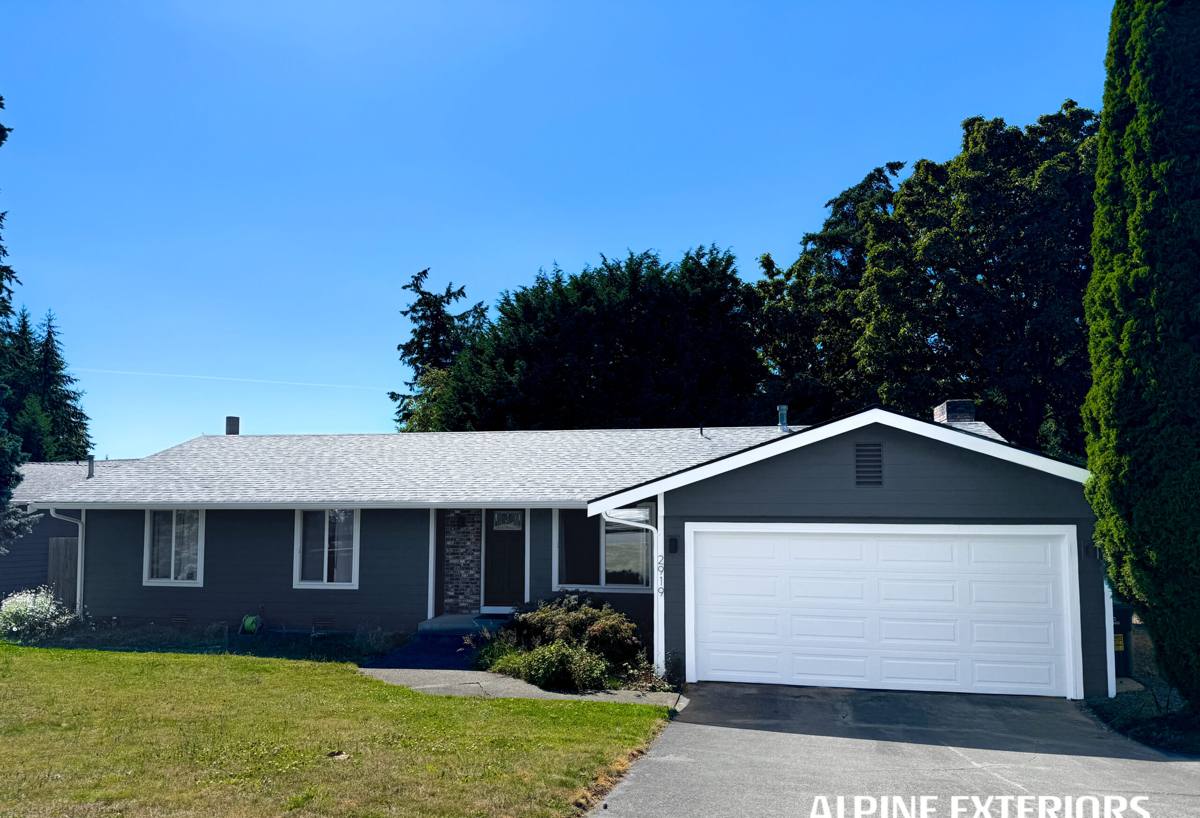
What Fiber Cement Siding Has to Get Right Here
Fiber cement is a good match for this climate on paper, but "fiber cement" covers a wide range of products and installation quality, and the difference between a correct job and a mediocre one shows up fastest in exactly the conditions Cordata deals with.
Salt Air and Fastener Corrosion
Homes closer to the water pick up airborne salt that accelerates corrosion on anything metal — fasteners, flashing, trim caps. Fiber cement itself doesn't corrode, but a siding job is only as good as the metal components tying it together. We use corrosion-resistant fasteners and flashing rated for coastal exposure rather than whatever came cheapest in the box.
Moss, Algae, and Shade
Shaded walls under conifers stay damp longer after every rain, which is exactly the environment moss and algae need. Fiber cement resists rot the way wood-based products can't, but it still needs a factory finish that resists organic growth and a drainage gap behind it so moisture isn't trapped against the wall.
Driving Rain and Wind-Driven Moisture
Storms off the Sound don't just fall straight down — wind pushes rain sideways into laps, seams, and trim joints. Every seam, joint, and penetration on a Cordata home is a place where wind-driven rain will eventually test the installation, not just the material.
What a Correct Installation Actually Involves
A lot of siding problems we get called out to inspect aren't material failures at all — they're installation shortcuts that only become visible after a few wet seasons. Getting fiber cement right in this climate comes down to a handful of details that are easy to skip and expensive to fix later.
The Drainage Plane and Rain Screen Gap
Behind the siding, there needs to be a weather-resistive barrier and, ideally, a small gap that lets any moisture that gets past the siding drain and dry out instead of sitting against the sheathing. Skipping this is one of the most common shortcuts we see, and it's invisible until there's already damage behind the wall.
Flashing and Clearances
Windows, doors, and any horizontal trim need proper flashing so water is directed out and away rather than behind the cladding. Siding also needs correct clearance from the ground, roof lines, and decks — too tight, and it wicks moisture no matter how good the product is.
Fastening and Joint Treatment
Fiber cement has to be fastened at the manufacturer's specified pattern and depth, with joints treated and caulked (or shiplap-fit, depending on the product) to manufacturer detail. Over- or under-driven fasteners are a common source of cracking and water intrusion down the road.
The James Hardie Products We Install in Cordata
We install James Hardie fiber cement exclusively. We don't carry LP SmartSide, vinyl, Cemplank, Allura, or wood siding, and we're upfront with Cordata homeowners about why: those products each carry trade-offs — moisture sensitivity, maintenance burden, or shorter real-world lifespan under this exact kind of weather — that we're not willing to install and then stand behind. James Hardie's fiber cement is non-combustible, holds a factory-applied ColorPlus finish that resists the fading and chalking we see on painted products in this climate, and is engineered in specific formulations for different climate zones, including the wetter HZ5 zone that covers western Washington.
| Product Line | Best Use on Cordata Homes | Why It Fits This Climate |
|---|---|---|
| HardiePlank Lap Siding | Primary wall cladding, most home styles | HZ5 formulation resists moisture absorption in high-rainfall areas |
| HardiePanel Vertical Siding | Modern facades, accent walls, gables | Fewer horizontal laps means fewer seams for wind-driven rain to test |
| HardieShingle | Accent gables, craftsman and cottage styles | ColorPlus finish holds up under shaded, damp conditions better than field-painted shingle |
| HardieTrim | Corners, window and door trim, fascia | Matches expansion behavior of the field siding, reducing joint gaps that let water in |
Our Process, Start to Finish
Every Cordata job starts with an actual look at the wall, not just a guess from the driveway.
- Assessment: We check current siding condition, moisture readings where we can get them, and look for existing damage around windows, trim, and the base of walls.
- Tear-off and sheathing check: Once the old siding is off, we inspect the sheathing underneath. Any rot or soft spots get repaired before anything new goes up — covering damaged sheathing with new siding just hides a problem that will keep growing.
- Weather barrier and drainage plane: We install the water-resistive barrier and drainage gap correctly, since this is the layer that actually protects the house once the siding is on.
- Flashing: Windows, doors, and horizontal trim get flashed to shed water outward, not behind the wall assembly.
- Installation to Hardie spec: Fastening pattern, clearances, and joint treatment follow James Hardie's published installation requirements — this is also what keeps the manufacturer's warranty valid.
- Final walkthrough and cleanup: We review the finished job with the homeowner and clear the site of debris and old material.
Cost Factors to Expect
We don't publish flat prices because every home is different, but the factors that move the number are consistent. A realistic estimate for a typical Cordata single-family home runs into the tens of thousands, with these variables doing most of the moving:
| Factor | Why It Matters |
|---|---|
| Home size and stories | More wall area and taller walls mean more material and more labor, including staging for multi-story sections |
| Removal and disposal of old siding | Tear-off and haul-away is real labor, especially with layered or damaged existing siding |
| Sheathing repair | Any rot found underneath the old siding adds carpentry work before new siding can go on |
| Product line and profile | Lap width, vertical panel, and shingle accents price differently in material and labor |
| Trim and detail work | Homes with more corners, gables, and window trim take more time to flash and finish correctly |
| Color | Factory ColorPlus finishes come in a set palette; custom field-painted finishes add cost |
Maintenance Checklist for Cordata Homeowners
Fiber cement is low-maintenance compared to wood or painted products, but "low" isn't "none" — especially with the moss and algae pressure this neighborhood gets from tree cover and marine humidity.
- Rinse siding with a garden hose once or twice a year to knock off pollen, dust, and early moss growth before it takes hold
- Keep gutters clear so overflow isn't running down the wall face during heavy rain
- Trim back shrubs and tree limbs that keep a wall shaded and damp longer than the rest of the house
- Check caulking at trim joints and penetrations every year or two and recaulk if it's cracked or pulling away
- Look at the bottom courses near grade and decks for staining or soft spots, which can signal a clearance or drainage issue
- Avoid pressure washing directly at the siding face — it can force water behind laps and joints
Why Hire a Crew That Already Works This Neighborhood
A siding crew that's spent time on Cordata roofs and walls already knows which exposures take the worst of the wind-driven rain, which lots hold shade and moisture longest, and how the salt air off the bay tends to age fasteners and trim faster than manufacturers' generic estimates assume. That's not something you can fully substitute with a general contractor working from a spec sheet. It shows up in small decisions — where to add extra flashing, which corners need heavier-duty fasteners, how tight to run clearances near a shaded foundation — that a manufacturer's install guide covers in general terms but a local crew has actually seen play out on homes like yours.
It also matters for the paperwork side: correct installation is what keeps a James Hardie warranty valid, and a crew that installs Hardie exclusively, on this kind of home, in this exact climate, day in and day out, is going to catch the details that void a warranty faster than a crew that installs five different siding brands and treats the install guide as optional.
If your Cordata home's siding is showing moss staining, chalking paint, soft trim, or you're just planning ahead for a replacement, we're happy to come take a look. The estimate is free, there's no pressure, and you'll get a straight answer about what your home actually needs — use the form below to get started.