 Bellingham Siding
 Why Birch Bay Roofs Age Differently Than Roofs Inland
Birch Bay sits right on the water, and that changes what a roof has to survive year after year. Salt-laden air moves in off the bay and settles on every exposed surface, including shingles, flashing, fasteners, and vents. Add Whatcom County's long wet season, frequent wind-driven rain, and the shade from mature evergreens that keeps roof surfaces damp for days at a time, and you get a roofing environment that's noticeably tougher on materials than what you'd find a few miles inland. Moss and algae growth season runs long here, and once it takes hold, it holds moisture against the roof surface and works its way under shingle edges.
None of this means a roof in Birch Bay is doomed to fail early. It means the products, fasteners, and installation details need to be chosen with this specific exposure in mind. A roof built for a dry inland subdivision, installed the same way in Birch Bay, will not perform the same over time.
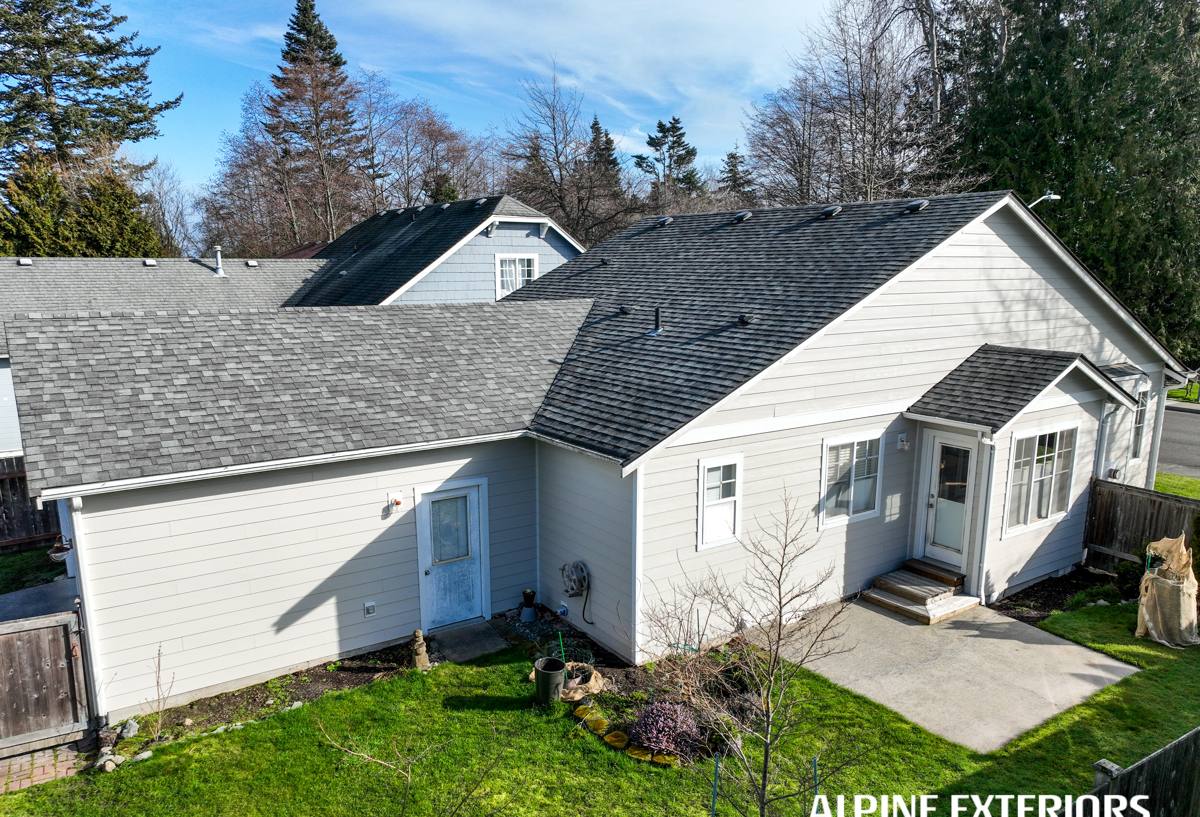
Signs Your Birch Bay Roof Needs Replacement, Not Just Repair
Homeowners often call us for a repair and find out the roof has actually reached the end of its useful life. Some signs point clearly toward full replacement rather than another patch:
- Granule loss heavy enough that you're finding gravel-like grit in gutters and downspouts every season
- Shingles that are cupping, curling, or cracking across large sections rather than in one isolated spot
- Moss or algae staining that keeps returning within a year of cleaning, especially on north-facing or shaded slopes
- Soft spots in the roof deck you can feel underfoot, which usually means water has already reached the sheathing
- Rusted or failing metal flashing around chimneys, skylights, and valleys — a common early failure point in salt air
- Daylight visible through the attic roof boards, or damp insulation after a storm
- A roof that's simply past the manufacturer's expected service life for this climate, even if it looks okay from the ground
If only one or two of these apply and the roof is otherwise sound, a targeted repair may be the honest answer. We'll tell you that. Replacement makes sense when the underlying materials — not just the surface — are compromised.
What a Correct Roof Replacement Actually Involves
A roof replacement is more than swapping old shingles for new ones. The parts you don't see are what determine whether the roof holds up through Birch Bay's wet winters and salty summers.
Full Tear-Off and Deck Inspection
We remove the existing roofing down to the deck rather than layering over it. This lets us inspect every square foot of sheathing for soft spots, delamination, or rot that's been hidden under the old roof — very common in homes with a history of moss growth or ice damming at the eaves. Any compromised sheathing gets replaced before anything new goes down.
Underlayment and Water Barrier Details
In a climate with driving rain and long wet stretches, the underlayment matters as much as the shingle. We use synthetic underlayment across the field of the roof and self-adhered ice-and-water membrane at the eaves, valleys, and around every penetration — the places wind-driven rain is most likely to get pushed backward under shingles.
Ventilation
A roof that can't breathe traps moisture in the attic, which accelerates deck rot and feeds the kind of algae and moss growth already common here. Proper intake at the eaves and exhaust at the ridge keeps air moving and the underside of the roof dry, extending the life of both the deck and the shingles above it.
Flashing and Valleys
Flashing failure is one of the most common causes of roof leaks we find in coastal homes, because salt air corrodes lower-grade metal faster than it would inland. We flash chimneys, sidewalls, valleys, and vent penetrations with corrosion-resistant metal and proper step-and-counter technique rather than relying on sealant alone.
Choosing Roofing Materials for a Salt-Air, Moss-Prone Climate
There's no single "best" roofing material for every home — it depends on your roof's slope, sun exposure, tree cover, and budget. What matters is understanding the trade-offs honestly rather than picking based on price alone.
| Material | Moisture & Moss Behavior | Maintenance | Typical Lifespan Here |
|---|---|---|---|
| Architectural asphalt shingle | Good when paired with proper ventilation and algae-resistant granules; can still host moss in heavy shade | Periodic soft washing recommended in shaded areas | 20-30 years |
| Standing seam metal | Sheds moisture fast, very moss-resistant on steeper slopes | Low; occasional fastener and sealant checks at penetrations | 40-50+ years |
| Cedar shake | Attractive but holds moisture and is more vulnerable to moss and rot in shaded, damp settings without diligent upkeep | Higher; regular cleaning and treatment needed | 20-25 years with upkeep |
| Composition/synthetic shake | Moisture-stable, resists moss better than natural wood | Low to moderate | 30-40 years |
We generally steer homeowners with heavily shaded, moss-prone lots away from untreated cedar unless they're committed to the maintenance schedule it requires — not because cedar is a bad product, but because the upkeep burden in this specific climate is real and worth knowing about upfront. Metal and quality architectural shingle are the two options we install most often for Birch Bay homes, depending on roof style and budget.
Our Roof Replacement Process
- On-site inspection and estimate. We walk the roof and attic, note deck condition, ventilation, and flashing issues, and give you a clear written scope — no surprise change orders for things we could have caught upfront.
- Material selection. We go over the trade-offs for your roof's slope and exposure so you're choosing based on how it will actually perform, not just how a sample looks.
- Scheduling around the weather. Wet-season roofing in Whatcom County requires realistic scheduling and tarping contingencies — we build weather buffers into the timeline rather than pretending rain won't happen.
- Tear-off and deck repair. Old roofing comes off, the deck is inspected and repaired as needed, and the site is kept protected throughout the day.
- Underlayment, flashing, and ventilation installed. These details go in before a single shingle or panel, since they're impossible to fix properly once the roof is closed up.
- Final roofing material installed to manufacturer spec. Correct nailing patterns and exposure are followed closely — this is where corner-cutting shows up years later as wind or leak damage.
- Cleanup and final walkthrough. Magnetic sweep for debris, gutter check, and a walkthrough so you know what was done and what to watch for going forward.
Living With the Roof After Replacement: Moss, Algae, and Salt Air
A new roof still lives in the same climate as the old one. A little routine attention goes a long way toward protecting your investment:
- Keep tree limbs trimmed back from the roofline to reduce shade and debris buildup, especially on north-facing slopes
- Clean gutters at least twice a year — clogged gutters back water up under the roof edge
- Have moss or algae growth soft-washed rather than pressure-washed, which can strip granules and shorten shingle life
- Check flashing and sealant at penetrations annually, since salt air accelerates corrosion faster than most homeowners expect
- Watch for granule buildup in gutters after storms as an early indicator of wear
Cost Factors for a Birch Bay Roof Replacement
Every roof is different, but the same handful of factors drive most of the cost variation we see on Birch Bay homes.
| Factor | Why It Matters |
|---|---|
| Roof size and number of slopes/valleys | More complex rooflines mean more flashing detail and labor time |
| Deck condition | Hidden rot found during tear-off adds material and labor to replace sheathing |
| Material choice | Metal and premium shingle products cost more upfront but shift long-term maintenance and lifespan |
| Access and site conditions | Steep slopes, tree cover, or difficult staging near the water can affect labor and safety measures |
| Ventilation upgrades needed | Adding proper intake/exhaust venting where none existed is a worthwhile add, not just a cost |
We give a broad range during the initial estimate and a firm number once the deck is inspected during tear-off — that's the point where hidden issues, if any, become visible.
Why Hiring a Crew That Already Works Birch Bay Matters
Roofing crews that mostly work drier, inland neighborhoods don't always account for how differently a coastal roof behaves. A crew that's already worked roofs in Birch Bay knows which slopes tend to hold moss, where salt air causes flashing to corrode first, and how to sequence a tear-off around a wet forecast without leaving a deck exposed overnight. That local pattern recognition is the difference between a roof that's technically installed to code and one that's actually built for this specific stretch of Whatcom County coastline.
If you're weighing a repair against full replacement, or just want an honest read on how much life is left in your current roof, we're happy to take a look. The estimate is free, there's no pressure, and you'll get a straight answer about what your roof actually needs — use the form below to get started.