 Bellingham Siding
 Fiber Cement Siding Built for Birch Bay's Waterfront Exposure
Birch Bay sits directly on the water in northern Whatcom County, and that location puts more strain on a home's exterior than most inland properties ever deal with. Salt-laden air moves off the bay year-round, wind-driven rain gets pushed sideways into wall assemblies instead of just falling straight down, and a long moss and mildew season settles in on shaded and north-facing walls for much of the year. Siding here has to hold up to a combination of stresses, not just one, and that's exactly why we install James Hardie fiber cement siding for Birch Bay homes rather than a broader mix of products.
This page is specifically about fiber cement siding replacement in Birch Bay — what the climate demands from it, what a correct installation actually involves, and how our process works for homeowners in this part of Whatcom County.
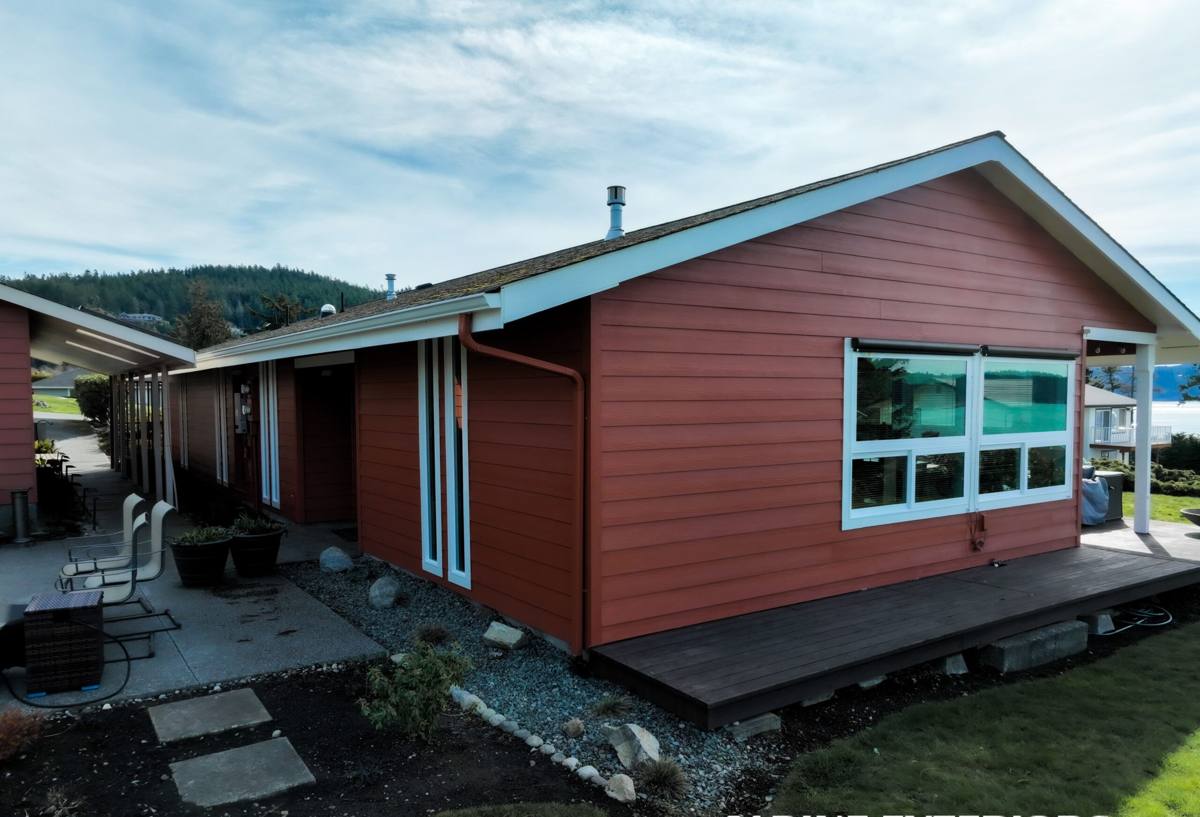
What Birch Bay's Climate Demands From Siding
Salt Air and Corrosion
Because Birch Bay is right on the water, homes here take on more direct salt exposure than properties even a few miles inland. Salt accelerates corrosion in fasteners, flashing, and trim, and it can break down lower-quality paint finishes faster than a drier climate would. Siding material matters, but so does every piece of hardware behind it — fastener grade and flashing choice have to account for salt exposure from the start, not as an afterthought.
Wind-Driven Rain
Waterfront exposure also means more wind, and wind-driven rain doesn't behave like a typical rain shower — it gets forced sideways into seams, laps, and penetrations. That's a heavier moisture load on a wall assembly than annual rainfall totals suggest. Siding and the drainage plane behind it need to be detailed for water moving sideways and upward under wind pressure, not just water running down the face of the house.
A Long Moss and Mildew Season
Mild temperatures, shade, and near-constant moisture add up to a moss and mildew season that runs much of the year across this stretch of Whatcom County. Shaded walls and anything under tree cover are usually the first places it shows up. Any siding material that's even slightly porous, or that holds moisture against its substrate, becomes a growth surface over time — which is a real problem for wood-based products in particular.
Why James Hardie Fiber Cement Is the Right Match Here
We install James Hardie fiber cement siding exclusively. We don't offer LP SmartSide, vinyl, Cemplank, Allura, primed spruce, or cedar, and that's a deliberate professional standard, not a limitation in what we're able to source. It came out of years of installing, inspecting, and repairing exterior siding in this specific kind of coastal, wet climate.
- Non-combustible core: Fiber cement doesn't feed a fire the way wood-based siding products can, which matters for safety and can matter for insurance considerations as well.
- Factory-applied ColorPlus finish: Color is baked on under controlled factory conditions instead of applied on-site, and it holds up longer against fading, chalking, and moisture intrusion than field-applied paint on wood-based products.
- Climate-engineered HZ formulation: Hardie's HZ5 product line is engineered for regions with heavy moisture exposure and freeze-thaw cycling, which describes waterfront Whatcom County accurately.
- Dimensional stability: Fiber cement doesn't swell, cup, or warp the way engineered wood or solid wood siding can after repeated wetting through a Pacific Northwest wet season.
- Strong transferable warranty: Hardie backs the product with one of the stronger warranty structures in the industry, as long as installation follows their published specifications.
Products like cedar and primed spruce have real appeal — they look good and plenty of homeowners are happy with them in drier climates. Engineered wood siding is generally more affordable upfront than fiber cement. Vinyl is low-maintenance in the sense that it doesn't need repainting. But each of those trade-offs shifts real risk onto the homeowner once you factor in Birch Bay's specific combination of salt, wind-driven rain, and moss — either in ongoing maintenance, in how the material handles sustained moisture, or in how well it holds up to direct salt exposure over decades. We'd rather install one system we fully stand behind than offer a cheaper option that trades short-term savings for long-term upkeep.
What a Correct Fiber Cement Installation Involves
Fiber cement only performs the way it's engineered to when it's installed to Hardie's published specifications — the material itself isn't what fails first on a poorly installed job, the installation details are.
Fastening and Clearances
Correct fastener type, spacing, and penetration depth matter for wind resistance and for keeping water out at every nail line. Clearance from grade, roof lines, and decks also matters — siding installed too close to the ground or to a roof plane will wick up moisture regardless of how good the material is.
Drainage Behind the Panels
In a climate that pushes rain sideways into a wall, drainage detailing behind the siding — a rain-screen gap or drainage plane, depending on the wall assembly — gives any moisture that does get past the surface a way out instead of a place to sit. This is one of the details that separates siding that lasts a couple of decades from siding that lasts three or four.
Joints and Trim
Factory-mitered corners, properly caulked butt joints, and correctly flashed trim around windows, doors, and roof-to-wall transitions are where most real-world leaks originate. A Hardie board installed with sloppy joint work will still develop moisture problems in this climate, even though the board itself is rated for it.
Signs Birch Bay Siding Needs Replacing, Not Just Patching
- Soft, spongy, or crumbling siding, especially near the base of walls or below windows
- Persistent moss or mildew on shaded or north-facing walls that keeps coming back after cleaning
- Visible warping, cupping, or buckling of individual boards or panels
- Paint that's peeling, bubbling, or chalking heavily rather than just fading evenly
- Interior wall staining or a musty smell near exterior walls, which often points to moisture already inside the assembly
- Gaps opening up at joints, corners, or trim where caulking has failed
One or two of these on their own might mean a repair. Several at once, or damage that's spread across multiple walls, usually means the underlying assembly has been taking on moisture for a while and a full replacement is the more honest recommendation.
Comparing Siding Materials for a Birch Bay Property
| Material | Moisture Behavior | Upkeep in Salt Air | Realistic Lifespan Here |
|---|---|---|---|
| James Hardie fiber cement | Dimensionally stable, resists swelling and cupping | Low; factory finish resists fading and chalking | 30+ years with correct installation |
| Vinyl siding | Can distort or warp under heat and UV over time | Low upfront, but seams and fasteners are exposure points | Variable; often shorter in direct wind-and-salt exposure |
| LP SmartSide / engineered wood | Wood-based core sensitive to moisture at cut edges and joints | Moderate; caulk and edge sealing need regular attention | Depends heavily on installation quality and upkeep |
| Cedar / primed spruce | Absorbs and releases moisture readily | High; regular refinishing needed in wet, salty air | Shorter without consistent, ongoing maintenance |
What Actually Drives the Cost of a Fiber Cement Siding Job in Birch Bay
| Factor | Why It Matters |
|---|---|
| House size and wall complexity | More corners, gables, and dormers mean more cuts, trim, and labor time |
| Condition of the existing wall assembly | Hidden rot or moisture damage found during tear-off adds repair work before new siding goes on |
| Siding profile chosen | Lap siding, board-and-batten, and shingle-style panels differ in material and labor cost |
| Drainage detailing needed | Adding or upgrading a rain-screen gap behind the siding adds material and labor but pays off in this climate |
| Access and site conditions | Steep grades, limited access, or extensive scaffolding affect labor time |
We won't quote a job without seeing the house, but these are the factors that actually move a number up or down, and any honest estimate should walk through them with you directly.
Our Process for a Birch Bay Fiber Cement Siding Replacement
We start with an on-site walkthrough of the existing siding and the wall assembly behind it, looking specifically for how moisture and salt exposure have affected the house so far — soft spots, failed joints, moss patterns, and any signs of trapped water. From there we put together a clear, written scope covering the siding profile, drainage detailing, and trim work, along with a realistic timeline, before any work begins.
During tear-off, we check the sheathing and framing underneath for hidden damage, since that's the point where problems are easiest to find and fix. New siding goes up with correct fastening, drainage detailing, and properly flashed joints as standard practice on every job — not as an upsell over a stripped-down installation. We walk the finished job with the homeowner before calling it done.
Why Hiring a Crew That Already Works Birch Bay Matters
A contractor who regularly works this stretch of coastline already knows how salt air, wind-driven rain, and a long moss season behave differently here than they do just a few miles inland. That familiarity shows up in the details that actually determine how long a siding job lasts — fastener grade, how joints and trim get sealed, and where extra drainage detailing gets added without being asked. A crew installing siding on Birch Bay for the first time is learning those lessons on your house; a crew that's already installed and repaired siding out here has usually learned them already.
A Quick Checklist Before Hiring for Siding Replacement in Birch Bay
- Ask what siding material they install and why, and whether they'll put that in writing along with a manufacturer warranty
- Confirm current Washington contractor licensing and active liability insurance
- Ask specifically how they handle drainage and flashing detailing for wind-driven rain, not just general moisture resistance
- Ask how they check for hidden rot or moisture damage during tear-off, and how that's handled if it's found
- Get a clear, written scope of work — profile, trim details, and timeline — before signing anything
If your Birch Bay home's siding is showing wear, or you're planning ahead for a replacement, we're happy to walk the exterior with you and give an honest, specific read on what it needs. Reach out below for a free, no-pressure estimate.