 Bellingham Siding
 Why Sunnyland's Siding Takes More Punishment Than You'd Think
Sunnyland sits close enough to Bellingham Bay that homes here deal with a combination most siding was never designed for: salt-laden air moving in off the water, long stretches of driving rain pushed sideways by wind, and a moss season that can run from October well into spring. None of these things alone is unusual for Whatcom County. Together, on the same wall, year after year, they add up to a workload that separates siding that was installed correctly from siding that was just installed.
Salt air is corrosive to exposed metal fasteners and trim, and it accelerates the breakdown of lower-grade paint finishes faster than inland neighborhoods ever see. Driving rain finds every gap in flashing and caulk and drives water sideways into seams that would stay dry in a calmer climate. And moss doesn't just sit on a roof — it colonizes damp, shaded siding too, especially on north-facing walls and under eaves where sun never reaches long enough to dry things out. A siding system that isn't built and installed for this combination will show it early: chalking paint, soft trim, streaking, and swelling at the seams.
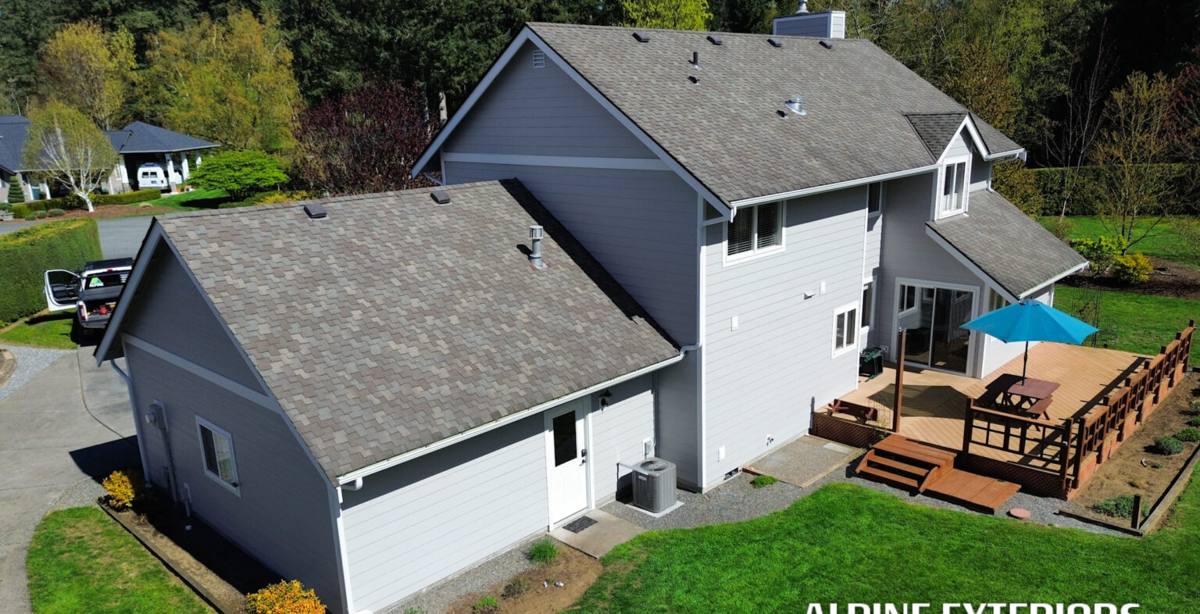
What Fiber Cement Siding Needs to Do in This Neighborhood
Fiber cement is a good starting point for Sunnyland because the base material — cement, sand, and cellulose fiber — doesn't rot, doesn't feed moss the way wood fiber does, and doesn't warp with repeated wetting and drying. But the material alone isn't the whole story. Three things determine whether a fiber cement installation actually performs here:
- Moisture management behind the siding — a drainage plane and properly lapped weather-resistive barrier so any water that gets past the surface has somewhere to go besides your sheathing.
- Correct fastening and clearances — siding nailed too tight, with no gap at trim and no clearance off grade or roof lines, traps moisture right where it can't dry.
- A factory finish that actually holds up to salt air and UV — field-painted cement board depends entirely on the installer's prep and the paint chosen; a factory-baked finish removes that variable.
Get all three right and fiber cement siding in Sunnyland can go decades with only routine cleaning. Get any one wrong and you're looking at premature caulk failure, paint breakdown, or moisture intrusion behind the boards — problems that are expensive to fix because they're hidden until they're not.
Why We Only Install James Hardie Fiber Cement
Not all fiber cement siding is built the same way, and we've made a deliberate choice to install James Hardie exclusively rather than other fiber cement brands on the market. A few reasons that matter specifically for a neighborhood like Sunnyland:
Climate-Engineered Product Lines
James Hardie makes region-specific HZ formulations rather than one generic board sold everywhere in the country. For the Pacific Northwest's wet climate, that means a product engineered around resisting moisture-related damage in exactly the conditions Bellingham sees — not a board designed for a dry Southwest market and sold here as a one-size-fits-all.
ColorPlus Factory Finish
Rather than relying on field-applied paint, Hardie's ColorPlus finish is baked on at the factory in multiple coats under controlled conditions. In a salt-air environment, that finish resists fading and chipping far longer than a job-site paint job, and touch-up product is available to match it when trim gets nicked during normal life.
Non-Combustible Composition
Fiber cement is non-combustible, which matters increasingly for insurance considerations and general home safety, regardless of region.
A Warranty Backed by the Manufacturer
Hardie's transferable limited warranty is tied to their own product and finish system, which simplifies claims compared to piecing together warranty coverage across a separate substrate and a separate paint manufacturer.
We don't install LP SmartSide, vinyl, Cemplank, Allura, or primed wood siding — not because every one of those products is without merit, but because we'd rather stand behind one system we know performs in this exact climate than offer several and hope each one holds up equally well on a home a mile from the water.
Signs Your Current Siding Is Losing the Fight
If you're in Sunnyland and wondering whether it's time to look at replacement rather than another round of patching, a few signs tend to show up in this climate before others:
| What You're Seeing | What It Usually Means |
|---|---|
| Persistent moss or green streaking on north or shaded walls | Siding surface is staying damp longer than it should, often due to poor drying conditions or failing paint |
| Soft or crumbling trim, especially near ground level or roof lines | Wood trim components absorbing water — common failure point even on otherwise sound wood siding |
| Paint that's chalking, peeling, or badly faded within a few years | Field-applied finish not holding up to UV and salt air exposure |
| Visible gaps or cracked caulk at seams and trim joints | Water pathway behind the siding — a priority to address before it reaches sheathing |
| Boards that feel warped, bowed, or separated from the wall | Moisture cycling has compromised the board itself, common with wood-based or improperly installed products |
How We Approach a Sunnyland Siding Project
1. On-Site Assessment
We walk the exterior with you, looking specifically at the sides of the home that take the worst of the weather — usually the walls facing the prevailing wind and rain, and any shaded areas prone to moss. We check trim, flashing at windows and rooflines, and look for soft spots that indicate moisture has already gotten behind the existing siding.
2. Tear-Off and Sheathing Check
Once old siding comes off, we inspect the sheathing underneath. This is the step that gets skipped by crews trying to move fast, and it's the step that matters most in a wet climate — installing new siding over compromised sheathing just buries the problem.
3. Weather-Resistive Barrier and Drainage
We install a properly lapped weather-resistive barrier with a drainage gap behind the siding, so incidental moisture has a path to drain and dry rather than sitting against the wall assembly.
4. Hardie Installation to Spec
Fastening, clearances at grade and roofline, and joint treatment all follow Hardie's published installation requirements — not shortcuts. This is also what keeps the manufacturer's warranty intact if you ever need it.
5. Trim, Caulking, and Finish Detail
The seams and trim joints are where driving rain finds its way in if they're rushed. We take the time here because it's the difference between siding that looks right for a year and siding that performs for decades.
6. Final Walkthrough
We go over the finished work with you directly, including what routine maintenance looks like for your specific home and exposure.
What Affects Cost for a Sunnyland Home
Every home is different, but a few factors consistently move the price on a fiber cement siding project in this neighborhood:
| Cost Factor | Why It Matters |
|---|---|
| Total square footage and home height | More surface area and multi-story access both add labor time |
| Amount of trim, corners, and window/door detailing | Detail work is slower and more material-intensive than flat wall runs |
| Condition of existing sheathing | Rot repair discovered during tear-off is priced separately from the siding itself |
| HZ5 product selection and profile (lap, shingle, panel) | Profile and plank width affect both material cost and install time |
| ColorPlus color choice vs. field-painted finish | Factory finish carries a different cost structure than site-applied paint, but lasts longer |
| Existing siding removal and disposal | Tear-off labor and haul-away add to the scope beyond the new install |
We give you an itemized, honest estimate before any work starts — no vague lump sums, and no pressure to decide on the spot.
Maintaining Fiber Cement Siding in a Moss-Prone, Salt-Air Climate
Correctly installed Hardie siding is low-maintenance, not no-maintenance. A little routine attention goes a long way in Sunnyland's conditions:
- Rinse siding annually, focusing on shaded and north-facing walls where moss and mildew take hold first
- Keep gutters clear so overflow doesn't run down the wall face and stay against the siding
- Trim back vegetation and tree branches that keep any section of wall in permanent shade or damp contact
- Check and re-caulk trim joints if you notice cracking, rather than waiting for a full failure
- Watch for any soft spots at grade level, where splashback and standing water are most likely
- Touch up any chips or scratches with matched ColorPlus touch-up product before bare edges are exposed to weather
Why It Matters That We Already Work in Sunnyland
A crew that's worked this specific pocket of Bellingham knows which walls take the worst of the weather off the bay, understands Whatcom County's permitting and inspection expectations, and isn't guessing at how a product will hold up here — we've already seen how it performs on homes like yours. That local familiarity shows up in small decisions during a project: where to add extra flashing attention, which product profile handles this exposure best, and what maintenance schedule actually makes sense for a home with this orientation and shade pattern. It's the difference between a crew executing a generic install and a crew that's solving for Sunnyland specifically.
Get a Straightforward Estimate
If your siding is showing wear, or you're planning ahead before it becomes an urgent repair, we're happy to take a look and give you a clear, no-pressure estimate for James Hardie fiber cement siding on your Sunnyland home. Fill out the form below and we'll get in touch to schedule a time that works for you.