 Bellingham Siding
 Building a Deck That Actually Suits Sudden Valley
Sudden Valley sits in a different microclimate than a lot of Bellingham. The tree cover is heavier, the lots slope more, and Lake Whatcom's proximity keeps humidity and shade lingering longer into the day than you'll find on an open, sun-exposed lot closer to downtown. That combination is great for privacy and views, but it's tough on a deck. A design that would hold up fine on a dry, open lot in another part of Whatcom County can fail early here if it wasn't built with this specific setting in mind.
A custom deck for a Sudden Valley home isn't just about picking a nice railing style or a composite color. It's about understanding how shade, tree debris, moss, and driving rain off the lake interact with the structure over years, not just the first season.
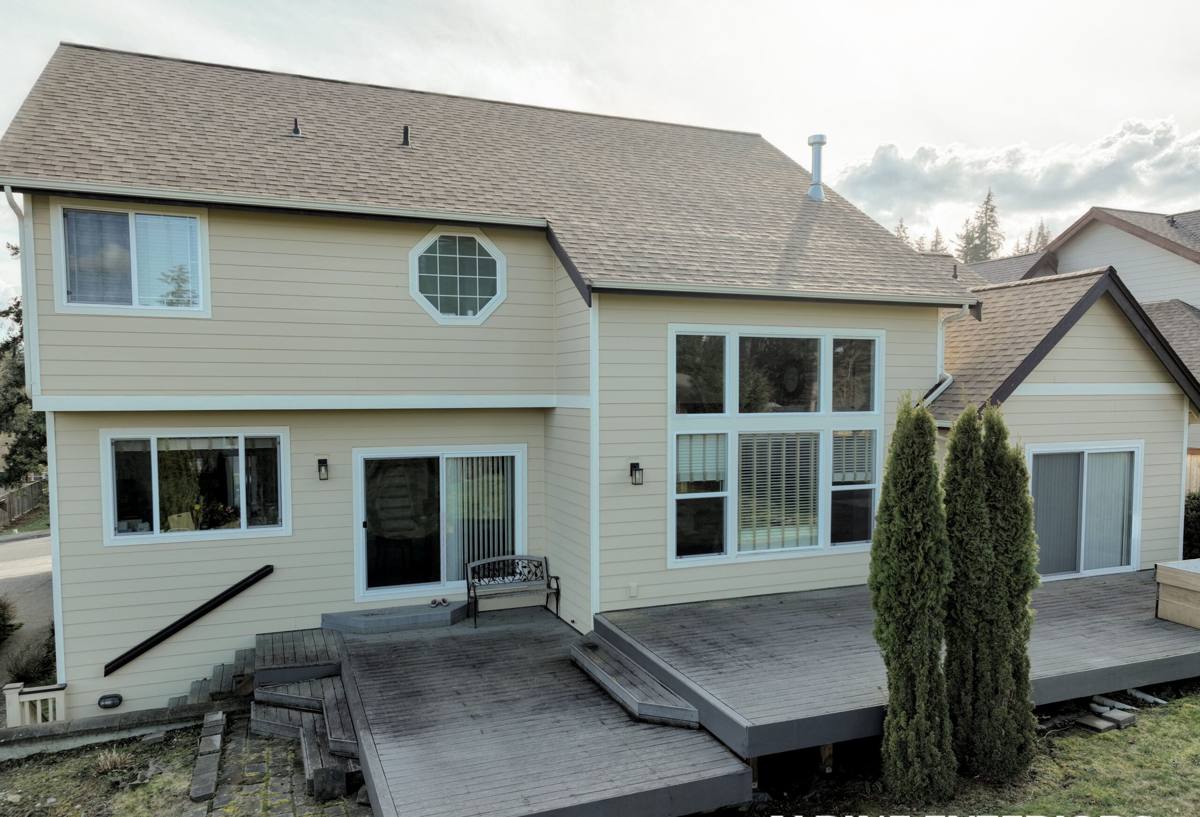
What the Local Climate Does to a Deck
Three things shape how we build decks in this neighborhood:
Persistent Shade and Moisture
Heavy tree canopy means many Sudden Valley decks stay damp long after a storm has passed elsewhere in Bellingham. Wood surfaces that don't get afternoon sun can stay wet for days at a time during the wetter months, which accelerates rot in untreated framing and speeds up mildew and algae growth on decking boards.
A Long Moss Season
Moss doesn't just grow on roofs. On a shaded deck, spores settle into the grain of wood decking, into fastener heads, and into any low spot where water sits. Once moss establishes, it holds moisture against the board surface around the clock, which is exactly the condition that breaks down both wood fiber and the surface layer of lower-grade composite decking. In a neighborhood with this much tree cover, moss isn't an occasional nuisance — it's a season that has to be designed around.
Driving Rain and Wind Off the Water
Being close to Lake Whatcom means weather doesn't always come straight down. Wind-driven rain gets pushed sideways under railings, into ledger connections, and behind fascia boards. If flashing details and gaps weren't handled correctly at installation, water finds its way into framing that was never meant to get wet, and you don't see the damage until it's already advanced.
What a Correctly Built Deck Involves Here
None of this means a deck in Sudden Valley has to be over-engineered or unusually expensive. It means a handful of details get treated as non-negotiable rather than optional upgrades:
- Ledger board flashing that sheds water away from the house rim joist, not just a bead of caulk behind the board
- Joist tape or a comparable membrane on every top-cut joist surface, since exposed end grain is where rot starts fastest in a shaded, damp setting
- Corrosion-resistant fasteners and hardware rated for the moisture level this site sees, not standard-grade hardware
- Footings sized and depth-checked for the actual soil and slope on the lot, since many Sudden Valley parcels aren't flat
- Board spacing and airflow underneath the deck that lets shaded areas dry out between rain events instead of staying saturated
- A decking material chosen with this specific shade and moisture load in mind, not just for looks
Skip any one of these and the deck may look fine for a year or two, then start showing soft spots, staining, or movement right around the time a homeowner assumes it should still be "new."
Choosing the Right Decking Material for a Shaded, Wet Lot
There's no single right answer for every deck, but in a heavy-shade, high-moisture setting like Sudden Valley, some materials handle the conditions noticeably better than others.
| Material | How It Handles Shade & Moss | Maintenance Load | Typical Lifespan Here |
|---|---|---|---|
| Pressure-treated wood | Absorbs moisture readily; needs consistent sealing to resist moss and rot in shaded areas | High — annual cleaning and periodic re-sealing | 10–15 years with upkeep |
| Cedar | Naturally rot-resistant but still needs sealing where it stays shaded; can gray and hold moisture if neglected | Moderate to high | 15–20 years with upkeep |
| Capped composite | Solid cap layer resists moisture absorption; still needs regular cleaning to keep moss from taking hold on the surface texture | Low to moderate — occasional washing | 25–30 years |
| PVC decking | Doesn't absorb moisture, so it's the most resistant to rot; surface still needs periodic cleaning in heavy-shade spots | Low | 25–30+ years |
We don't push one product on every homeowner. A cedar deck on a partially shaded lot can be the right call if someone's willing to keep up with sealing. But on the deepest-shade lots in this neighborhood, we're honest that a capped composite or PVC product will save a lot of scrubbing and re-sealing over the years, and we'll walk through the real maintenance trade-offs rather than just the upfront cost.
A Note on Cheaper Composite Boards
Not all composite decking is built the same. Older or lower-grade composite formulations without a full cap layer can absorb moisture at the surface, which in a shaded, moss-prone spot means algae and moss can take hold faster than most homeowners expect from a "low-maintenance" product. Our standard is to spec fully capped boards on shaded installations specifically because of how this neighborhood's tree cover behaves — it's a maintenance and moisture-performance decision, not a brand preference.
Designing Around Sudden Valley's Terrain
A lot of homes here sit on sloped, wooded lots with views toward the lake or the surrounding tree line. That changes the engineering, not just the aesthetics:
- Taller decks on sloped lots need engineered footings and bracing that a flat-lot deck wouldn't require
- Railing height and spacing need to meet current code, especially on elevated decks where a fall risk is real
- Tree roots near the build site can affect footing placement and sometimes require adjusting the layout to avoid root damage
- Drainage below and around the deck needs a real plan so runoff isn't directed against the house foundation or a neighboring slope
If your property falls under Sudden Valley community design guidelines or setback requirements, we account for that during the design phase, not after materials are already ordered.
Our Process for a Sudden Valley Deck Project
1. On-Site Assessment
We walk the actual site — the slope, the shade pattern through the day, existing drainage, and how close the build is to trees — before any design conversation happens. A deck plan that ignores the site's shade and grade is a plan built for the wrong house.
2. Design and Material Selection
We talk through layout, railing style, and decking material with the real maintenance trade-offs on the table, not just the upfront price. If low-maintenance matters more to you than upfront cost, we'll say so plainly.
3. Permitting
Deck permitting requirements depend on height, size, and attachment to the house. We handle the paperwork with the applicable local building department so the project isn't left in limbo or built out of compliance.
4. Construction
Framing, flashing, and fastening are done to the standard described above — not the minimum standard, the one that actually holds up in this specific setting. We don't skip joist tape or flashing details to save an afternoon.
5. Finish and Walkthrough
Before we call it done, we walk the deck with you — railing feel, board spacing, drainage under the structure — so nothing gets discovered after the fact.
Living With a Deck in This Climate
Even a well-built deck needs some seasonal attention in a shaded, moss-prone neighborhood like this one. A short annual routine keeps a good deck good:
- Sweep debris and standing leaf litter off the deck surface regularly through fall, since trapped organic matter holds moisture and feeds moss
- Clean moss and algae off boards before it establishes deep in the grain, rather than waiting until it's visibly thick
- Check that gaps between boards haven't filled with debris that blocks drainage and airflow
- Inspect ledger flashing and railing posts once a year for any sign of water intrusion
- Re-seal wood decking on the schedule the manufacturer recommends — skipping a year in this climate matters more than it would in a drier part of the county
Why It Matters That We Already Work in Sudden Valley
A deck crew that mostly builds on flat, open lots elsewhere in Bellingham isn't automatically wrong for a job here, but they're guessing at conditions we already know firsthand — how fast moss establishes under this tree cover, how driving rain off the lake behaves against a ledger board, and what the sloped, wooded lots in this neighborhood actually require from footings and drainage. That familiarity shows up in fewer surprises during the build and a deck that's still solid well past the point where a poorly detailed one would start showing problems.
If you're planning a new deck, replacing an aging one, or aren't sure whether your current deck's framing is still sound under the surface, we're happy to take a look and talk through honest options — no pressure, no obligation. Fill out the form below and we'll set up a free estimate for your Sudden Valley property.