 Bellingham Siding
 Siding in Puget: What This Neighborhood's Homes Are Up Against
Puget is one of the quieter residential pockets on Bellingham's south side, a mix of older single-family homes and newer infill sitting on lots with real tree cover and, in a lot of cases, walls that don't get much direct sun for long stretches of the year. That combination, shade plus moisture plus age, is exactly the profile where siding problems show up first. This page is about one thing only: James Hardie fiber cement siding, installed correctly, on Puget homes specifically, not a general rundown of every siding option on the market.
We install James Hardie exclusively. That's not a marketing angle, it's the product line we've chosen to stand behind after years of estimates, tear-offs, and repair calls across Whatcom County, and Puget's mix of shaded lots and older housing stock is a good example of why that decision holds up here.
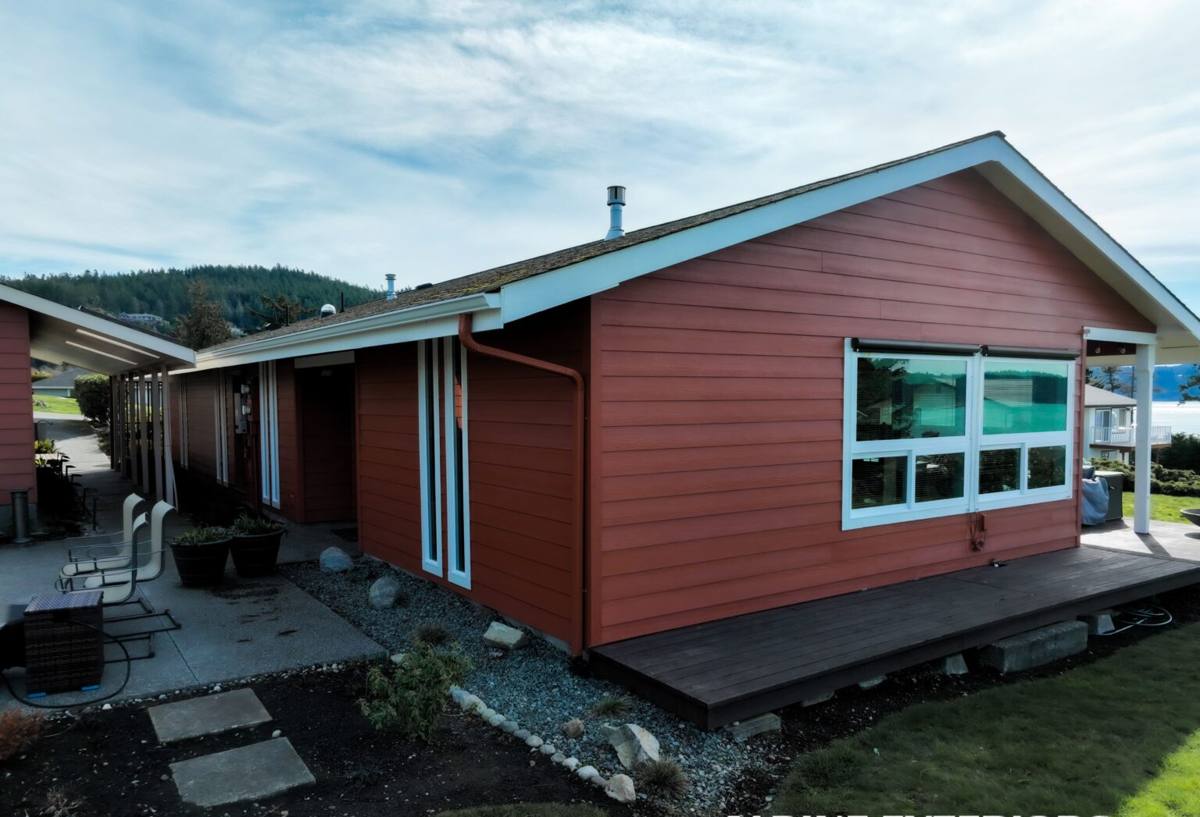
Salt Air, Driving Rain, and Moss: The Three-Part Test
Bellingham homes deal with three climate factors that compound each other rather than acting alone, and Puget's lots see all three.
Salt-Laden Air Off Bellingham Bay
Puget sits close enough to Bellingham Bay that salt-tinged marine air reaches most of the neighborhood, not just the properties with a water view. Salt exposure speeds up the breakdown of paint films and accelerates corrosion on fasteners, trim hardware, and any exposed metal flashing. It's a slow effect, not a dramatic one, which is exactly why it gets overlooked until a siding job is already twenty years old and showing it.
Wind-Driven Rain
Rain in this part of Whatcom County rarely falls straight down for long. Storm systems push it sideways against west- and south-facing walls, and that wind-driven pattern forces water into lap joints, under trim, and into any seam where flashing or caulking isn't detailed correctly. A siding product's rating on a spec sheet matters less here than how well it's actually installed against that kind of exposure.
A Moss Season That Runs Most of the Year
Puget's tree cover is part of what makes the neighborhood pleasant to live in, and it's also what keeps shaded walls and rooflines damp for months at a stretch. Moss and mildew take hold on organic siding surfaces especially easily under those conditions, and once growth establishes itself, it traps moisture against the wall behind it. That's where a lot of long-term rot problems actually start, not from a single storm but from months of low-grade dampness with nowhere to dry out.
Why James Hardie Is the Product We Install in Puget
We used to install a broader range of siding products. What changed our minds was watching how different materials actually performed on homes in shaded, moisture-heavy settings like this one, over years, not just through the first winter. Vinyl's lapped, unsealed joints aren't built for sustained wind-driven rain. Engineered wood and primed wood products depend on an intact factory or field-applied coating holding up indefinitely, and every fastener penetration or field cut is a point where that coating can fail. Cedar and primed spruce are organic and combustible, and moss finds an organic surface especially hospitable in a climate that stays damp most of the year.
James Hardie fiber cement is a blend of Portland cement, sand, and cellulose fiber, cured into rigid boards. It's inorganic, so it doesn't have a wood-based core that can swell, rot, or feed insects, and it's non-combustible. None of that means it's maintenance-free or that installation quality stops mattering. It means the material itself is working with the climate here instead of against it.
Choosing the Right Line and Profile for a Puget Home
James Hardie builds different product lines for different climate zones, and the HZ5 line is engineered for regions with freeze-thaw cycles and sustained moisture exposure, which fits Whatcom County's winters better than a line engineered for hot, dry regions. On profile, most Puget homes we've worked on suit either traditional lap siding, which reads close to the existing character of the neighborhood's older housing stock, or board and batten for a more vertical, contemporary look on newer builds and additions. Neither profile is objectively better; it comes down to what fits the house and what the homeowner wants it to look like once it's done.
Color matters more here than in a drier climate, because a coating that fades or chalks under UV and salt exposure shows fast against Bellingham's gray-sky backdrop. Hardie's ColorPlus finish is baked on in multiple coats at the factory rather than applied on site, and it carries its own finish warranty separate from the substrate warranty, which is worth understanding before you pick a color and move on.
What Correct Installation Actually Involves
Fiber cement's real-world performance depends more on installation quality than almost any other siding material on the market. A rushed crew that treats Hardie boards like an interchangeable swap for whatever they usually hang can undercut the product's advantages entirely.
| Installation Detail | Why It Matters for a Puget Home |
|---|---|
| Manufacturer clearances at grade, roofline, and deck ledgers | Keeps splash-back and standing moisture off the board edge on shaded, slow-drying lots |
| Correct fastener type, spacing, and depth | Prevents cracking and keeps the water-resistive barrier behind the siding intact |
| Flashing at every window, door, and penetration | Directs wind-driven rain off the wall instead of into the seam |
| Factory-cut edges used wherever possible, field cuts sealed to spec | Preserves the factory finish's protection everywhere the boards are exposed |
| Rain screen or drainage plane behind the siding | Gives any moisture that gets past the surface a path to drain and dry, critical on shaded walls that don't get direct sun to help dry them out |
We send certified installers to every Puget job for this reason. The material resists moisture and combustion on its own, but the installation details around it are what actually determine how it performs twenty years in.
Our Process, Start to Finish
The steps don't change much from job to job, but the details we look for shift based on the property.
- Walk-through and assessment. We look at the current siding, sheathing condition where it's visible, tree cover and shade exposure, and any signs of moisture damage around windows, trim, or the foundation line.
- Straight recommendation. We tell you what we'd install, which Hardie line and profile fits the house, and why, based on what we actually saw on your property, not a standard script.
- Written estimate. Material, labor, and any anticipated sheathing repair are itemized so there aren't surprise line items once the old siding comes off.
- Tear-off and inspection. Once the existing siding is off, we inspect the sheathing underneath for rot or moisture damage that wasn't visible before, and flag anything that needs repair before new siding goes on.
- Installation to manufacturer spec. Clearances, fastening, flashing, and drainage detailing are done to James Hardie's published specifications, not shortcuts.
- Final walk-through. We go over the finished job with you before calling it done.
What It Costs and What Drives the Price
Every Puget property is a little different, but a few factors consistently move the number more than anything else.
| Cost Factor | Why It Moves the Price |
|---|---|
| Square footage and wall complexity | More corners, gables, and trim detail mean more labor and cutting |
| Sheathing condition once old siding is off | Rot or moisture damage found underneath adds repair scope that can't be fully known until tear-off |
| Profile choice (lap vs. board and batten vs. panel) | Labor and trim requirements differ by profile |
| Access and site conditions | Tree cover, tight side yards, and multi-story walls affect scaffolding and staging |
| ColorPlus color and trim package | Some colors and accessory trim options carry different material costs |
Fiber cement generally costs more upfront than vinyl and is comparable to or somewhat above engineered wood, but it doesn't carry the repainting or recaulking schedule that wood-based products do, which changes the math over a fifteen- or twenty-year ownership horizon.
Why a Crew That Already Works This Neighborhood Matters
Puget isn't a large neighborhood, but its lots vary more than they look like they should from the street, older homes next to newer infill, heavy tree cover on some blocks and open exposure on others. A crew that's already worked here has a feel for which walls actually get direct sun, where the wind tends to drive rain hardest, and how the local sheathing and framing typically age under this specific mix of shade and moisture. That's not something a spec sheet or a generic estimate template captures. It shows up in small decisions on site, like where to add extra flashing attention or which side of the house needs a closer look at the sheathing before committing to a scope.
Before You Hire: A Quick Checklist
Whether you go with us or get a second opinion, these are worth confirming before signing anything:
- Ask whether the crew is manufacturer-certified for James Hardie installation specifically, not just experienced with siding in general.
- Ask which HZ line and profile they're proposing and why it fits your property's exposure.
- Ask what happens if hidden sheathing damage turns up once the old siding is removed, and get that answer in writing.
- Ask what the warranty covers, whether it's prorated, and whether it transfers if you sell the home.
- Ask to see the manufacturer's installation spec sheet and compare it against the crew's actual plan for clearances, flashing, and fastening.
Get a Free, No-Pressure Estimate
If your Puget home is due for a re-side, or you're just not sure whether what's on the walls now is still doing its job, we're glad to take a look. Reach out using the form below to schedule a free estimate, no pressure and no upsell script.