 Bellingham Siding
 Lynden's Climate Is Harder on Siding Than It Looks
Lynden sits in the Nooksack Valley, a few miles south of the Canadian border, in one of the wettest and most humid corners of Whatcom County. The farmland and tree cover that make the area beautiful also keep moisture close to the ground for most of the year. Homes here deal with long stretches of steady rain, heavy morning dew off the fields, and short summers that don't give siding much time to fully dry out between wet spells.
That constant dampness is the real enemy of exterior siding, not any single storm. Wood-based and wood-adjacent products absorb moisture slowly, over months and years, and once it's inside the material it doesn't leave easily. The result on a lot of older Lynden homes is soft trim, swollen panel edges, and dark green-black staining low on the wall and under eaves where airflow is worst. None of that is a sign of a bad house — it's what this climate does to the wrong siding material over time.
Add in Whatcom County's broader marine-influenced weather pattern — the same driving rain and salt-tinged air that moves inland off the Sound during winter storms — and you've got a combination that rewards materials engineered specifically for wet, humid, low-drying-time environments. That's the standard we hold every siding job to, whether it's a farmhouse outside town or a newer build closer to Front Street.
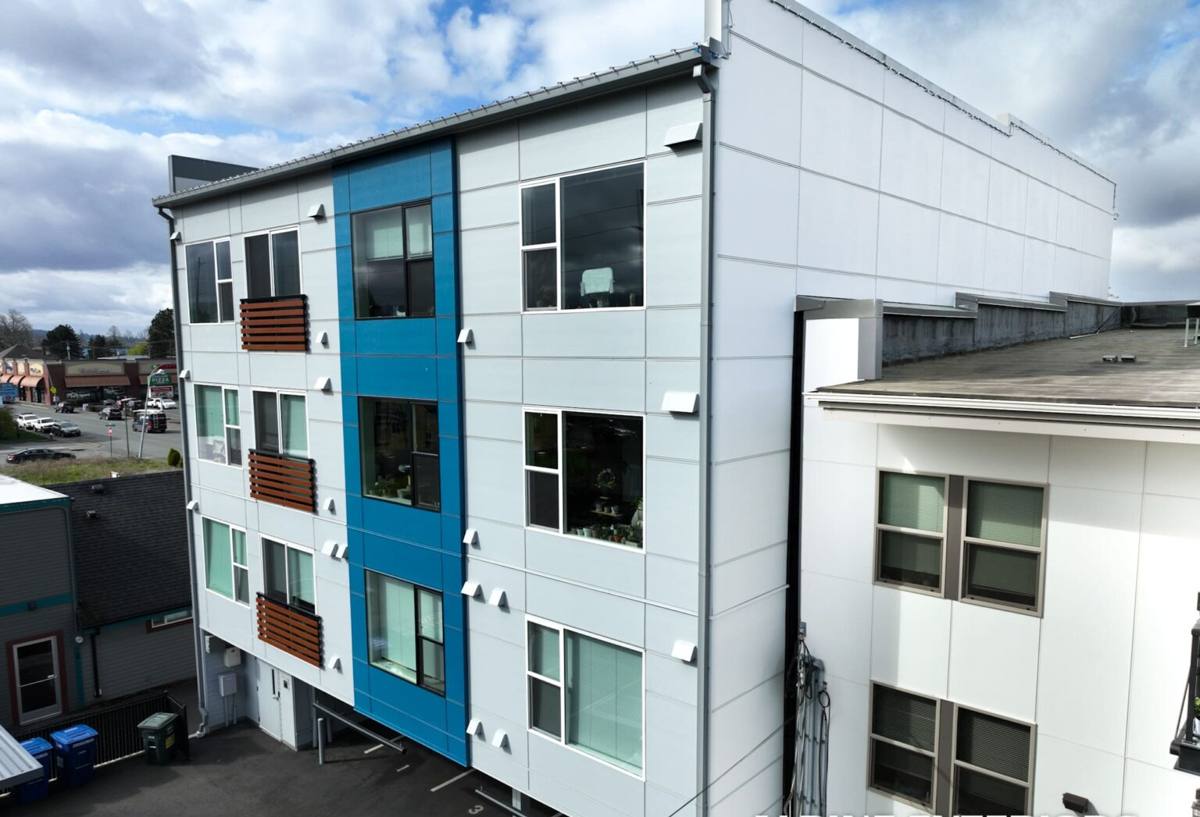
What Fiber Cement Actually Solves
Fiber cement siding is a mix of Portland cement, sand, and cellulose fiber, cured into a rigid plank. Unlike wood or wood-composite siding, it doesn't have organic material sitting exposed on the surface for mold and moss spores to feed on, and it doesn't swell and shrink with every wet-dry cycle the way wood does. That matters enormously in a place like Lynden, where the siding rarely gets a long uninterrupted dry stretch to reset.
Non-Combustible by Composition
Fiber cement is also non-combustible, which is a genuine safety advantage over wood, vinyl, and most composite sidings — not a marketing point. For a property near open fields or with any wildfire exposure risk in a dry August, that's not nothing.
Engineered for Moisture, Not Just Resistant to It
James Hardie builds its siding on what it calls HZ5 and HZ10 engineering — formulations tuned to specific climate zones for moisture and freeze-thaw performance. Western Washington, including Whatcom County, falls into the HZ5 zone, which is engineered around exactly the conditions Lynden sees most: sustained dampness, moderate winters, and repeated wet-dry cycling rather than deep freezes.
Why We Only Install James Hardie
We install James Hardie fiber cement exclusively. We don't install vinyl, LP SmartSide, Cemplank, Allura, primed spruce, or bare cedar, and we're upfront about why: every one of those products asks the homeowner to accept a trade-off we're not willing to put our name behind in this climate. Vinyl flexes, fades, and can crack in cold snaps. LP SmartSide is a wood-strand product — better engineered than old-school hardboard, but still wood at its core, still vulnerable to edge swelling if a seam or cut edge isn't perfectly sealed and maintained. Primed spruce and cedar look great on day one and require the most upkeep of anything on this list.
Hardie isn't magic — it still has to be installed correctly, with the right gaps, flashing, and fastening, or it will fail like anything else. But the base material gives us a much wider margin for error against Lynden's weather than the alternatives do, and it comes backed by a real, transferable non-prorated warranty on the substrate.
| Material | Moisture behavior in wet climates | Maintenance burden | Fire rating |
|---|---|---|---|
| James Hardie fiber cement | Engineered for HZ5 zone; resists swelling and rot | Repaint every 12-15+ yrs with ColorPlus finish | Non-combustible |
| Vinyl | Doesn't rot, but can warp/crack in temperature swings | Low, but limited repair options | Combustible |
| LP SmartSide | Wood-strand core; vulnerable at cut edges and seams | Moderate to high; edge sealing critical | Combustible |
| Cedar / primed spruce | Absorbs moisture; prone to swelling, rot, moss growth | High; refinishing every few years | Combustible |
What a Correct Installation Looks Like Here
The siding material is only half the equation. In a high-moisture area like Lynden, the installation details matter as much as the product itself, and this is where a lot of siding jobs — regardless of brand — quietly fail.
Water Management Behind the Siding
Every job starts with a proper water-resistive barrier and correctly lapped flashing at every window, door, and horizontal trim transition. Fiber cement is durable, but it's not waterproof at the seams — the barrier and flashing system behind it is what actually keeps bulk water out of the wall assembly. This is the step that gets rushed on lower-bid jobs, and it's the one that causes the most expensive problems years later.
Clearances and Gaps
James Hardie specifies minimum clearances from grade, roof lines, and decks, and gaps at every butt joint and trim intersection, sealed with a flexible, paintable sealant rated for exterior use. Skipping these gaps to make a "tighter" looking joint is one of the most common installation mistakes we see on older or improperly installed Hardie jobs in this area — it traps moisture instead of letting it drain and dry.
Fastening for Wind and Wet-Dry Cycling
Correct fastener placement and count matter more in a climate that never fully dries out, since panels experience more expansion and contraction stress over their lifespan than they would in a drier region. We follow Hardie's fastening schedule to the letter, not a shortcut version.
Our Process, Start to Finish
- Walkthrough and assessment — we look at the existing siding, trim, flashing condition, and any moisture or moss damage before quoting anything.
- Written estimate — clear scope, product line, color, and timeline, no pressure to sign on the spot.
- Prep and tear-off — removal of old siding, inspection of sheathing for rot or soft spots, repair of any damaged framing before new material goes up.
- Water barrier and flashing — house wrap and flashing installed and lapped correctly at every penetration.
- Hardie installation — panels, trim, and fasteners installed to manufacturer spec, with correct gaps and clearances.
- Caulking and paint touch-up — factory ColorPlus finish means minimal field painting, mostly limited to cut edges and fastener heads.
- Final walkthrough — we go over the finished job with the homeowner before calling it done.
Living with Fiber Cement Siding in a Moss-Prone Area
Even the right material needs basic upkeep in a climate like this. Fiber cement won't rot from moss the way wood can, but moss, algae, and lichen can still grow on the painted surface, especially on north-facing walls and anywhere shaded by trees — common conditions on Lynden lots with mature landscaping. Left alone for years, that growth holds moisture against the finish and shortens paint life.
- Rinse siding with a garden hose or soft wash setting once or twice a year, focusing on shaded and north-facing walls
- Keep gutters clear so overflow doesn't run down the siding face
- Trim back shrubs and tree branches to maintain airflow and sunlight along the wall
- Check caulking at trim joints and window flashing annually for cracking or gaps
- Address any soft or discolored trim boards promptly — they're usually not Hardie, but wood trim used alongside it
- Avoid pressure washing directly at seams and joints, which can force water behind the panels
What Drives Cost on a Lynden Project
Every home is different, but a few factors consistently move the price on fiber cement projects in this area. We give exact numbers only after a walkthrough, but this is what to expect going into a conversation.
| Factor | Why it matters |
|---|---|
| Existing siding removal | Tear-off and disposal of old material adds labor, especially with multiple layers |
| Sheathing/framing condition | Rot or moisture damage found during tear-off requires repair before new siding goes on |
| Home size and complexity | Dormers, multiple stories, and detailed trim increase labor time |
| Product line and profile | Lap width, texture, and trim style affect material cost |
| Access and site conditions | Tree cover, fencing, and setbacks common on larger Lynden lots can affect staging and scaffolding needs |
Why Local Experience Matters
Contractors who don't work this area regularly tend to under-detail the water management side of a siding job, because they're used to drier climates where those shortcuts don't show up as problems for years. A crew that installs siding in and around Lynden and the rest of Whatcom County on a regular basis knows how this weather behaves month to month, what clearance and flashing details actually hold up here, and what local permitting and inspection expect. That familiarity shows up in fewer callbacks and a siding job that's still performing well a decade or more after installation, not just on the day it goes up.
If you're thinking about siding replacement on a Lynden home, we're happy to take a look and give you a straightforward, no-pressure estimate — including an honest read on what's actually driving any moisture or moss issues you're seeing now.