 Bellingham Siding
 Composite Decking for Lynden: Built for the Weather You Actually Get
Lynden sits in a part of Whatcom County that sees more rain than sun for a good chunk of the year, and that moisture doesn't stay in the clouds — it settles into wood, works its way under paint and stain, and feeds moss that never really goes dormant. A deck built here has to shed water fast, resist rot at every joint, and hold its footing through freeze-thaw swings in the winter months. Composite decking, installed correctly, is one of the better answers to that problem. This page covers what that actually means for a Lynden property, not a generic decking pitch.
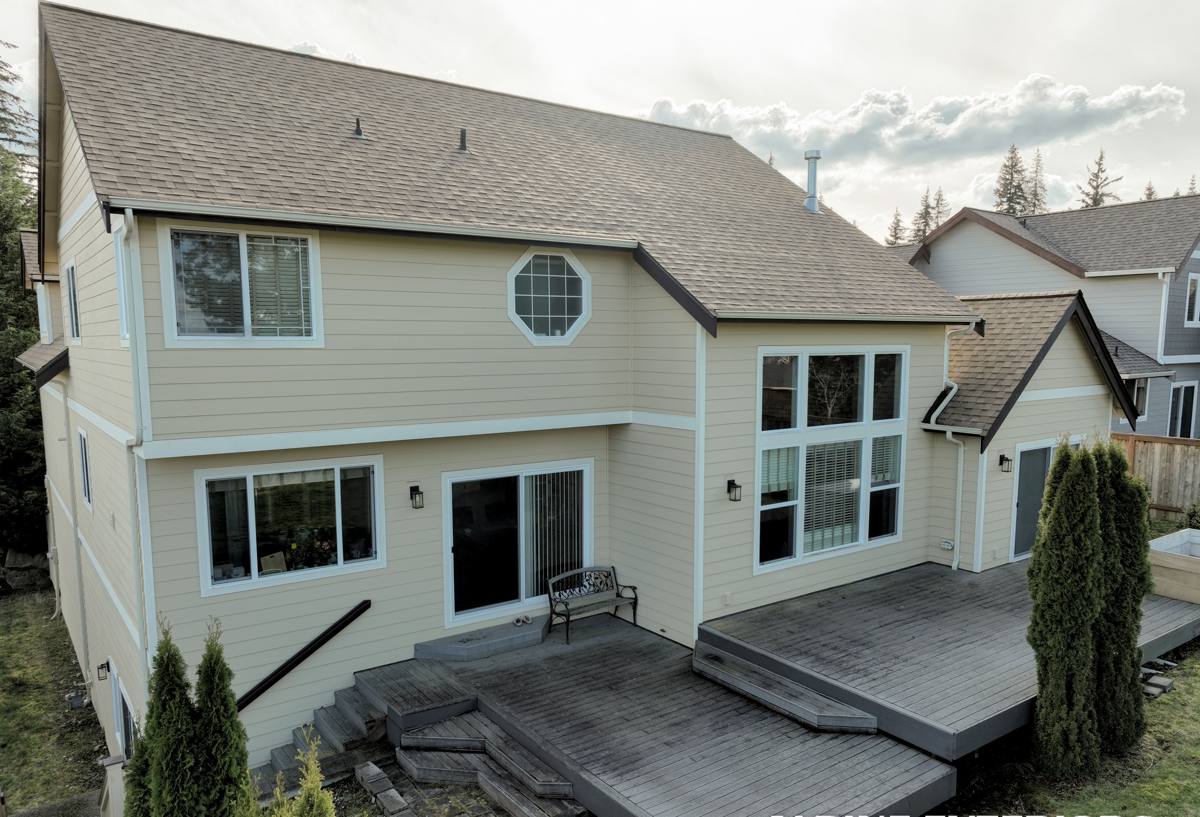
What Whatcom County Weather Does to a Deck Over Time
Homeowners in Lynden and the surrounding farmland don't need us to tell them it rains a lot — they live it. But it's worth breaking down exactly how that plays out on a deck surface over several seasons:
- Driving rain pushed sideways by wind gets under railings, into end-grain cuts, and behind ledger boards where it can sit for days without drying.
- Long moss season — often stretching from fall through spring — means anything with a rough or porous surface becomes a growing medium, not just a stain problem.
- Marine-influenced air moving in off the Salish Sea and Puget Sound region carries persistent moisture inland across Whatcom County, keeping humidity higher near ground level than drier parts of the state see.
- Freeze-thaw cycling in winter opens up small cracks in wood and fasteners that widen every year until boards cup, split, or pop nails.
None of this is unique to Lynden specifically, but it's a bigger factor here than in most of the country, and it's why decking choices that work fine in a dry climate can underperform badly in this one.
Why Wood Struggles Here Long-Term
Untreated or even pressure-treated wood decking can still look good for the first few years in this climate. The trouble shows up later — moisture cycling through the boards causes checking and splintering, moss and algae take hold in the grain, and the annual sanding-and-sealing routine becomes a permanent chore rather than a one-time job. We still install and repair wood decks for homeowners who want that look and understand the upkeep. But for anyone who's tired of refinishing a deck every couple of years, composite is the more honest long-term answer for this part of Washington.
Composite vs. Wood vs. PVC Decking: An Honest Comparison
There's no single "best" decking material for every home — it depends on budget, how the deck gets used, and how much maintenance a homeowner actually wants to do. Here's how the three main options stack up for a Whatcom County property:
| Factor | Pressure-Treated Wood | Composite (capped) | PVC |
|---|---|---|---|
| Upfront cost | Lowest | Mid-range | Highest |
| Moisture resistance | Fair; needs regular sealing | Strong; capped boards resist absorption | Excellent; fully synthetic |
| Moss/algae resistance | Poor without upkeep | Good; textured caps shed growth better | Good, though very smooth surfaces can stay slick |
| Annual maintenance | Sanding, staining, sealing | Occasional wash-down | Occasional wash-down |
| Expected lifespan | 10-15 years before major repair | 25-30+ years | 25-30+ years |
| Warranty structure | Manufacturer warranty on lumber grade only | Typically 25-50 year limited fade/stain warranty | Typically 25-50 year limited warranty |
We steer most Lynden homeowners toward capped composite because it hits the best balance for this climate — it costs less than PVC, resists the moisture and moss issues that plague wood, and doesn't demand a yearly maintenance weekend. PVC has its place for very high-moisture applications like dock-adjacent decks or pool surrounds, but for a standard residential deck it's often more product than the situation calls for.
What a Correct Composite Deck Installation Involves
Composite boards are only as good as what's underneath them. A lot of decking problems we get called out to fix aren't the board's fault at all — they're framing, drainage, or fastening mistakes made during installation. Doing it right here means:
Framing and Structure
Composite boards are heavier and flex differently than wood, so joist spacing has to match the manufacturer's specification for the board profile being used — usually tighter than a typical wood deck, especially on diagonal or picture-frame layouts. We use joist tape or another moisture barrier on top of the framing itself, since even composite decking sits on wood or steel joists that still need protection from the same rain and freeze-thaw cycles.
Drainage and Airflow
A deck that can't shed water underneath is a deck that grows moss and mildew underneath, even with composite boards on top. Proper spacing between boards, correct slope away from the house, and enough clearance under the frame for air to move through are what actually keep the space dry and keep smells and staining from building up over a wet Whatcom County winter.
Fastening and Fit
Hidden fastener systems give a clean surface with no exposed screw heads for water to collect around, but they have to be installed to the exact spacing the manufacturer specifies — too tight and boards can't expand and contract with temperature changes, too loose and boards can shift or squeak over time. Ledger board attachment to the house also needs proper flashing, since that's one of the most common points where water finds its way into the structure behind the siding.
Our Process, Start to Finish
- On-site assessment. We look at the existing structure (if there is one), grade and drainage around the area, and how the deck will actually be used before recommending anything.
- Material selection. We walk through board options, colors, and railing systems based on budget and how the deck sits relative to sun, shade, and sightlines from the house.
- Permitting. Most deck projects in Whatcom County require a permit depending on size and height — we handle that paperwork rather than leaving it on the homeowner.
- Demolition and framing. Old decking and any compromised framing comes out; new structural members go in to current code and to the composite manufacturer's span requirements.
- Decking, railing, and finish work. Boards, fascia, and railing go in with attention to fastener spacing, expansion gaps, and clean end cuts.
- Final walkthrough. We check the deck with the homeowner before calling the job done, not before.
Choosing the Right Composite Board for a Lynden Home
Not every composite board is built the same way, and the differences matter more in this climate than in drier regions:
- Fully capped boards have a protective shell on all sides, which matters most in a climate where moisture reaches the deck from underneath as well as above.
- Textured, low-sheen surfaces tend to resist visible moss growth better than very smooth or high-gloss finishes, and they're less slippery when wet.
- Darker colors hide dirt and organic staining well but can amplify heat during the rare hot stretch of a Whatcom County summer, while lighter tones stay cooler underfoot but show pollen and grime faster.
- Grooved-edge boards designed for hidden fasteners generally shed standing water at the seams better than square-edge boards fastened face-down.
We'll walk through actual samples on-site so a homeowner can see and feel the difference before committing, rather than picking off a small swatch.
Maintenance: What Composite Decking Still Needs Here
Composite is a major step down in maintenance compared to wood, but "low-maintenance" isn't "no-maintenance," especially through a long, damp moss season. A realistic care routine looks like:
- A seasonal wash-down with a soft-bristle broom or brush and mild soap, focused on shaded areas and the gaps between boards where organic debris collects.
- Keeping planters, mats, and furniture feet clear of standing water and moved periodically so moisture doesn't sit in one spot on the surface.
- Clearing leaves and needles out of the gaps between boards before they compact and hold moisture against the surface.
- An annual check of railing hardware and fastener points, since even composite systems have metal components that can loosen with seasonal temperature swings.
What to Check Before Hiring a Deck Contractor in Lynden
Composite decking is a meaningful investment, and installation quality determines whether it performs the way the manufacturer intends. Before signing with anyone, it's worth confirming:
- They carry current Washington state contractor licensing and liability insurance, and can show proof without hesitation.
- They pull the required local permit rather than treating it as optional.
- They can explain joist spacing and fastener specifications for the specific board you're considering — a vague answer here is a red flag.
- They install a moisture barrier on the framing, not just the decking on top of it.
- They've actually worked in Whatcom County before and can speak to how the climate affects the build, not just the product brochure.
Why It Matters That We Already Work in Lynden
A lot of decking problems in this region come from installation habits that would be fine in a drier climate but fall short here — under-spec'd drainage, skipped flashing, joist spacing pulled from a warm-climate spec sheet. We do siding, decking, and exterior work throughout Bellingham and the surrounding Whatcom County communities, including Lynden, so the framing and drainage decisions we make on a deck come from the same climate-first mindset we apply to every siding job we do. That's less about brand loyalty and more about not having to relearn the local weather on every project.
If you're weighing composite decking for a home in Lynden, we're glad to come take a look, walk through material options in person, and put together a straightforward, no-pressure estimate — just fill out the form below to get started.