 Bellingham Siding
 Building Decks for Columbia's Older, Tree-Covered Streets
Columbia is one of Bellingham's older established neighborhoods, close enough to downtown and the waterfront to catch the same marine air that shapes exterior work across the rest of the city, with a lot of mature tree cover shading yards and back decks for much of the day. That combination, salt-tinged moisture off Bellingham Bay and shade that keeps wood surfaces damp long after a storm has passed, is exactly the environment that wears out a poorly built deck fastest. We build and repair decks throughout Columbia, and the approach we take here is built around that specific set of conditions rather than a one-size-fits-all deck package.
The housing stock in Columbia tends to mix older homes from earlier decades of the city's growth with newer infill construction, which means the decks we're asked to look at run the full range: a deck that's original to a house and clearly past its service life, a deck added on later that was never properly flashed where it meets the house, or a bare patch of yard where a homeowner wants a first deck built right from the ground up. Whatever the starting point, the climate math is the same for every one of them.
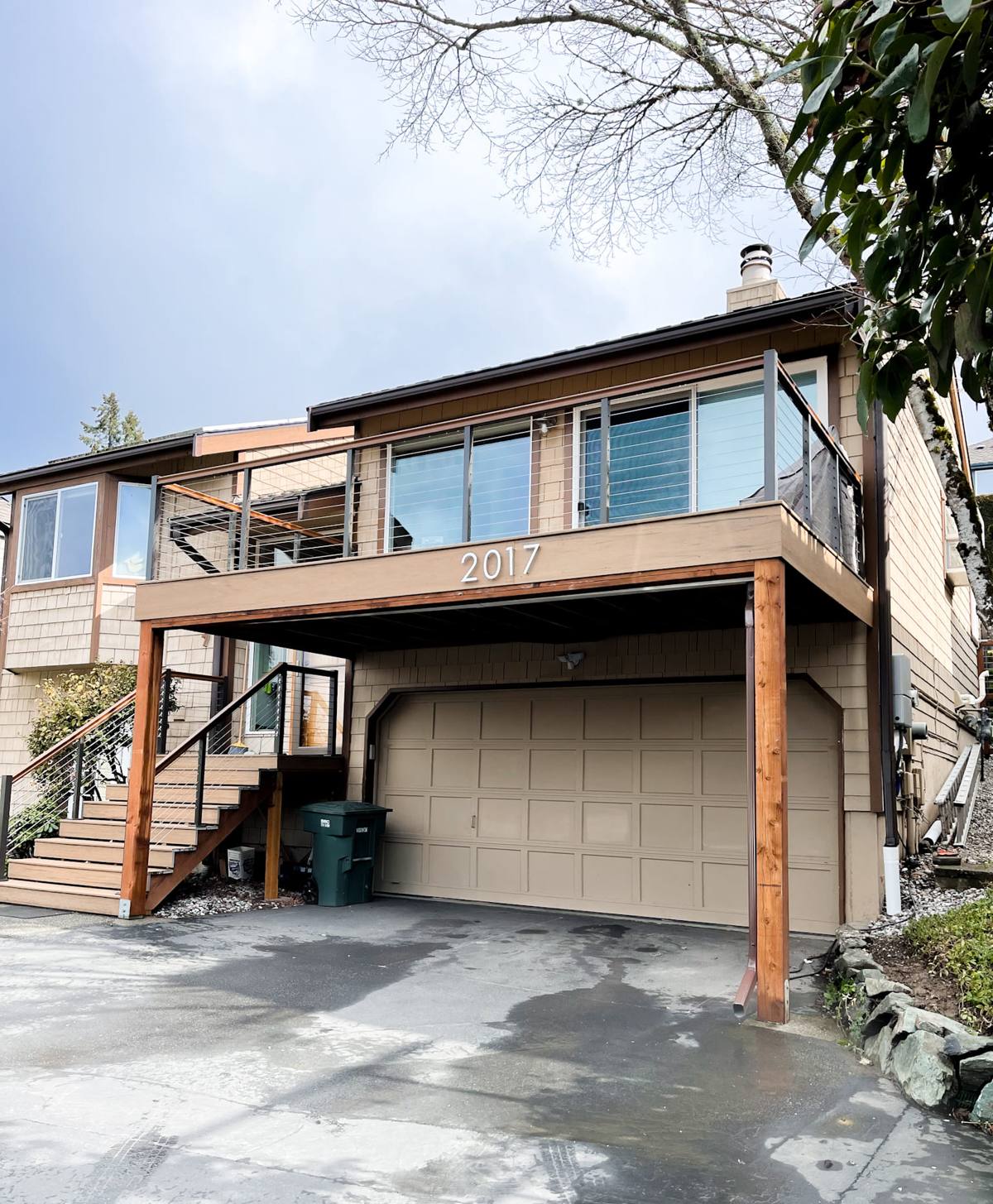
What Bellingham's Climate Does to a Deck
Salt Air and Sustained Moisture
Bellingham's position on the bay means a steady background level of moisture-laden, salt-tinged air, not just during storms. On a deck, that shows up as accelerated corrosion on cheap fasteners and hardware, faster breakdown of low-grade finishes, and a general aging process that's slower and quieter than storm damage but adds up over the years into loose railings, rusted screw heads bleeding into the decking, and connections that are weaker than they look.
Driving Rain and Standing Water
Rain here doesn't just fall straight down, wind pushes it sideways into ledger connections, under railing posts, and into any gap where end grain is exposed. A deck built without real attention to drainage, and one where boards are laid tight against each other instead of spaced to shed water, ends up holding moisture in exactly the places where wood and metal fasteners fail first: fastener holes, joist tops, and the ledger connection to the house.
A Long Moss Season
Shaded, tree-covered lots like a lot of what you find in Columbia stay damp for extended stretches of the year, which is ideal growing conditions for moss and algae on any horizontal wood surface. Beyond looking bad, a mossy deck surface is also a slip hazard and a sign that the wood underneath is staying wet longer than it should, which shortens the life of the boards regardless of what material they're made from.
The Ledger Board: Where Most Deck Failures Actually Start
If a deck attached to the house is going to fail structurally, it's usually going to start at the ledger board, the framing member that bolts the deck to the house and carries a significant share of the deck's total load. This is also the single most common place we find water damage on older decks in this climate, because a ledger that isn't flashed correctly lets water track behind the siding or trim and into the wall framing, rotting both the ledger connection and the wall structure behind it before it's ever visible from outside.
A correct ledger installation uses proper flashing that directs water out and away from the house rather than behind it, lag bolts or through-bolts rated for the load (not just deck screws), and a small gap or flashing detail that keeps the ledger from sitting flush against wet siding. Because we also do siding work across the Bellingham area, we look at this connection the same way we'd look at any other wall penetration: as a spot that has to shed water completely, every time, or it becomes a hidden rot problem a few years down the road.
Footings, Framing, and Ground Conditions in Columbia
Whatcom County's frost depth is modest compared to harsher inland climates, but footings still need to be sized and set correctly for the load they're carrying and the soil they're sitting in. Columbia's older lots can have variable soil conditions depending on how the property was originally graded, and a footing that's undersized or set too shallow is a problem that doesn't show up on day one, it shows up as a deck that starts to settle, rack, or feel spongy underfoot a few years in.
Framing lumber that's ground-contact rated where it needs to be, joist hangers sized correctly for the actual joist dimension rather than just close enough, and blocking at the right intervals all matter more in a climate that keeps wood damp for long stretches than they would somewhere drier. We frame every deck to carry the loads it's actually going to see, not just to pass a quick visual inspection.
Decking Material Comparison for Columbia's Climate
| Material | How It Handles This Climate | Maintenance |
|---|---|---|
| Pressure-treated lumber | Affordable and structurally solid; performs fine when sealed and maintained, but exposed end grain and fastener holes are entry points for moisture in a climate this wet | Needs regular cleaning and re-sealing to keep water out and slow moss growth |
| Cedar | Naturally moisture- and rot-resistant compared to other softwoods, and it's a good visual fit for the Pacific Northwest, but it still weathers and grays without upkeep | Periodic staining or sealing to maintain both appearance and water resistance |
| Composite decking | Doesn't absorb moisture the way wood does, which matters directly for moss growth and rot on shaded, damp lots common in Columbia | Occasional washing; no staining or sealing required over the life of the product |
None of these is the automatically correct answer for every project. A homeowner who wants the classic look of real wood and is willing to keep up a maintenance schedule can get a lot of years out of well-built cedar or treated lumber. A homeowner who wants to minimize upkeep on a shaded lot that stays damp most of the year is often better served by composite. We'll walk through the honest trade-offs for your specific site rather than pushing one material as the only right choice.
Railings, Stairs, and Code Requirements
Any deck attached to a house and elevated above a certain height falls under Washington state building code requirements for guardrail height, baluster spacing, and stair geometry, and Bellingham's permitting process reviews new deck construction against those standards. Guardrails generally need to meet a minimum height with spacing between balusters narrow enough that a small child can't pass through, and stairs need consistent rise and run so they're safe to use without thinking about it. These aren't optional details we skip to save time, they're the parts of a deck that keep people safe, and a permitted, inspected build gives you documentation that the work was done to code if it ever matters for insurance or resale.
Permitting in Bellingham
Most new deck construction and many significant repairs require a permit from the City of Bellingham. We handle that process as part of the job rather than leaving it to the homeowner, because a deck built without the required permit can become a real problem when you go to sell the house or file an insurance claim.
Fasteners and Hardware That Actually Hold Up Here
The hardware holding a deck together matters as much as the lumber or decking on top of it, and it's the part that's easiest to cut corners on because it's mostly invisible once the project is done. In a marine climate with sustained salt exposure, we use stainless steel or hot-dip galvanized fasteners and connectors rated for exterior and ground-contact use, not the cheaper coated screws that start showing rust streaks and losing grip strength within a few seasons. Joist hangers, post bases, and ledger bolts all see the same standard, because a deck is only as strong as its weakest connection, and in this climate that weak point is usually corrosion, not the wood itself.
Our Process, Start to Finish
- On-site walkthrough of the property, existing structure (if any), and how the space will actually be used
- Honest conversation about material options and what each one means for upkeep in a shaded, damp Columbia lot
- Written estimate with a clear scope, no vague allowances or surprise add-ons
- Permit filing with the City of Bellingham where required, handled by us rather than left to the homeowner
- Proper ledger flashing, footing placement, and framing before a single deck board goes down
- Final walkthrough covering railings, stairs, and any maintenance the chosen material will need going forward
Signs Your Existing Columbia Deck Needs Attention
- Soft, spongy, or bouncy spots in the decking or framing underneath
- Persistent moss or dark staining that returns quickly after cleaning, especially on shaded sections
- Rust streaks bleeding out from screw heads or metal hardware
- Gaps, cracking, or separation where the ledger board meets the house
- Railings or posts that feel loose or wobble under light pressure
- Visible daylight or water staining on the siding or trim directly above the ledger connection
Any one of these is worth a look before it turns into a structural problem. A soft ledger connection or a rotted joist isn't something to wait out through another wet season.
Why a Local Crew Matters for a Columbia Deck
A crew that regularly builds and repairs decks in Bellingham neighborhoods like Columbia has already seen how salt air, driving rain, and a long moss season actually play out on real structures over several years, not just how a product or framing detail looks on paper. That experience shows up in small decisions on build day: extra attention at the ledger flashing, hardware chosen for this specific exposure rather than a generic spec sheet, and decking spaced and oriented to shed water instead of holding it. Columbia's mix of mature tree cover and older housing stock isn't identical to every other part of Bellingham, and a crew that's worked this neighborhood specifically accounts for that instead of applying the same generic approach everywhere.
If you're planning a new deck in Columbia, need an old one repaired or replaced, or just want an honest opinion on whether that ledger connection is doing its job, we're glad to take a look. Reach out using the form below to schedule a free, no-pressure estimate.