 Bellingham Siding
 Why Birch Bay Homes Wear Out Siding Faster Than You'd Expect
Birch Bay sits right on the water in Whatcom County, and that location cuts both ways. It's part of what makes the area a great place to live, and it's also exactly why siding here takes more abuse than siding a few miles inland in Bellingham. Salt-laden air, wind that comes straight off the water with nothing to slow it down, and a wet season that runs long even by Pacific Northwest standards all add up to a harder job for whatever material is covering your walls.
None of this means Birch Bay homes are doomed to constant siding problems. It means the material and the installation have to be matched to the actual conditions, not to a generic "Pacific Northwest" climate assumption. A lot of siding failures we get called out to inspect in shoreline neighborhoods aren't failures of the product itself — they're failures of a product or an install that wasn't built for wind-driven rain and near-constant moisture.
Salt Air and Metal Fatigue
Airborne salt doesn't just affect boats and railings. It settles on siding, trim, and fasteners, and over years it accelerates corrosion on anything metal that isn't rated for coastal exposure — nail heads, flashing, hose bibs, light fixtures mounted to the wall. On homes closer to the water, we pay extra attention to fastener material and flashing details for exactly this reason.
Wind-Driven Rain
Rain that falls straight down is a much easier problem to solve than rain that's being pushed sideways into a wall. Birch Bay gets more of the sideways kind than sheltered inland lots do. Wind-driven rain finds gaps that vertical rain never would — poorly lapped seams, undersized flashing, caulk used in place of proper detailing. It pushes water uphill and sideways behind siding that isn't installed with enough overlap or the right drainage plane behind it.
A Moss Season That Doesn't Really End
Shaded, north-facing, and tree-lined walls in this part of Whatcom County stay damp for long stretches of the year, and that's exactly what moss and algae need to get established. Once organic growth takes hold on a wall, it holds moisture against the surface longer, which speeds up whatever deterioration is already happening underneath. Siding that resists moisture absorption and finishes that resist mildew staining matter more here than they do in drier inland areas.
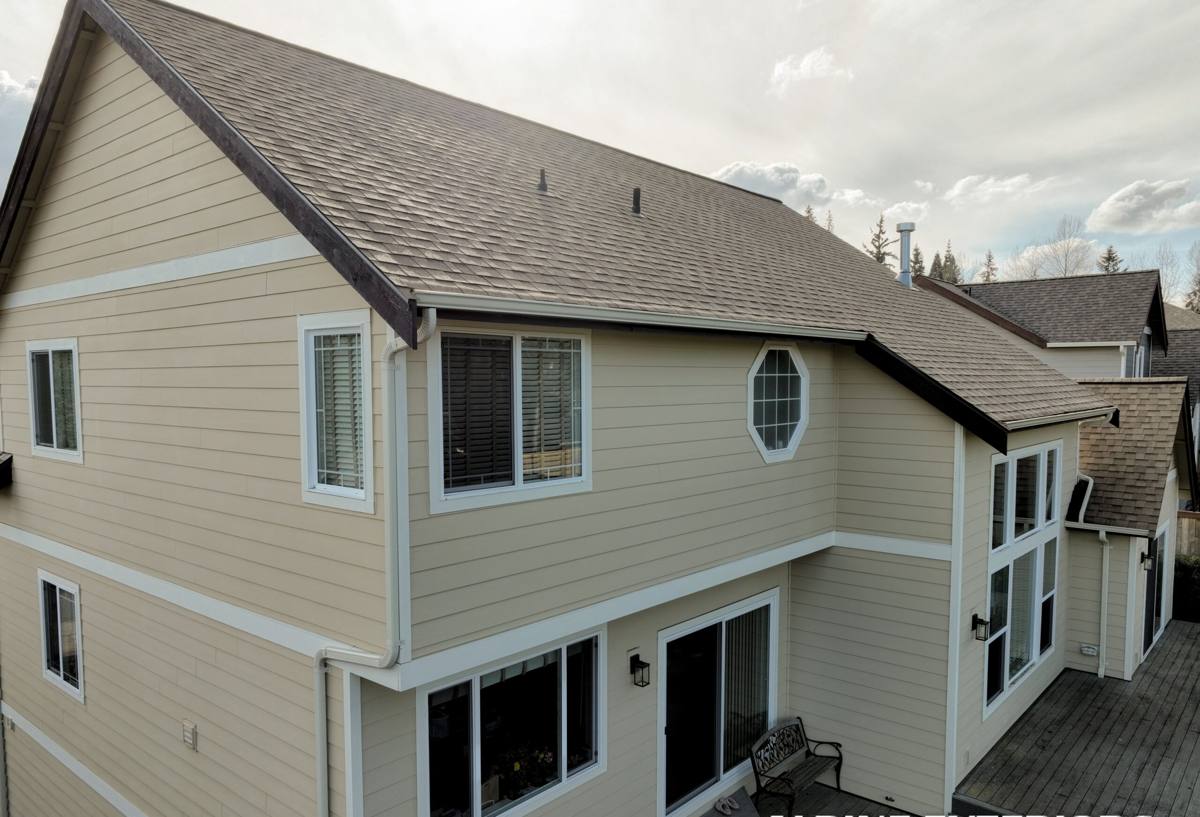
What a Correct Siding Installation Actually Involves
"Siding" is really a system, not a single layer. The visible boards or panels get all the attention, but the parts nobody sees — the weather-resistive barrier, the flashing, the fastening pattern, the clearances — are what determine whether that system holds up in a coastal environment or fails quietly behind the finish.
The Weather-Resistive Barrier and Flashing
Behind every properly installed siding job is a water-resistive barrier designed to shed anything that gets past the outer layer, plus flashing at every window, door, deck ledger, and roof-to-wall intersection. In a high wind-driven-rain environment like Birch Bay, these details aren't optional extras — they're the difference between a wall that dries out on its own and one that traps moisture against the sheathing.
Fastening, Gaps, and Clearances
Fiber cement siding has to be fastened correctly — right nail type, right spacing, right depth — or it can crack, work loose, or trap water at the fastener itself. Panels and boards also need proper gaps at butt joints and correct clearance from grade, roofing, decks, and other siding to allow drainage and airflow. Skipping these details is common on rushed jobs, and it's usually invisible until a few winters have passed.
Caulking Used the Right Way
Caulk has a place in a siding installation, but it's a finishing detail, not a substitute for flashing. On coastal homes we see failed installs where caulk was used to "solve" a flashing problem — it looks fine for a season or two, then fails and traps water behind it instead of keeping it out.
Why We Install Only James Hardie Fiber Cement Here
We standardized on James Hardie fiber cement siding across every job we take on, including in Birch Bay, and we don't install vinyl, LP SmartSide, Cemplank, Allura, or bare wood siding. That's a deliberate professional standard, not a sales pitch, and it comes down to how each material actually performs against salt air, driving rain, and sustained moisture over decades, not just in the first few years.
Fiber cement is dense and non-combustible, and it doesn't absorb and swell the way wood-based products can when they take on repeated moisture exposure. James Hardie's HZ5 product line is engineered specifically for regions with this kind of climate profile — freeze-thaw cycles, high humidity, and coastal moisture — which fits Whatcom County's shoreline communities well. The factory-applied ColorPlus finish is baked on under controlled conditions rather than field-applied, which matters in an area where a field-applied finish has less time to properly cure between rain events.
None of this means other products are worthless — it means we've made a professional call that, for the homes we put our name on, Hardie's combination of moisture resistance, factory finish durability, and transferable warranty is what holds up best to Birch Bay's specific conditions.
How Hardie Compares for a Coastal Whatcom County Home
| Factor | James Hardie Fiber Cement | Vinyl Siding | Wood / Engineered Wood |
|---|---|---|---|
| Moisture absorption | Very low; resists swelling | Doesn't absorb, but seams and joints can let water behind it | Absorbs moisture; prone to swelling, rot without diligent maintenance |
| Wind-driven rain resistance | High when installed with correct flashing and laps | Moderate; can flex and rattle, seams are vulnerable | Lower; joints and end grain are weak points |
| Salt air / corrosion exposure | Non-metallic surface; unaffected directly | Unaffected directly, but hardware and fasteners still corrode | Fasteners and hardware corrode; finish degrades faster in salt air |
| Moss / algae resistance | Good, especially with factory finish | Moderate; can stain and hold growth in seams | Lower; organic material holds moisture against wood |
| Fire resistance | Non-combustible | Melts / combustible | Combustible |
| Finish durability | Factory-cured ColorPlus finish, long warranty | Color molded in but can fade and chalk | Field-applied paint/stain, shorter repaint cycle |
Signs Your Birch Bay Home Needs New Siding
Coastal siding problems tend to develop quietly, often on the walls that face the water or sit in shade most of the day. A few things worth checking before they turn into a bigger repair:
- Soft or spongy spots when you press on the siding, especially near the bottom courses
- Persistent moss or algae growth that comes back within weeks of cleaning
- Visible warping, buckling, or panels that have pulled away from the wall
- Peeling, bubbling, or chalky paint that keeps failing faster than it should
- Rust streaks below fasteners or trim, a sign of fastener corrosion
- Rising energy bills without another clear explanation, which can point to moisture-compromised insulation behind the siding
- A musty smell or visible staining on interior walls that back up to exterior siding
Our Process, Start to Finish
Every Birch Bay job starts with an on-site assessment, not a phone estimate. We want to see how exposed the walls are to wind and rain off the water, what the current siding and sheathing condition looks like once we open things up, and whether there's existing moisture damage that needs to be addressed before new siding goes on — installing new siding over a compromised wall just hides the problem.
From there, the job generally follows the same sequence on every home: remove the old siding and inspect the sheathing, repair or replace any damaged sheathing and framing, install a proper weather-resistive barrier, flash every penetration and transition point, then install the James Hardie siding to manufacturer specification for fastening, spacing, and clearances. We finish with trim, caulking at the appropriate joints only, and a full site cleanup, including nail and debris cleanup around the yard and landscaping.
Timelines vary with home size and how much prep work the sheathing needs, but we'll walk you through a realistic schedule before work starts, not after.
Why Local Experience in Birch Bay Actually Matters
A crew that's worked shoreline homes in Birch Bay before knows things a crew coming from a drier, more sheltered market doesn't automatically account for — how much more flashing detail a west- or north-facing wall here needs, how quickly moss re-establishes on shaded siding, which sheathing conditions are common once old siding comes off homes that have sat exposed to the water for decades. That experience shows up in the small decisions made on-site, not just in the sales pitch.
It also matters for permitting and building code familiarity specific to Whatcom County, and for setting realistic expectations with homeowners about what coastal exposure means for maintenance down the road. A contractor who only occasionally works this stretch of coastline is more likely to install a wall the same way they would inland — and that's often where the flashing and clearance shortcuts start.
Caring for Your Siding After Installation
Correctly installed Hardie siding is genuinely low-maintenance, but "low-maintenance" doesn't mean "no maintenance," especially this close to the water. A yearly rinse-down to clear salt residue, pollen, and early moss growth goes a long way. Keep gutters clear so water isn't sheeting down the wall in places it shouldn't be, keep landscaping and sprinklers from spraying directly onto siding, and take a walk around the house once a year to check caulking at trim joints and look for anything that needs attention early, while it's still a small fix.
If you're weighing your options for a Birch Bay home — whether you're dealing with visible damage now or just planning ahead — we're happy to come take a look and give you a straight, no-pressure assessment of what your siding actually needs. Use the form below to request a free estimate.