 Bellingham Siding
 Why Barkley Roofs Take a Different Kind of Beating
The Barkley neighborhood sits close enough to Bellingham Bay and the Salish Sea that salt-laden air is a real factor in how a roof ages here, not a theoretical one. Add Whatcom County's long, wet winters and the tree cover common to this part of Bellingham, and you get a combination that's harder on a roof than almost anywhere else in the state: corrosion pressure from the air, near-constant moisture from driving rain, and a moss season that can run eight months or more. A roofing system that works fine in a drier inland county can fail early here if it wasn't chosen and installed with these specific conditions in mind.
Metal roofing, done correctly, handles this combination better than most other materials — but "done correctly" is doing a lot of work in that sentence. The wrong fastener, the wrong flashing detail, or the wrong panel finish will show its weaknesses here faster than in a milder climate.
Salt Air and Corrosion
Salt in the air accelerates corrosion at any exposed metal edge, fastener head, or scratch in a protective coating. This doesn't mean metal roofing is a bad choice near the water — it means the coating system, fastener metallurgy, and flashing details matter more here than they would fifty miles inland. A roof spec'd without that in mind will show rust bleed at fastener heads and cut edges years before it should.
Driving Rain and Wind-Driven Moisture
Storms coming off the Sound don't just drop rain straight down — wind pushes it sideways, up under laps, and into any gap in flashing or underlayment. Metal roofing sheds bulk water extremely well when the laps, seams, and penetrations are detailed correctly. When they're not, wind-driven rain finds the one weak point and works it every storm for years.
The Long Moss Season
Shade, moisture, and mild temperatures are exactly what moss needs, and Bellingham has all three for most of the year. Moss doesn't just look bad on a roof — it holds moisture against the surface, works into laps and fastener penetrations, and on some materials it accelerates surface breakdown. Metal roofing resists moss far better than shingles or wood because there's no rough, absorbent surface for spores to root into, but panel design and slope still affect how much moss tries to establish itself.
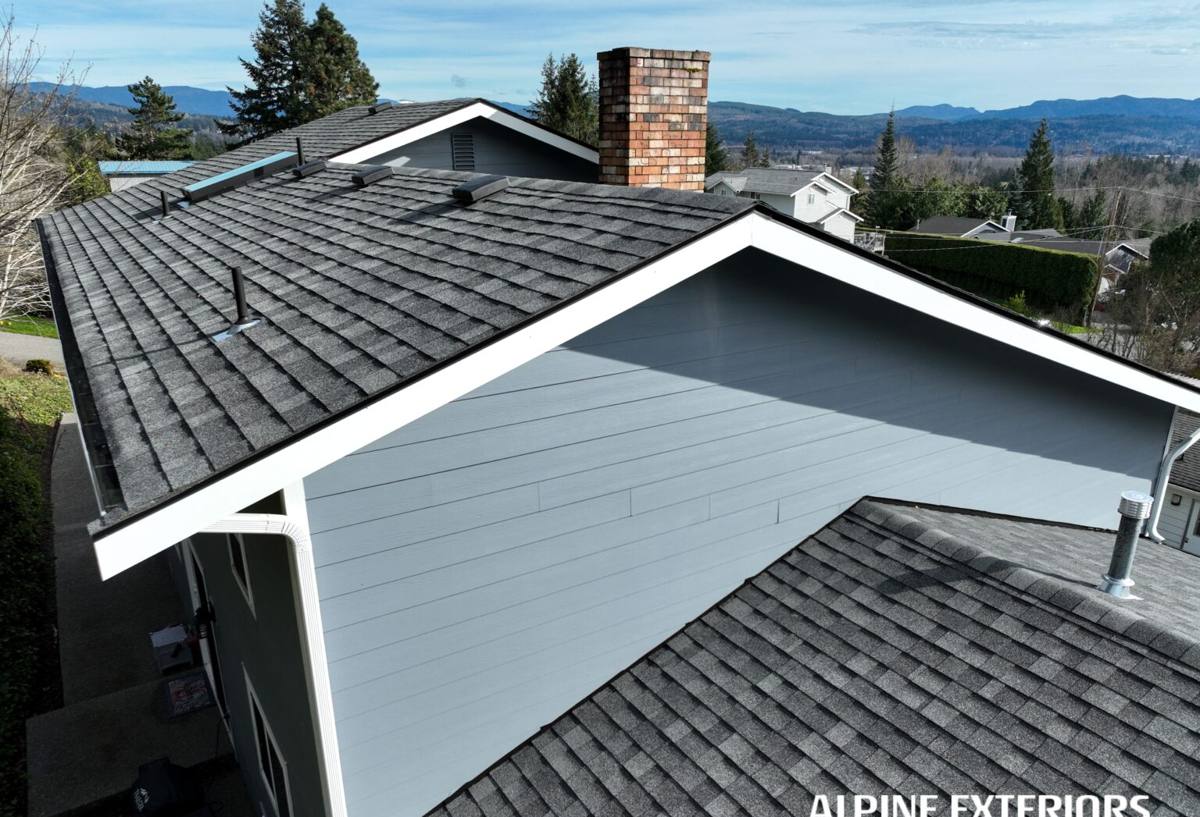
What a Correct Metal Roof Installation Actually Involves
Metal roofing looks simple from the ground — panels, screws, done. The parts that actually determine whether it lasts twenty years or forty in this climate are mostly invisible once the job is finished.
- Underlayment — a synthetic or self-adhered underlayment rated for the exposure, not a generic felt that degrades under UV and moisture cycling.
- Fastener selection — matched metallurgy between the panel and the fastener to prevent galvanic corrosion, which is a bigger issue in salt air than it would be inland.
- Flashing at every transition — valleys, walls, chimneys, and penetrations get formed flashing, not caulk-and-hope.
- Ventilation — proper intake and exhaust venting so moisture doesn't condense against the underside of the panels.
- Panel expansion allowance — metal moves with temperature swings, and fastener patterns or clip systems need to allow for that movement without loosening or oil-canning.
Skip any one of these and the roof may still look fine for a year or two. In this climate, the failures show up as rust streaking, leaks at transitions, or panels that loosen over a few seasons — not immediately, but earlier than the material's real lifespan should allow.
Choosing the Right Metal Roofing System for This Climate
Not all metal roofing is the same product wearing different colors. The panel type and fastening method affect how the roof performs against salt air, wind-driven rain, and moss over time.
| System Type | Fastening | Best For | Trade-Offs |
|---|---|---|---|
| Standing seam | Concealed clips, no exposed fasteners | Maximum weathertightness, long-term low maintenance | Higher upfront cost, needs a skilled crew to detail seams correctly |
| Exposed-fastener panel (ribbed/corrugated) | Screws through the panel face with sealing washers | Budget-conscious projects, outbuildings, simpler rooflines | Fastener washers age and need eventual replacement; more penetration points for water to test |
| Stone-coated steel | Concealed with overlapping profile | Homeowners wanting a shake or tile look with metal's durability | More complex profile can trap debris and moss-friendly shade pockets if not detailed well |
For most homes in the Barkley area, we lean toward standing seam or a well-detailed concealed-fastener panel specifically because there are far fewer through-panel penetrations for salt-laden moisture to work into over the years. Exposed-fastener systems aren't wrong — they're a legitimate, lower-cost option for simpler roofs — but they carry a maintenance conversation we make sure homeowners understand upfront rather than after the fact.
How We Approach a Barkley Metal Roofing Project
- On-site assessment — we look at slope, tree cover, prevailing wind exposure, and the current roof's failure points before recommending a system.
- System selection — panel type, gauge, and finish chosen for this specific home's exposure, not a one-size-fits-all package.
- Tear-off and deck inspection — we check the decking for moisture damage before anything new goes down; covering a wet deck just hides a problem.
- Underlayment and flashing — installed to handle wind-driven rain at every valley, wall, and penetration.
- Panel installation — correct fastener spacing, expansion allowance, and seam detailing for the panel type chosen.
- Final walk-through — we go over what was done, what maintenance (if any) the system needs, and what to watch for going forward.
Mistakes We See on Roofs That Weren't Installed With This Climate in Mind
A lot of the metal roofing problems we get called out to inspect in Bellingham weren't caused by bad metal — they were caused by installation shortcuts that don't show up until the roof has been through a few wet seasons.
- Mismatched fasteners causing corrosion streaks around every screw head within a few years.
- Flashing sealed with caulk instead of formed and lapped correctly, so it fails as soon as the caulk ages.
- No ventilation plan, leading to condensation on the underside of panels that homeowners mistake for a roof leak.
- Panels fastened rigidly with no allowance for thermal movement, causing oil-canning or loosened fasteners over time.
None of these are metal roofing problems. They're installation problems, and they're the reason the crew doing the work matters as much as the material itself.
Living With a Metal Roof in a Moss-Heavy Climate
Metal roofing needs far less upkeep than shingles or wood shakes in this climate, but "far less" isn't "none." A short seasonal routine keeps a correctly installed metal roof performing the way it's supposed to for decades.
- Clear debris from valleys and gutters each fall before the wet season sets in.
- Trim back overhanging branches that keep sections of the roof shaded and damp.
- Check for any moss establishing in valleys or against flashing and remove it gently — no pressure washing, which can damage finishes and force water under laps.
- Have flashing and sealant points looked at every few years, especially after major windstorms.
- Watch for any fastener washers showing wear if the roof uses an exposed-fastener system.
What Affects the Cost of a Metal Roof in This Area
| Factor | Why It Matters Here |
|---|---|
| Panel type and gauge | Heavier gauge and standing seam systems cost more upfront but hold up longer against salt air and wind-driven rain |
| Roof complexity | More valleys, walls, and penetrations mean more flashing work, which is where most weathertightness is won or lost |
| Tear-off vs. overlay | A full tear-off lets us inspect and repair the deck, which matters on older Bellingham homes with hidden moisture damage |
| Ventilation upgrades | Older homes often need intake or exhaust venting added or corrected as part of the reroof |
| Finish and coating | Higher-grade coatings resist salt air corrosion longer but add to material cost |
We give homeowners honest ranges based on the actual roof in front of us, not a generic per-square number that ignores the complexity or exposure of the specific home. A simple roof and a roof with multiple valleys and dormers are not the same project, even at the same square footage.
Why It Matters That We Already Work in Barkley
A roofing crew that only occasionally works this part of Whatcom County has to relearn the local conditions on every job — how much moss pressure to expect, how exposed a given roof is to wind off the water, which flashing details actually hold up here versus on paper. A crew that already works in and around Barkley has that knowledge built in before the first panel goes on. That shows up in the small decisions: fastener choice, flashing sequence, where extra venting is worth the cost and where it isn't. It's also simpler for scheduling, follow-up questions, and any warranty service down the road when the crew is already local rather than driving in from out of the area for a single job.
Get a Straight Answer on Your Roof
If you're weighing metal roofing for a home in the Barkley area, we're glad to come look at the actual roof, explain what system makes sense for its exposure and layout, and give you a clear, no-pressure estimate — no generic pricing, no upsell script. Use the form below to get started.