 Bellingham Siding
 Building a Deck That Holds Up in Fairhaven
Fairhaven sits close to Bellingham Bay, and that location puts a deck through more than most homeowners expect. Salt-tinged air drifts across the neighborhood most of the year, rain arrives sideways as often as it falls straight down, and shaded, tree-lined lots keep moss and mildew active well beyond a typical dry season. A deck out here isn't just outdoor furniture bolted to the house, it's an exterior structure exposed to the same conditions that wear down siding and roofing, except it's also flat, walked on, and holding standing water every time it rains. We build and replace decks throughout Whatcom County, and composite decking has become our default recommendation for Fairhaven specifically because of how the material behaves under this exact combination of stresses.
This page focuses on composite decking as it applies to Fairhaven homes: what the climate actually does to a deck here, what a correct composite installation involves, and how to think about the decision if you're currently comparing materials or replacing a deck that's failed.
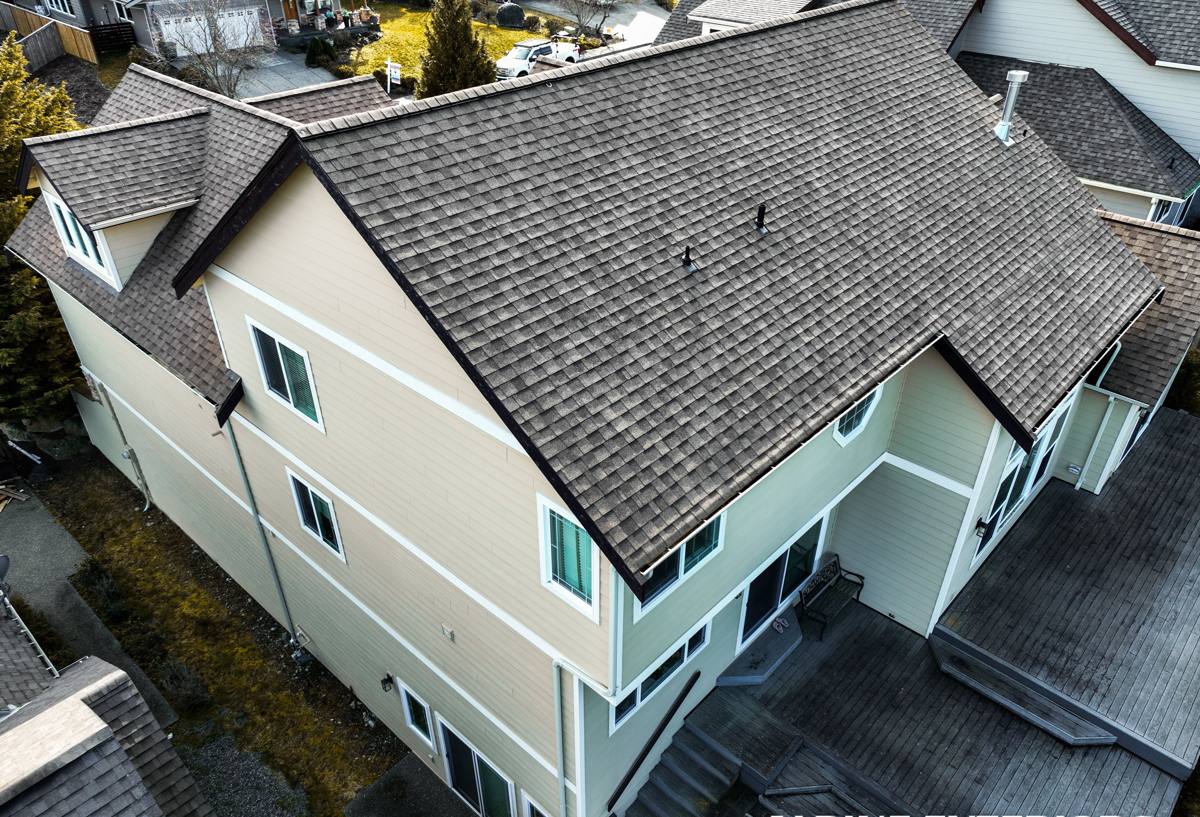
What Bellingham Bay Does to a Deck Over Time
Standing Moisture and Slow-Drying Surfaces
A deck is horizontal, which means it holds water in a way a wall never does. Rain that a vertical wall sheds in minutes can sit on a deck board, in a fastener recess, or between boards for hours, especially on shaded sections of a Fairhaven lot where mature trees block afternoon sun. Wood decking depends on that surface drying out reasonably fast to avoid rot; when it doesn't, moisture works its way into end grain, screw holes, and any spot where the protective coating has worn thin.
Salt Air and Fastener Corrosion
The same marine air that bleeds rust through siding nail heads does the same thing to deck fasteners, joist hangers, and structural hardware, usually starting at the connections rather than the visible boards. It's slow and rarely dramatic, which is exactly why it tends to get discovered only once a board feels soft or a railing post has some give in it.
Moss, Algae, and Shaded Lots
Fairhaven's tree canopy and hillside terrain mean plenty of decks spend a good part of the day in shade, and shaded, damp surfaces are where moss and algae take hold fastest. On wood decking, that growth doesn't just look bad, it holds moisture directly against the board surface and makes the deck genuinely slippery underfoot, which matters on stairs and near doorways.
UV Exposure on the Sections That Do Get Sun
Not every part of a Fairhaven deck is shaded. West- and south-facing sections that catch afternoon sun deal with the opposite problem: UV breakdown of finishes, fading, and surface checking on wood that dries out and re-wets in cycles through the year. A deck that gets both heavy shade in one area and direct sun in another is actually a harder environment to build for than a uniformly shaded or uniformly sunny lot, because the material has to hold up to both failure modes at once.
Why We Recommend Composite Decking for Fairhaven Homes
We install real wood decking too, and it has its place. But for most Fairhaven properties, we steer homeowners toward composite because of what we consistently see when we're called out to repair or replace failed wood decks in this exact climate.
- No annual sealing or staining: Composite doesn't need the yearly maintenance cycle wood decking requires to keep moisture out, which matters in a climate where that maintenance window is short and often gets skipped.
- Consistent moisture resistance across the whole board: Composite boards are engineered to resist water absorption through the full board, not just a surface coating that wears through over a few seasons.
- Resistant to rot and insect damage: The wood-fiber content in composite is bound with plastic polymer, which removes the rot risk that comes with sustained dampness against solid wood.
- Better footing when wet: Most composite boards use a textured or embossed surface that holds traction better than smooth or weathered wood when it's damp, which is a real safety consideration on a deck that's wet more often than not.
- Fade and stain resistance: Cap-stock composite in particular resists UV fading and surface staining from tannins, moss residue, and organic debris far better than an unfinished or lightly finished wood surface.
We don't say this to talk every homeowner out of wood. Some people want the specific look and feel of real cedar or fir decking and are willing to keep up with the maintenance it needs. That's a legitimate choice. Our professional standard is to be upfront that in a climate this consistently wet, wood decking demands a maintenance commitment that composite simply doesn't, and we'd rather explain that trade-off clearly than let a customer find out the hard way three years in.
Composite Decking Versus Wood: A Side-by-Side Look
| Factor | Composite Decking | Wood Decking (Cedar/Fir/Pressure-Treated) |
|---|---|---|
| Annual maintenance | Occasional cleaning, no sealing required | Sealing or staining needed roughly every 1-2 years in this climate |
| Moisture resistance | Resists absorption through the board | Depends on coating; end grain and cut edges are vulnerable |
| Moss and algae growth | Textured surface resists growth, cleans off easily | Porous surface allows growth to take hold faster |
| Upfront material cost | Higher | Lower |
| Long-term cost over 20 years | Lower once maintenance labor is factored in | Higher once repeated sealing and board replacement are factored in |
| Fastener and hardware corrosion | Still a factor; stainless or coated hardware still required | Same requirement; no material difference here |
| Appearance | Consistent color, wood-look texture, doesn't age to gray | Natural wood grain, ages and weathers over time unless maintained |
What a Correct Composite Deck Installation Involves
Composite decking is only as good as the structure underneath it and the details around fasteners, flashing, and framing. A lot of the deck failures we're called out to look at in Fairhaven aren't material failures at all, they're installation shortcuts that would have caused problems no matter what decking product sat on top.
Framing and Structural Layer
Composite decking is heavier than most wood decking, so joist spacing and beam sizing need to match the manufacturer's engineering specs for the specific product, not just whatever spacing the old wood deck used. We check the existing substructure on every replacement rather than assuming it's adequate.
Ledger Attachment and Flashing
Where a deck attaches to the house is one of the most common points of hidden water damage anywhere in residential construction, and it's directly relevant to siding condition. A ledger board that isn't properly flashed can trap water against the house's wall assembly, which shows up later as rot or siding damage that has nothing to do with the decking material itself. Correct ledger flashing is non-negotiable on every deck we build.
Hidden Fastener Systems
Most composite decking today uses a hidden fastener or clip system rather than face-screwing through the board. Done correctly, this gives a cleaner surface with fewer penetration points where water could otherwise track into the board. It also requires more precise installation than face-screwing, which is part of why installation quality matters as much as product choice.
Ventilation Beneath the Deck
Airflow underneath a deck helps the structure dry out between rain events, which matters even with a low-absorption material like composite because the framing, hardware, and any wood blocking underneath still need to dry out. Skirting and under-deck detailing that block airflow entirely can trap moisture against the structure long after the surface looks dry.
Railings, Stairs, and Structural Connections
Railing posts and stair stringers take direct structural load and see repeated stress from use, which makes their connections a common failure point regardless of decking material. We use corrosion-resistant hardware sized to the actual structural load, not just whatever fits, and we check post attachment against current code requirements rather than matching whatever was there before.
Cost Factors to Understand Before You Get a Quote
| Factor | Why It Moves the Price |
|---|---|
| Deck size and shape | Square footage is the baseline driver; multiple levels, angles, or curves add labor and material waste |
| Substructure condition | A full tear-off and reframe costs more than decking installed over sound, code-compliant existing framing |
| Composite product tier | Entry-level composite, mid-range, and premium cap-stock lines carry meaningfully different material costs |
| Railing system | Composite or metal railing systems cost more than basic wood rail but need less upkeep |
| Stairs and multiple access points | Each set of stairs adds framing, decking, and railing labor beyond the main deck surface |
| Site access and slope | Fairhaven's hillside lots can mean harder material staging and more complex footing work |
| Ledger and flashing repair | If the existing ledger attachment has hidden water damage, that repair adds cost before decking even starts |
We give straight, itemized estimates rather than a single lump number, so you can see exactly what's driving the price and where there's room to adjust scope if needed.
Signs Your Current Deck Needs Attention
- Boards that feel spongy, soft, or flex underfoot in specific spots
- Persistent moss or algae that comes back within weeks of cleaning
- Rust staining around fasteners or visible corrosion on hardware
- Gaps or movement where the deck meets the house at the ledger board
- Railing posts or stair stringers with any noticeable wobble
- Discoloration or staining that won't clean off wood decking, suggesting the finish has failed
- A deck more than 15-20 years old that hasn't had structural hardware inspected recently
Any one of these on its own might be minor. A few of them together usually means the deck is due for a real evaluation rather than another round of surface cleaning.
Repair, Resurface, or Full Replacement
Not every deck problem in Fairhaven means starting over. If the substructure is sound and code-compliant, resurfacing with composite boards over existing framing can be a reasonable path, and it's less disruptive and less costly than a full rebuild. But if the ledger attachment has hidden rot, if joist spacing doesn't meet current code or the load requirements of composite decking, or if multiple structural connections show corrosion, resurfacing just puts a good-looking new surface on top of a compromised structure. We'll tell you honestly which category your deck falls into before we quote anything, because that determination changes the whole scope of the project.
Why a Local Whatcom County Crew Matters for Deck Work
A contractor who works Fairhaven and the surrounding Whatcom County waterfront regularly has actually seen how salt air, wind-driven rain, and a long moss season play out on real decks over years, not just how a product is rated on a spec sheet. That experience shows up in specific decisions: where extra flashing attention at the ledger pays off, which hardware holds up against marine air and which corrodes early, and how much ventilation a substructure needs on a shaded, hillside lot versus an open, sun-exposed one. Those are judgment calls that come from doing this work in this exact neighborhood, not from a generic installation manual.
What to Check Before Hiring a Deck Contractor
- Confirm an active Washington state contractor license and current insurance
- Ask which composite decking brand and product line they install, and why they chose it
- Ask how they handle ledger board flashing and attachment to the house
- Confirm they'll evaluate the existing substructure rather than just decking over it sight unseen
- Ask whether permits are pulled for the project, particularly for railing and structural work
- Get a written scope specifying fastener type, framing spacing, and railing system, not just "new deck installed"
If your Fairhaven deck is showing signs of wear, or you're planning a new deck and want an honest comparison of composite and wood for your specific lot, we're glad to take a look. Reach out using the form below to schedule a free, no-pressure estimate.
```